Yes, AP curriculums follow a standardized framework across the US, but the way AP courses are taught can vary by teacher and school.
- Standardized Framework: The College Board provides the official course frameworks, learning objectives, and exam expectations for AP subjects.
- Same AP Exams: Students taking the same AP subject are assessed through the same AP exam and scoring system nationwide.
- Local Differences: Teachers and schools can differ in their teaching methods, pacing, textbooks, assignments, and classroom resources.
- AP Course Audit: The AP Course Audit helps ensure that courses carrying the AP designation meet the College Board's requirements.
Are AP curriculum the same across the US? The short answer is: the AP framework and exam expectations are standardized, but schools and teachers have flexibility in how they deliver AP courses. This means students across the country work toward the same AP learning objectives while their classroom experiences can look different.
The College Board provides the official framework and Course and Exam Descriptions for each AP subject, while teachers can adapt their course plans, instructional methods, pacing, and resources to their students.
In this guide, we'll explain who governs the AP curriculum, what remains consistent across states, where schools and teachers can differ, how the AP Course Audit supports consistency, and what these differences mean for students, teachers, and tutors.
Who designs and governs the AP curriculum?
The College Board centrally governs the AP curriculum.
However, there are multiple entities that play different roles in the entire curriculum design, administration, audit, and delivery.
The College Board
In addition to overseeing the AP program across the USA, the College Board plays the following roles:
- Align: It ensures the AP course standards across all the locations remain aligned with the original goals laid down.
- College-level rigor: The College Board makes sure that an AP course matches the demands of its equivalent college-level course.
- Academic expectations: The College Board sets the benchmarks that students need to meet during the course and at the exams.
Expert committees for the AP course
College faculty and AP teachers, in equal numbers, form an expert committee that decides what students should learn.
While the college faculty typically set the context for what colleges expect, the high school AP teachers have a closer understanding of where high-school students are. Jointly, the committee identifies the key skills that students need to pick up, as well as how to teach and evaluate students on those skills.
The committee comes up with what is called Course and Exam Descriptions (CEDs). This document acts as a blueprint for learning objectives, desired skills, and exam structures.
Despite this structured design, AP teachers enjoy a great deal of flexibility in how they deliver the curriculum. Consequently, the core elements of an AP course remain the same nationwide.
What stays the same across all AP classes in the US
AP courses are highly standardized. Because of this structure, the core academic framework does not change.
Across all states, the following remain consistent:
- Goals: The AP course standards across states, in terms of learning objectives and skill expectations, remain consistent and identical.
- Course framework: The official course framework for each AP subject remains the same, no matter the state or resources available in the school.
- Exam layout: The format, difficulty, and structure of the AP exam remains unchanged across the US.
- Evaluation: All AP exams are scored on a scale of 1 to 5, where 5 is the best. A score of 3 or higher is accepted as a passing standard and makes a student eligible for college-level credits.
Hence, an AP Physics student in Miami and one in Delaware work toward the same academic goals. They work with the same course framework, take the same exam, and are assessed along identical criteria.
It is this consistency that makes AP scores carry weight with colleges. That’s because colleges know that an AP score reflects a nationally consistent benchmark, regardless of the school or state the course was taught in.
Some parents might be interested in learning more about college credit and placement. Understanding how AP scores translate into college credit can help clarify why this standardization matters so much.
AP syllabus differences: Where curriculums can differ
The AP syllabus differences rise from the delivery and instruction, and not from the content. The curriculum framework and exam expectations remain fixed.
Teachers enjoy considerable freedom in how they deliver AP courses. As a result, a teacher in one location may use local or regional examples, while another teacher in a different setting may spend more time on specific topics. They have the freedom to decide how quickly to move through topics, how much time to spend on discussions versus exam practice, and which instructional materials to use.
Consider APUSH (the popular acronym for AP US History course). While teaching APUSH, a teacher in Alabama may expound the topic of slavery quite differently from how a teacher in Missouri would. This is because slavery was more widespread in the former state than in the latter.
Other factors also make the learning experience different. The class size and access to technical resources - a lab, for instance - can significantly change how students perceive and engage with a course. Simultaneously, how the school formats the schedules and what kind of training has the teacher received till date can impact what the students take home from the course.
While such differences influence how students experience the course, they do not change the evaluation standards.
By the way, if you’re still confused about choosing between IB and AP, you’re not alone. Many students and parents compare AP with other advanced programs, especially IB. Use this IB vs AP comparison to develop a clear understanding of what each program offers.
The role of the AP Course Audit in ensuring consistency
Given the freedom that teachers enjoy, maintaining consistency in AP course standards across states needs strategic oversight. That’s where the AP Course Audit comes in.
The AP Course Audit exists to protect the integrity of the AP label. In the absence of this audit, it’d become virtually impossible to maintain consistency, and colleges would not be in a position to compare or use these scores.
When a school wishes to offer an AP course, it first needs to submit to the AP committee a syllabus for review. This submitted syllabus should be clearly aligned with the official course framework that the College Board maintains. Additionally, it must include skills and academic rigor, as laid down by the College Board. Only an approved syllabus can carry the AP tag.
While the Course Audit doesn’t control the daily operational details or academic methodology, it establishes a baseline that all AP courses must meet. It makes sure that the course demands college-level rigor and that the student is expected to meet college-level standards.
AP curriculum vs state education standards
The AP curriculum is governed by the College Board, which is a private, not-for-profit organization. It administers an important exam (the SAT), but it has no affiliation with any federal or state body.
AP frameworks are designed to mirror college courses. Because these colleges are located across the entire US, the AP framework doesn’t have regional or state context. They also do not seek state education board approvals.
Some schools may align AP instruction with state requirements. However, that might be to accommodate priorities, take advantage of resource availability, or offer more options. On the whole, AP course standards are consistent across different states. Anyone asking ‘are AP curriculums the same across the US’ will now see that comparing the performance of students in AP exams is quite simple.
In contrast, state education standards are meant to serve different goals, and they aren’t always what an AP course is looking for.
State standards guide general high school instruction. The federal nature of the US system allows states considerable freedom, and it is reflected in how each state frames and executes their education policy. Importantly, state education reflects regional priorities. This makes it difficult to compare the performances of students educated under different state systems.
What this means for students taking AP classes in different states
Despite the flexibility that teachers enjoy while delivering AP courses, the College Board ensures the evaluation exams and grading criteria remain fully consistent. This creates a system of fairness with the distinct features below:
- Mobility: If a student moves from one city to another or even one state to another, they can be confident that the fundamentals of the course and evaluation criteria will not change. Sure, there will be differences arising due to pacing differences or how teachers engage their class. However, students can rest assured that academic benchmarks and AP course standards across states are the same nationwide.
- Neutrality: Despite the diverse ways in which a course might be taught in different locations, AP students are evaluated in a location-agnostic manner. This creates equal opportunities for all students.
- Comparability: Colleges can easily compare AP scores of two students confidently, irrespective of the location of the student. The scoring criteria is the same nationwide, cutting across school or state boundaries.
- Completeness: Because the AP framework is so standardized, learning gaps are negligible. Colleges can be confident about what students know when they look at the score, no matter what school or state the student comes from.
Understanding this perspective will also help students understand how many AP classes to take.
What this means for AP teachers and tutors
As said earlier, there are virtually no AP syllabus differences. For educators, AP offers a structure free from rigidity. Teachers must align with a national framework, but they retain flexibility in instructional approach.
This format requires 4 clear things from teachers and tutors. They need to:
- Have a clear understanding of the skills that AP requires from students
- Plan instructional approach based on the AP syllabus framework
- Leverage regionally relevant tools and resources to help students
- Teach while keeping in mind what the AP exam expects
It goes without saying that the instructional quality and methodology can vary, based on experience, training, resources, and regional factors. Tutors and supplemental support can often play an important role in balancing the flexibility and discipline of AP course standards across states.
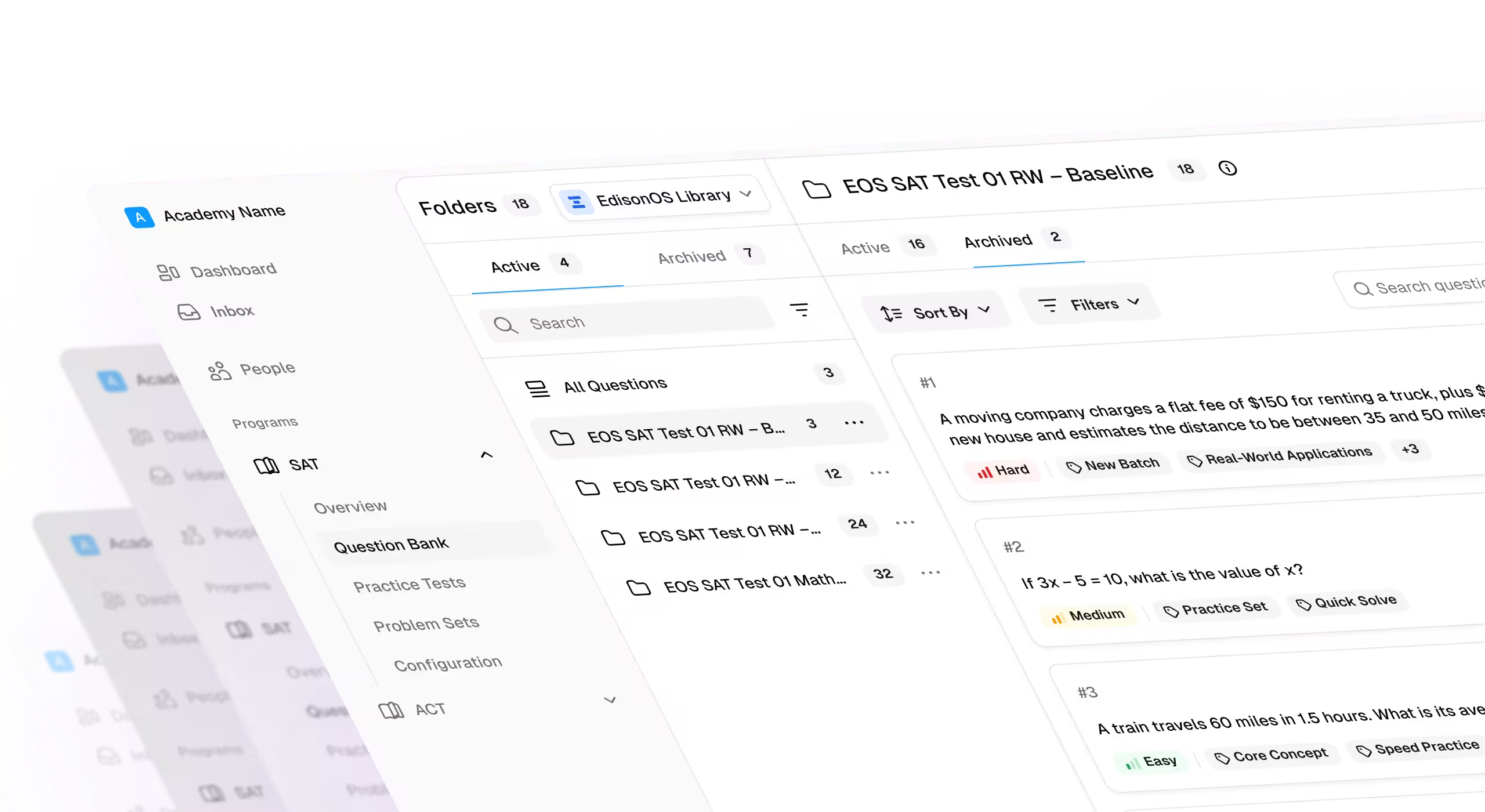
How EdisonOS helps maintain AP curriculum consistency
Teachers and schools move with the entire class in mind. It is not always possible - or practical - for them to center their AP course delivery around any one student. Classroom pacing or coverage of the syllabus can sometimes overwhelm students. That’s where structured learning platforms add value for AP students.
EdisonOS aligns the learning paths of students with the official AP framework. By tracking the student’s progress against the learning objectives, EdisonOS helps students build on their strengths and eliminate weaknesses. It helps develop the key skills that the AP syllabus stresses.
Explore our pricing plans to find the right solution for your AP program.
Frequently Asked Questions
.svg)


.png)