- Remediation-free scores signal college readiness and let students skip costly non-credit remedial courses
- Meeting ACT, SAT, or AP benchmarks saves time, money, and accelerates degree completion
- Early diagnostics and data tracking help educators guide students to remediation-free status
Navigating the transition from high school to higher education is often filled with technical jargon that can feel overwhelming for students and parents alike. One of the most critical terms you will encounter is the remediation-free score.
In simple terms, a remediation-free score is a benchmark on a standardized test (like the ACT or SAT) that indicates a student is academically prepared for college-level coursework. Achieving this score means the student can bypass "remedial" or "developmental" classes—non-credit courses designed to catch students up in subjects like math or English—and move directly into classes that count toward their degree.
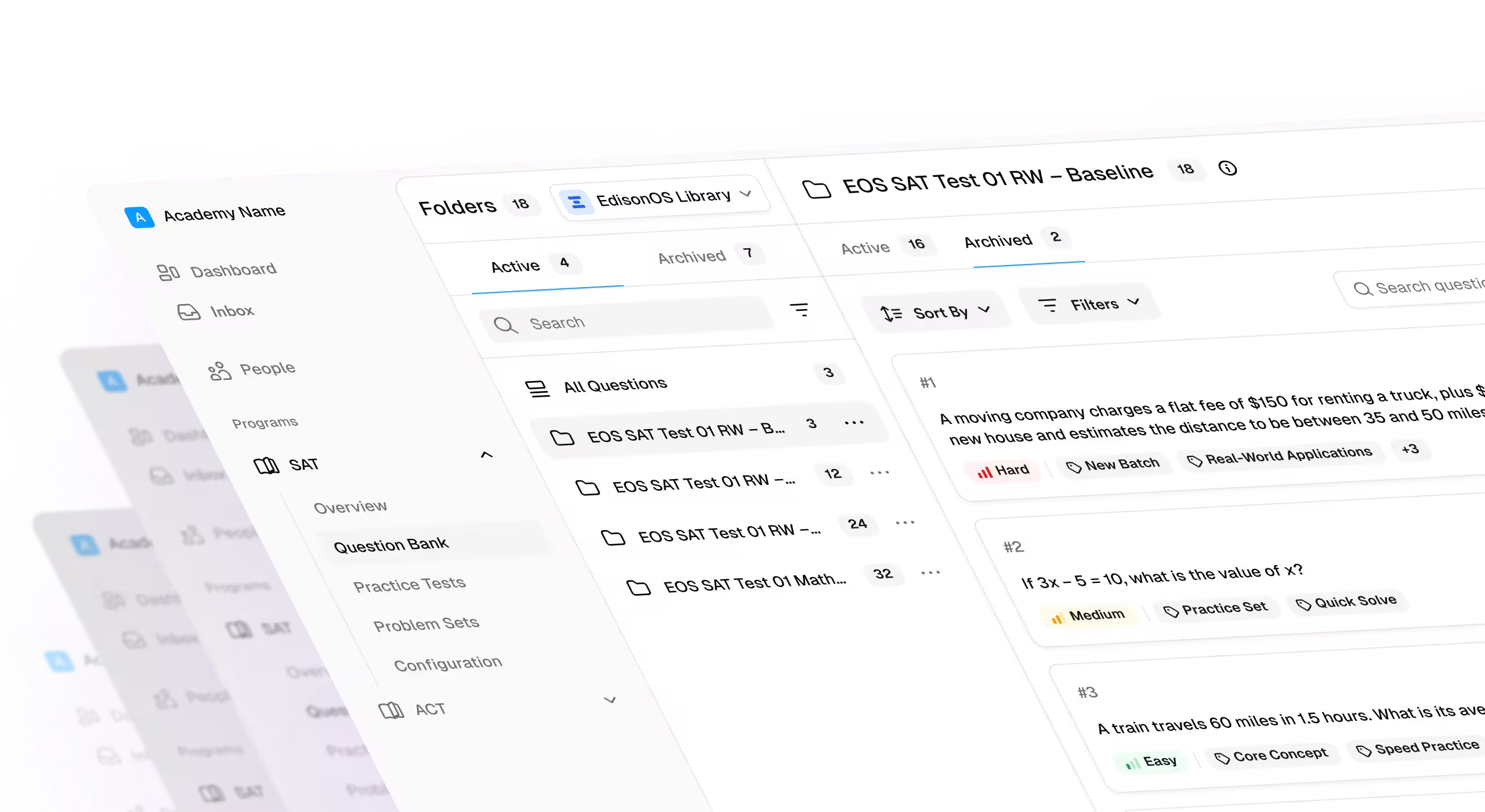
For colleges, these scores are a primary tool for assessing readiness. For students, they are a ticket to saving thousands of dollars and months of time. For educators, tracking these benchmarks is the key to early intervention. Platforms like EdisonOS have become essential in this process, allowing educators and tutors to monitor student performance on diagnostics and mock exams to ensure they meet these thresholds long before they step onto a college campus.
What Does “Remediation” Mean in College Education?
To understand why a remediation-free score is so valuable, we must first define "remediation." In a college context, remediation refers to courses—often called developmental education—offered to students who lack the foundational skills required for standard college-level work.
While these courses are designed to be helpful, they come with significant drawbacks:
- No College Credit: Remedial courses cost the same tuition as regular classes but do not count toward your degree requirements or graduation total.
- Delayed Graduation: Because students must pass remedial sequences before they can enroll in "gateway" courses (like English 101 or College Algebra), their graduation timeline is often pushed back by a semester or more.
- Lower Completion Rates: Statistically, students who start in remediation are less likely to graduate than those who start in credit-bearing courses. The "remedial trap" can lead to student frustration and higher dropout rates.
What Is Considered a Remediation Free Score?
Benchmarks for remediation-free status vary slightly by state and institution, but many states (most notably Ohio) have established uniform standards to provide clarity for high schoolers. These thresholds are typically set by state departments of higher education in collaboration with public universities.
Standard Benchmarks (General Guidelines)
Below is a common breakdown of remediation-free scores used by many public university systems:
Note: EBRW stands for Evidence-Based Reading and Writing.
These scores represent the "baseline." If a student hits these numbers, they are legally "remediation-free" in those specific subjects at participating state institutions.
Which Exams Use Remediation Free Score Benchmarks?
While the ACT and SAT are the most common national exams used to determine readiness, they aren't the only ones. Colleges use a variety of "placement" assessments to sort students into the correct course levels:
- ACT/SAT: These are the gold standards. Most universities allow students to submit these scores as proof of readiness during the admissions process.
- ACCUPLACER: Developed by the College Board, this is a computer-adaptive test often used by community colleges and regional universities for students who didn't take (or didn't score high enough on) the ACT/SAT.
- ALEKS: Specifically for mathematics, many universities use the ALEKS PPL (Placement, Preparation, and Learning) system to determine which math course is the right fit.
- Local Institutional Exams: Some selective universities design their own placement tests for subjects like foreign languages or chemistry.
How a Remediation-Free Score Affects College Placement
Think of a remediation-free score as a "fast-pass" at a theme park. Without it, you are funneled into a long line of prerequisite courses. With it, you go straight to the front.
The Placement Journey:
- Admission: You apply and are accepted into college.
- Score Review: The registrar's office reviews your ACT/SAT/AP scores.
- Direct Placement: If you meet the remediation-free benchmarks, you are automatically cleared to register for "Gateway" courses like Composition I or Introduction to Statistics.
- Conditional Placement: If you fall below the benchmark, you may be required to take a placement exam (like ACCUPLACER) to see if you can "test out." If you still don't meet the score, you are placed in remedial courses.
Financial & Academic Benefits of Achieving a Remediation-Free Score
Achieving a remediation-free score is one of the most effective ways to reduce the cost of a college degree.
1. Massive Cost Savings
Remedial courses are an out-of-pocket expense. Since they don't count toward graduation, every dollar spent on a remedial math class is essentially a dollar spent to get permission to take the actual class you need. By testing out, families can save thousands in tuition and fees.
2. Time Management
Students who are remediation-free are much more likely to graduate "on time" (four years for a bachelor's). Avoiding a three-course remedial sequence can save a student up to a full year of academic struggle.
3. Maintaining Momentum
Starting college with "real" credits builds confidence. Students who enter directly into credit-bearing courses often feel more like "college students" and less like they are repeating high school, which improves retention and motivation.
How AP Courses & Scores Can Help Students Avoid Remediation
Advanced Placement (AP) courses are one of the most powerful tools for bypassing remediation. Colleges recognize that a student who has tackled the rigors of an AP curriculum is inherently "college-ready."
- Bypassing Placement Tests: Many colleges allow a score of 3 or higher on AP exams (like AP English Language or AP Calculus) to serve as a blanket waiver for all placement testing.
- Earning Direct Credit: A qualifying AP score doesn't just make you remediation-free; it often gives you actual college credit. For example, a 4 on the AP English exam might place you directly into English 102, skipping both remediation and the first introductory course.
What Students Can Do If They Don’t Meet a Remediation-Free Score
If a student receives their junior-year ACT or SAT scores and they are below the benchmark, it is not a reason to panic. It is a call to action.
- Retake the Exam: Most students improve their scores on a second or third attempt. Targeted prep in the specific "weak" sub-score (e.g., just focusing on Math) can bridge the gap.
- Use High School "Transition" Courses: Many high schools offer specific "College Readiness" classes in the senior year. In some states, passing these classes with a "B" or higher grants automatic remediation-free status at state colleges.
- Summer Bridge Programs: Many colleges offer low-cost or free summer intensives to help incoming freshmen brush up on skills and re-test before the fall semester begins.
What Educators and Tutors Should Know About Remediation Free Scores
For educators, the goal is proactive monitoring rather than reactive "catch-up." Understanding these benchmarks allows teachers to identify students who are "on the bubble"—those just a point or two away from readiness.
Strategies for Tutors & AP Teachers:
- Early Diagnosis: Administering full-length diagnostics in 10th or 11th grade to see who is currently meeting the remediation-free score.
- Data-Driven Instruction: Instead of teaching a general curriculum, focus specifically on the question types that appear on the ACT/SAT benchmarks.
- Transparency: Inform parents of their child's current status relative to these benchmarks so they understand the financial implications of the senior-year testing cycle.
How EdisonOS Helps Students Achieve Remediation-Free Scores
In the modern test-prep landscape, data is the most valuable asset. EdisonOS provides a comprehensive platform that helps educators and tutors move the needle for their students.
- Benchmark Tracking: EdisonOS allows tutors to set specific "College Ready" targets. The analytics dashboard clearly highlights which students have met the remediation-free score on their mock exams and which are still in the "remedial zone."
- Simulated Testing Environment: By mirroring the digital SAT or ACT interfaces, EdisonOS reduces test anxiety, ensuring that a student’s performance on test day accurately reflects their skill level rather than their stress level.
- Adaptive Practice: If a student is struggling specifically with the "Mathematics" sub-score needed for remediation-free status, the platform can generate targeted practice sets to close those specific knowledge gaps.
- Transparency with Parents: Educators can share detailed performance reports that explain exactly how close a student is to hitting the remediation-free mark, making the preparation process a collaborative effort.
The Bottom Line
Meeting the remediation-free benchmark is more than just hitting a number—it’s about opening the door to a more affordable, efficient, and successful college career. Whether you are a student striving for that score or an educator guiding the way, understanding these standards is the first step toward college mastery.
For more insights into how to navigate the complexities of college readiness and boost your scores, this guide to college placement testing provides a deeper look into the tools available to students today. Understanding these assessment reports is crucial for both teachers and students to identify areas of growth and ensure every student is prepared for the next step in their academic journey.
Book a demo with EdisonOS today.
Frequently Asked Questions
.svg)


.png)