
- Superscoring highlights a student’s best SAT or ACT section scores across test dates.
- Explaining superscoring clearly helps parents support smart retake and prep decisions.
- Colleges vary in superscore policies—research and timing are key to admission success.
While discussing their child’s test prep performance, you’ve likely wondered how to explain superscoring to parents in the best possible manner. You want to take such discussions beyond answering a simple question like what is superscoring. Superscoring allows students to showcase their best performance, so you want invested parents to fully understand the idea.
In this guide, you’ll find how, with superscoring, college admissions chances are impacted. We list out the colleges that accept superscores and cover how to send superscores to colleges. Next, you’ll find an analysis of the key factors to consider before choosing superscore. We move on to explaining superscoring to parents and address the key concerns about superscoring that parents have.
In this SAT ACT superscore guide for parents, you’ll also find a clear discussion on how parents can support a superscoring strategy. We conclude up with some important, actionable advice for families using superscoring wisely. But first, we understand what superscoring is.
What Is SAT Superscoring?
Superscoring is an option where colleges put together the highest sectional scores of a student from several SAT or ACT test dates, and consider that as the aggregate or composite score for that student.
This is in sharp contrast to the conventional approach of considering the composite score from one single test date.
Because they use slightly different methods to arrive at the aggregate scores, the SAT and the ACT superscores are calculated in per their respective styles.
For the SAT, the total superscore is simply the sum of the best Math score from any test date added to the best Reading/Writing score from any test date. In the case of the ACT, the best scores of the three sections (English, Math, and Reading) from any test dates of a student are first added. That total is then divided by 3, which gives the average score of the three compulsory sections. This average is rounded off to the nearest integer, which becomes the ACT composite superscore of that student.
While a student is free to calculate the superscore for their own reference, the official superscore is only what the college calculates. We cover sending superscores later in this article.
How to Calculate Your SAT Superscore
Let us consider a hypothetical case of Lisa. She took the SAT three times and her scores are as below
While Lisa’s total scores in the last two dates are the same, her sectional scores are different on each of her three test dates.
Under superscore, her highest Math score is 650 (Date 2) while her highest Reading and Writing score is 710 (Date 1). That way, her total SAT score under superscore would be 1,360 - a clear benefit of 30 points over her best test scores.
Why SAT Superscoring Matters in College Admissions
College admissions in the US rely considerably upon SAT and ACT scores; no prizes for guessing that superscoring is important.
Here are the five principal ways superscoring matters for college admissions:
1. Boosts composite scores:
For a student taking the SAT or the ACT two or more times, superscoring offers a unique opportunity. Superscoring automatically combines the best scores from different test scores and raises the composite score.
2. Reduces stress of perfection in a single sitting:
Students typically try to maximize their scores every time they write a test. However, test fatigue and test anxiety can lower their ability to their best in each section on a single date. Just like early test prep can benefit students in scoring better sans anxiety, superscoring virtually eliminates the stress of sectional-best scoring in a single sitting.
3. Displays student’s best performances:
Under superscoring, colleges that accept superscore get to see what’s the best a student can do in each section. That provides the college a more comprehensive understanding of the student’s potential.
4. Improves admission and financial aid eligibility:
Because superscore displays a bigger total or aggregate score, it significantly raises the student’s chances of attracting financial aid. And of course, it improves their chances of getting admission.
5. Allows flexibility in test prep timelines and retakes:
Students enjoy more freedom in their test prep timelines when they opt for supercoring. It allows them to space test retakes and thus score better.
Why Tutors Need to Explain Superscoring to Parents
Parents play a key role in a student’s test prep journey, especially when multiple SAT or ACT attempts are involved. Understanding superscoring allows them to provide informed support, make strategic decisions, and provision for the costs involved. Here’s why it matters:
- Financial planning and investment: Multiple test attempts may involve additional fees for registration or prep resources. Parents who understand superscoring can better assess whether retakes are worth the potential score improvement and weigh it against the style of test-prep their child is most comfortable with.
- Active involvement in strategy: Understanding superscoring enables parents to participate in planning test schedules, ensuring that retakes are timed to maximize sectional scores, and reduce unnecessary stress.
- Guidance and encouragement at home: Students often rely on parental support for motivation, organization, and managing test anxiety. When parents understand how superscoring works, they can give targeted encouragement and help maintain a balanced test prep routine.
- Improved communication with tutors: Parents who know superscoring can engage meaningfully with tutors, asking informed questions and understanding recommendations for retakes or prep focus areas.
- Critical support: As a tutor, you are likely the go-to resource expert, the in-personal parent guide to test test scores. By explaining superscoring, you make parents be a part of the team that not only cheers for the student but also offers critical support at home. This goes a long way in helping students achieve the scores their hard work deserves.
By ensuring parents grasp superscoring, tutors can turn them into effective allies in the student’s journey toward their best possible SAT or ACT results.
Score Choice vs SAT Superscoring: What's the Difference?
Many parents assume Score Choice and SAT superscoring are the same thing. They're not. Score Choice determines which test dates a student sends, while superscoring determines how a college evaluates those scores after receiving them.
For example, a student may use Score Choice to send only their March and June SAT results. If the college superscores, it may then combine the highest Reading & Writing score from one test date with the highest Math score from another to create the strongest possible SAT score.
Understanding this distinction helps families make smarter decisions about retakes, score reporting, and college applications. Here’s a quick table of differences:
For tutors and parents, the key takeaway is simple: Score Choice affects what gets sent, while superscoring affects what gets counted.
How to Explain Superscoring to Parents
Just like your students, their parents come from diverse educational, social, and financial backgrounds. The understanding and initiative that Kathy’s parents (who are both dentists) show will be significantly different from what Alizeh’s parents (the father doesn’t have a steady job and the mother is a janitor at a recreation park) bring.
Fortunately, popular analogies can explain test and admission concepts, and bring most parents to a common denominator.
To a parent who’s a music buff, explain superscoring as something like The Best of Celine Dion. The album doesn’t feature songs from just one event or one tour, but is a collection of the most loved songs of Celine Dion till date. Similarly, superscore is essentially a collection of the best performances of the student from not one test date, but across multiple test dates.
Or take popular baseball cards. Many baseball cards carry important game stats of players, like their high scores or most home runs in a season and so on. Pretty much the same way, a student’s superscore is a collection of the max they scored in each section all through the testing ‘season’.
While explaining this to your student’s parents, also reassure them that superscore is a common practice, fairly common. It benefits the students and can dramatically change their admission as well as scholarship probabilities.
Parents' Concerns About Superscoring
The questions parents ask to SAT/ACT tutors can vary. Yet, when it comes to superscoring, nearly all these questions center around five areas:
- Fairness: Superscoring is a fair, legal, and acceptable option that many colleges have embraced.
- College policy: It’s part of the college policy to accept superscore or not. Some of them may accept superscore, but still insist on viewing all the scores as well.
- Helpful: When students ask you a question like ‘Should I superscore?’, there’s always a chance the question originated from a parent who wants to know if superscoring would help. Yes, superscoring certainly helps because it allows students to showcase their best. In particular, superscoring is helpful when there is a considerable gap in a student’s sectional scores, or when you are convinced the score hasn’t done justice to what a student can achieve.
- Acceptance: The College Board or the ACT, Inc. do not dictate how a college should accept scores. That freedom rests with respective colleges. So do not assume that every college chooses to view a student’s superscore.
- Downsides: It’s not appropriate to say that superscore suits all students, under all circumstances. A little later in this article, we discuss some limitations of superscoring.
Which Colleges Accept SAT Superscores?
Things don’t end when a student finds that their most preferred university accepts superscoring. College admissions are also influenced by fees and scholarships - among other factors - so it’s important to collect detailed information.
Even when colleges say they accept superscores, it could mean one of the two things:
Case 1: The college accepts the superscore for their admission process but not for financial aid.
Case 2: The college accepts the superscore for their admission process as well as for financial aid.
And within colleges that accept superscores, details vary. Some look at only the superscore but not at the other scores. Some colleges accept superscores, yet they need to look at all the test scores. Some colleges may offer freedom and allow a score choice.
This is why students should research their preferred colleges in order to be updated about the latest policies regarding superscores.
Many colleges, including top-tier colleges, accept superscores. Below is a partial list of colleges that accept superscore.
Does Harvard Superscore the SAT?
Not exactly.
Harvard does not create official superscores for applicants. However, its admissions team reviews the highest SAT section scores a student earns across multiple test dates when evaluating an application. In other words, Harvard won't generate a new combined score from different test sittings, but it does take note of a student's strongest performance in each SAT section.
For example, if a student scores 700 in Math and 650 in Reading & Writing on one SAT, then 750 in Math and 700 in Reading & Writing on a later test, Harvard will see those improvements when reviewing the application.
This is why students should always review each college's testing policy individually.
While many universities formally superscore the SAT, others, like Harvard, use their own approach to evaluating scores across multiple test dates.
Policies can change, so applicants should verify the latest requirements on the college's admissions website before submitting scores.
Examples of Colleges That Superscore the ACT
Public Universities:
University of Michigan–Ann Arbor
University of Wisconsin–Madison
Ohio State University
University of Washington
University of Texas at Austin
Indiana University Bloomington
University of Florida
Boston University
University of Colorado Boulder
Virginia Polytechnic Institute and State University (Virginia Tech)
Private Universities:
Massachusetts Institute of Technology (MIT)
Stanford University
Harvard University
California Institute of Technology (Caltech)
University of Chicago
Princeton University
Yale University
Columbia University
Johns Hopkins University
Northwestern University
Duke University
University of Pennsylvania
Cornell University
Brown University
Rice University
Vanderbilt University
Georgetown University
New York University (NYU)
Examples of Colleges That Superscore the SAT
Amherst College
Boston College
Brown University
Columbia University
Cornell University
Dartmouth College
Duke University
Fordham University
Georgia Institute of Technology
Johns Hopkins
Massachusetts Institute of Technology
New York University
Northwestern University
Rice University
Stanford University
Tufts University
University of Chicago
University of Pennsylvania
Vanderbilt University
Wesleyan University
Yale University
There are over 250 colleges that accept both the ACT and SAT superscore. Here’s a more comprehensive list:
Another 40+ colleges that accept only one of the two ACT or SAT superscore. Here’s the list:
Important note:
In the list of colleges that accept only one of the two superscores (SAT or ACT, but not both), some colleges have a unique approach.
For instance, Harvard does not officially superscore either the SAT or the ACT. However, when reviewing SAT results, Harvard considers a student's highest section scores across multiple test dates. For the ACT, Harvard evaluates the strongest composite score from a single test sitting. Students may choose to send an ACT superscore report, but Harvard will also receive the complete results from the student's best ACT sitting and evaluate the application using its own admissions process.
Superscoring and Merit Scholarships
SAT superscoring has benefits beyond just strengthening a student's college application. At some colleges, a higher superscore may also improve eligibility for merit-based scholarships.
Since many scholarship programs use SAT or ACT scores as one factor in their selection process, even a modest increase in a student's superscore could move them into a higher scholarship bracket.
This is one reason many families choose to retake the SAT after identifying opportunities for improvement in a specific section. For tutors, this creates an opportunity to shift the conversation beyond admissions. A strategic SAT retake could potentially improve both a student's admission prospects and their chances of earning merit-based financial aid.
Note: Scholarship policies vary widely. Some colleges consider superscores when awarding merit aid, while others use the highest score from a single test date. Before planning additional retakes, students should review the scholarship requirements of their target colleges and verify how test scores are evaluated.
Superscoring for Test-Optional Schools
A common misconception is that superscoring only matters at colleges that require SAT or ACT scores, but a strong superscore can still be valuable at many test-optional schools, too.
Test-optional means students can choose whether to submit test scores as part of their application. If a student's SAT superscore strengthens their academic profile, submitting that score may provide admissions officers with another data point alongside grades, coursework, essays, and extracurricular activities.
For example, a student with a 1450 SAT superscore may choose to submit their score to a test-optional college because it helps demonstrate academic readiness. On the other hand, a student whose scores are significantly below the college's typical range may decide not to submit them.
If the test-optional colleges superscore submitted SAT scores, your student can decide to retake the SAT, as submitting a superscore will strengthen their application.
When Superscoring Helps — and When It Doesn't
As discussed, superscoring has some limitations too, so it may be a great idea for some students but not for others.
In order to gain the advantages of superscoring, a student needs to take the test more than once. That means added stress and additional costs. Hence, parents must consider the strengths as well as the limitations of superscoring before finalizing.
Key Limitations and Considerations
As a tutor, you want your student to choose the alternative that’d help them do their best. So during your discussions with the student’s parents, you might want to mention the below key advantages vs the drawbacks of superscoring:
- Opportunity vs overtesting: Superscoring offers the opportunity to improve scores. Against that, it could encourage overtesting. When multiple tests do not offer any material advantage, superscoring is no longer beneficial.
- Focus vs lowered commitment: Having a single test date raises the commitment of students. In some students, superscoring could mistakenly lead them to under-prepare, because they are relying on subsequent attempts.
- Bigger scores vs unbalanced performance: Some students prepare only for one section for one test date, and for the other section in the next test date. That would lead to poor scores in the weaker sections. It is important to remember that because colleges can view all scores, extremely low scores can still attract attention and hurt.
- Choices vs inconsistency: As a choice, superscoring should be used as an asset, an opportunity. Students who use it to hide their sectional limitations to get decent scores, can actually make the wrong choices. They might be tempted to enroll in a college or a course that’s not best suited to their abilities. Also, the luxury of using cherry-picking scores ends with the SAT and the ACT - once the student enters college, they will be subject to conventional quizzes and semester exams.
What to Do When Scores Don't Improve Across Retakes
Parents often assume that one more attempt will automatically lead to a higher score. But when a student's scores plateau across multiple attempts, additional retakes may no longer produce meaningful gains. Tutors should look beyond the overall score and analyze section-level performance.
Ask if the student is consistently missing the same question types or if timing issues are preventing improvement. Check if the progress stalled in both sections or only one.
Answering these questions can help determine whether another retake is likely to be productive.
Another test date only makes sense when there is evidence that the student can improve. That evidence might include:
- Stronger performance on practice tests
- Improved accuracy in previously weak skills
- Measurable progress in a specific section
The key is to use data, not hope, when recommending another SAT attempt to students. If there is no clear path to improvement, it may be better to shift focus toward other parts of the college application, such as coursework, essays, extracurricular activities, or college selection strategy.
Superscoring is most effective when it supports genuine academic growth, not when students continue retesting without a clear goal.
How to Build a Superscore-Focused Study Plan
A superscoring strategy works best when students stop thinking about the SAT as a single score and start thinking about it as two separate opportunities: Reading & Writing and Math.
So, instead of trying to improve every skill at once, tutors can help students focus on the section with the greatest potential for score gains.
Step 1: Establish a Baseline with a Diagnostic Test
Before recommending an SAT retake, tutors need evidence that another attempt is likely to help.
A diagnostic SAT test provides a section-level baseline by showing how a student performs in Reading & Writing and Math. It also helps identify specific skills that need improvement. Instead of relying on intuition, tutors can use performance data to explain to parents where score improvements are most likely to come from.
Step 2: Identify the Section That Offers the Biggest Opportunity
Once baseline data is available, the next step is prioritization.
Consider a student with the following scores:
In this case, the greatest superscore opportunity is likely in Reading & Writing rather than Math. The study plan should reflect that reality. Students often make faster gains by focusing their efforts on one section rather than dividing their attention equally between both
Step 3: Create Section-Specific Practice Blocks
A superscore-focused study plan should mirror the section a student is trying to improve. For example, a math-focused plan would include:
- Algebra and Advanced Math drills
- Timed Math modules
- Weekly Math-only assessments
- Error analysis after every practice session
A reading & writing-focused plan would include:
- Reading comprehension practice
- Grammar and conventions review
- Timed Reading & Writing modules
- Targeted work on weak question types
This targeted approach allows students to spend more time strengthening the section that will have the greatest impact on their superscore.
Step 4: Use Targeted Assessments Instead of Full-Length Tests Every Week
While full-length SAT practice tests remain important, they are not always the most efficient way to improve a specific section. Tutors can create focused assessments that target the exact skills a student needs to develop.
EdisonOS supports this approach through its Build Your Own Test (BYOT) feature, which allows tutors to create custom assessments using their own question banks or the platform's SAT question library. Tutors can quickly build section-specific practice tests that align with each student's improvement goals rather than relying solely on generic full-length exams.
Step 5: Review Results Before Scheduling Another Retake
Before registering for another SAT, tutors should review whether the student's practice scores and section-level performance show meaningful improvement.
If the data suggests that the student has increased accuracy and confidence in the target section, another test date may be worthwhile.
If progress remains limited, it may be better to continue targeted preparation rather than rushing into another exam.
Remember: The goal of superscoring is not to take the SAT as many times as possible. The goal is to improve the right section at the right time and maximize the value of each test attempt.
How Many Times Should a Student Take the SAT for Superscoring?
There is no universal number of SAT attempts that works for every student. For some students, two test dates are enough to achieve their strongest superscore. Others may benefit from a third attempt if they have identified a specific section that still has room for improvement.
Instead of focusing on the number of attempts, tutors and parents should focus on the quality of improvement between tests. A student who raises their Reading & Writing score by 50 points between two attempts may have a strong case for another retake. A student whose scores have remained largely unchanged may not.
One useful approach is to review performance trends after each SAT attempt and answer the following questions:
- Is the student's target section score increasing over time?
- Are accuracy rates improving in previously weak skills?
- Are practice test results consistently exceeding official test scores?
- Is the student getting closer to the score range required by their target colleges?
This is where reporting and analytics become valuable. EdisonOS reporting allows progress tracking. It includes section score comparisons, skill accuracy charts, performance by difficulty level, and Skill Trends that track growth over time. These reports help tutors identify whether a student's weaker section is improving, whether specific skills are becoming more consistent, and whether recent gains are large enough to justify another retake.
For parents, this provides evidence instead of assumptions. Instead of asking, "Should my child take the SAT again?", they can ask, "Does the data show a realistic opportunity to improve the superscore?" That shift often leads to more confident and informed decisions.
For most students, the goal should be maximizing the value of each attempt rather than maximizing the number of SAT attempts. When the data shows a realistic opportunity for improvement, another retake may be worthwhile. When it doesn't, students are often better served by focusing their energy elsewhere in the college admissions process.
How to send superscores to colleges
The SAT and ACT have slightly different approaches on building superscores. If your student takes the ACT more than once, the ACT, Inc will automatically calculate the student’s superscore; no action is required from the student at that stage. After that, the student can request ACT, Inc. to send the superscore to whichever college they are targeting.
The SAT, on the other hand, offers students a choice. When students take the SAT on multiple dates, the College Board will let the student decide which test dates to use in order to build the superscore. After that, the SAT will send the superscore as well as the full test scores of each of the test dates. This means that the college will get to see the scores of all the sections of those test dates, not just the superscore.
In your meetings with the parents of your students, we recommend you stress the importance of college policies. Different colleges have different score policies, so it’s critical that your student fully understands what the college needs and submit appropriate details and scores. Sending superscores, in short, requires students to understand what the college is looking for.
When and how to update colleges with new test scores
Short answer: Send the scores promptly, through the channels the college has suggested - and don’t wait till the last date.
Long answer:
Because superscoring boosts a student’s admission application, you want their parents to make sure colleges receive updated SAT or ACt scores at the right time.
Once official scores are released by the College Board or ACT, Inc., review them and confirm they are higher than previously submitted ones. Ideally, send updated scores at least two to three weeks before application deadlines to ensure colleges can process them on time.
How parents can help send superscores
- Order official score reports through the College Board or the ACT website.
- Select the colleges your child is applying to. Even if you’ve sent scores earlier, arrange to send them the new scores so that the college can combine results for superscoring.
- Notify colleges directly if the new scores arrive close to a deadline. You can email the admissions office with your child’s full name, application ID, and note that updated scores have been sent.
- Check confirmation on your child’s application portal to ensure the scores were received and matched.
Keeping colleges updated ensures your student’s strongest scores are considered and they get the maximum benefits from superscoring.
How parents can support a superscoring strategy
Students need to make important choices, one of which is superscoring. College admissions and test-prep is a tough, demanding journey for students. As young adults, students are struggling with understanding their strengths and weaknesses, exploring potential career options, handling test anxiety, and coping with the extremely competitive atmosphere around them.
All through this, parents can offer support to their child and make things a little easier for them:
- Discuss: Instead of jumping to conclusions, discuss college admissions with an open mind.
- Be objective: Ask for supporting data if you aren’t convinced about something. When presenting your point of view, offer data that supports your argument.
- Balance: Help children balance ambition and preparations against strengths, weaknesses, and opportunities.
- Be candid: Explain what financial assistance you can - or cannot - extend. Help your children bridge gaps while they explore financial aid opportunities.
- Empathize: Be patient, and make sincere efforts to understand that many conventional ideas about education, career, and learning have changed in the past decade or so.
Final advice for families using superscoring wisely
While superscoring is a great way to present the best scores to a student’s dream college, it is certainly not a silver bullet. Nor is it a substitute for planning, hard work, resources, or the right tutoring guidance.
On the one hand, superscoring allows students to benefit from multiple tests and having colleges consider the best sectional scores from different test dates. On the other hand, the freedom of taking multiple tests also taxes the student in terms of anxiety or lowered commitment per test, depending upon the student.
Some of the colleges that accept superscore may still look at the student’s overall scores. And finally, the benefits of superscoring can only be realised if a student takes a test multiple times - which means better tutoring guidance and more expenses for the test.
With this context, families can do the following so that their student can get the best out of superscoring:
- Research colleges: Does the student’s dream college accept superscore?
- Emphasize planning: Discuss how the tutor and the student are planning for the test-prep ahead of time.
- Support application building: Help and support students build a better and stronger college admission application.
- Nurture positivity: Parents would do well to their bit in creating an environment that’s conducive to learning and growing.
One of the most important facets of leveraging superscoring is understanding the student’s strengths and weaknesses early on.
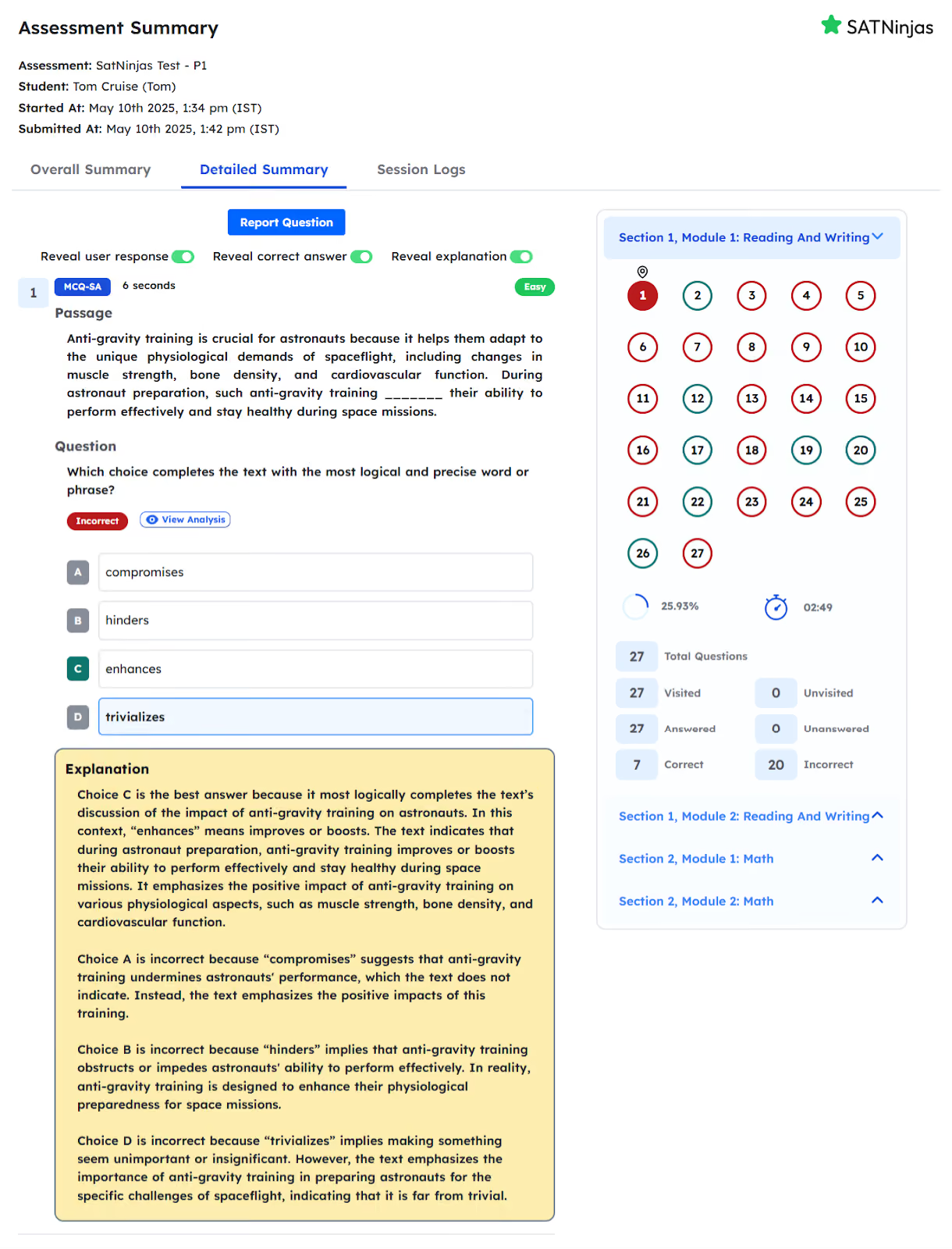
Taking a practice digital SAT is key to identifying areas that need the most attention. And the insight analytics after the test, as can be seen in the adjoining screenshot, will show the path to building scores faster and better.
Frequently Asked Questions
.svg)



.png)

.avif)