What Months of SAT Practice Test Data Reveal About Score Improvement
Before diving into the numbers, let's pause to appreciate what it takes to complete an SAT practice test. Whether it's a full-length exam or a single section, it requires effort, focus, and endurance. The score that emerges is not a final verdict, it's a starting point. When analyzed correctly, it becomes a roadmap toward meaningful improvement.
Over the past few months, around 1600 students took a free SAT Practice Test on the EdisonOS platform:
- ~1000 students completed a Full-length Adaptive Mock
- ~600 students completed Sectional Adaptive Mock (Reading & Writing only, Math only or both sections)
These test takers came from different backgrounds, schools, and preparation levels. Some took the test early in their prep journey. Others used it as a benchmark closer to test day. What stayed consistent were the patterns, patterns that reveal where students struggle most, where they excel, and what separates incremental progress from breakthrough scores.
This analysis breaks down those patterns and explains how they can inform focused study plans, personalized strategies, and more effective test preparation.
This is not merely a report. It’s an evidence based roadmap.
The Big Picture: What the Data Shows
Looking only at Full-length Adaptive Mock, the Average Total Score is 1185 (Median: 1300), with students averaging approximately 600 in Reading & Writing (Median: 650) and 640 in Math (Median: 690).
Grade Distribution of Test Takers
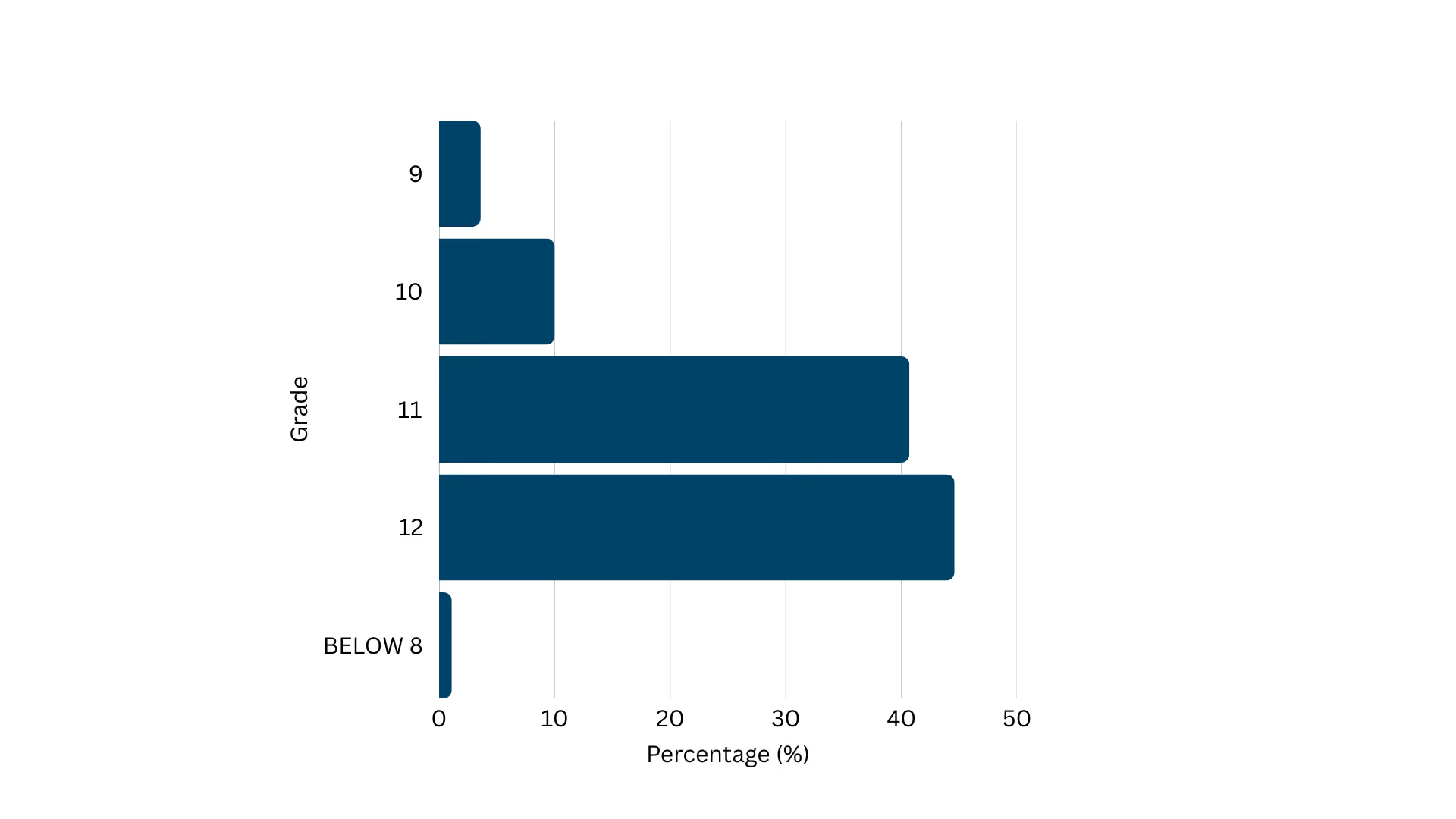
Our data reveals interesting patterns about which grade levels are most actively preparing for the SAT. As shown in the chart below, the majority of test takers are in their final years of high school, with 45% being in 12th grade and 41% in 11th grade. This suggests that most students begin serious SAT preparation in their junior and senior years. A smaller but significant portion (10%) starts earlier in 10th grade, while only 3% begin in 9th grade.
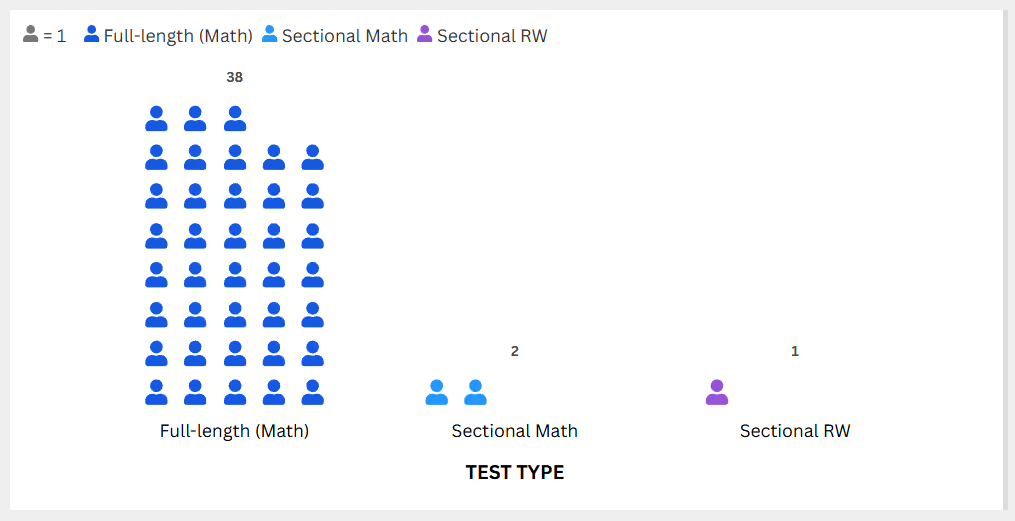
Of the students who took the full-length test, 38 earned a perfect section score of 800 on the Math section, and all were placed in the adaptive hard module, indicating that perfect scores were achieved under the highest difficulty conditions.
For students who attempted the Sectional Adaptive Mock:
- Reading & Writing averaged around 575 (Median: 620)
- Math averaged slightly higher at approximately 596 (Median: 620)
Notably, 2 students scored a perfect 800 in Math, while 1 student achieved a perfect 800 in Reading & Writing
Rather than labelling these results as “good” or “bad,” it’s more useful to interpret what they represent:
- Accuracy drops as questions become more abstract or multi-step
- Score outcomes are driven less by easy questions and more by performance on harder ones
In other words, effort alone isn’t the issue. Strategy is.
Where Most Students Struggle: The Toughest Questions on the EdisonOS SAT
Most incorrect responses came from questions that required students to put information together rather than recall it, demanding careful interpretation in Reading & Writing and precise setup in multi-step Math problems. Below are a few of the questions that students struggled with the most.
This is why EdisonOS emphasizes hard-module practice and post test analysis. Understanding why these questions are missed is the key to unlocking your next score jump.
Diagnostic Zones: What Your Score Range Really Means
Instead of thinking in terms of percentiles or comparison, think in terms of diagnosis. Use this score range as a guide to identify the specific skill gaps holding you back and address them strategically to drive score improvement.
The Foundation Builder (Below 1000)
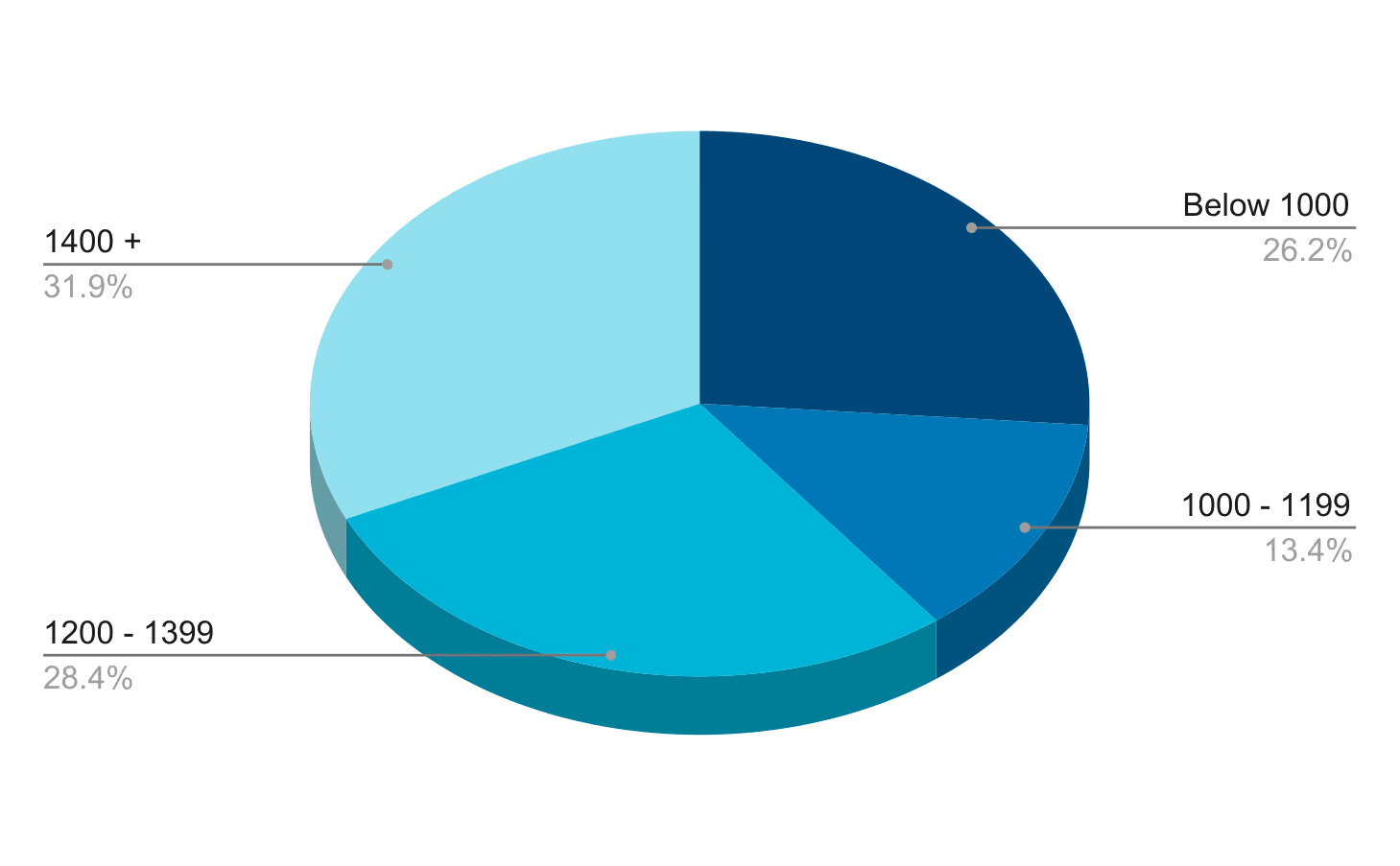
26% of students fall into this category
Your Reality Check: You’ve built a base, and now it's time to reinforce it. Your goal is to master the fundamentals that make up the bulk of the test.
Key Takeaway
- Lock in Grammar & Vocabulary: Our data shows that Standard English Conventions (punctuation, sentence boundaries, structure) and Words in Context are among the strongest-performing RW skills for students. Mastering these rules is one of the fastest ways to secure consistent points in RW.
- Solidify Core Algebra & Geometry: In Math, students perform best on linear equations, linear functions, probability, and basic geometry (circles, angles, and triangles). Becoming flawless in these areas is essential, as they form the foundation for more complex, higher-difficulty questions.
- Use EdisonOS: Head to our Skill level practice questions and focus on strengthening the foundational skills for both RW and Math modules.
The Climber (1000 - 1199)
13% of students fall into this category
Your Reality Check: You understand the concepts, but applying them consistently, especially on trickier questions, is the real challenge. Small, targeted improvements can lead to big score jumps.
Key Takeaway
- Tackle "Craft and Structure" in RW: This is one of the most challenging Reading & Writing skill areas, particularly Cross -Text Connections, Text Structure & Purpose, and nuanced word choice. These questions require deeper analysis rather than rule-based answers.
- Conquer Problem-Solving & Data Analysis: In Math, Data Analysis (interpreting charts, scatterplots, and statistical claims) emerges as one of the most error-prone areas for students. Focus on translating visuals and real-world scenarios into equations and conclusions.
- Practice Timed Sections: Start building your stamina. Take a 35-minute RW or Math section on EdisonOS to get used to the pressure.
The Contender (1200 - 1399)
28% of students fall into this category
Your Reality Check: You're in a strong position competing for top-tier schools. The easy points are yours; now it's about mastering the most difficult content and perfecting your strategy.
Key Takeaway
- Target Advanced Math & Geometry: The data shows that students struggle most with Area & Volume, Evaluating Statistical Claims, and advanced multi-step geometry and data problems. To push past 1400, you need to consistently win these questions.
- Analyze Your "Why": For every question you got wrong, don't just look up the right answer. Ask yourself why you chose your answer. Was it a careless mistake? A vocabulary gap? A flawed approach?
- Refine Your Pacing: You can't afford to get stuck. Practice identifying and skipping the most time-consuming questions to return to later.
Check out our blogs to learn more about Common Mistakes to avoid in Geometry and Algebra
The Top Scorer (1400+)
This is where most of our students (32%) find themselves!
Your Reality Check: You're in the top 32% of EdisonOS test-takers! In fact, 66 students scored an incredible 1500 or higher! Your challenge is no longer content knowledge, but precision, strategy, and avoiding the tiny mistakes that can cost you points.
Key Takeaway
- Refine Grammar & Sentence Precision: Even though Standard English Conventions is a strong-performing area overall, the remaining missed questions tend to come from edge-case punctuation, sentence structure, and clarity decisions. These are small but valuable points.
- Master the Hardest RW & Math Questions: Your focus should be on the most difficult Craft and Structure questions in RW (especially cross-text analysis) and the toughest Data Analysis and multi-step Math problems. These are what separate a strong score from an elite one.
- Simulate Test Day: Take full-length, timed practice tests regularly on EdisonOS to perfect your endurance and mental focus for the real 3-hour exam.
The Most Important Discovery: How the Test Adapted for Most Students
Because the SAT is adaptive, how you perform in the first module determines whether you move to an easier or harder second module, and that second module heavily influences your final score.
When we analyzed module movement across the months, the pattern was clear:
- In Reading & Writing, 36% of students moved to the easier module, while 64% moved into the harder module.
- In Math, 32% of students moved to the easier module, while 68% moved into the harder module.
This reveals something critical:
Most students performed well enough in the first module to be pushed into the harder second module, but many were not fully prepared for the jump in difficulty.
That second module is where scores are truly defined.
What separates students is not getting to the hard module, but knowing how to manage it:
- protecting easy and medium points
- not getting stuck too long on a single hard question
- making disciplined decisions under pressure
This pattern held true across the months, regardless of when a student took the test.
Check out our blog to learn more about How Often Should You Take SAT Practice Tests? The Ultimate Student Guide
When Do Students Actually Prepare for the SAT?
Our data reveals clear patterns about when students choose to take their SAT and prepare for it. Most students plan to take the actual SAT in December and August, with the majority beginning their preparation at least three months in advance.
This timing creates distinct peaks in practice test activity on our platform. August through November represents our busiest period, with students taking practice tests in preparation for the December SAT. This aligns with the academic calendar, as students often use the summer and early fall to intensively prepare before the winter testing window.
Understanding these patterns can help you plan your own preparation timeline.
Using Official Resources for Better Preparation
One of the best ways to prepare for the SAT is by practicing with official materials. The College Board provides 8 free, full-length SAT practice tests through its Bluebook digital platform, which closely mimic the real test experience. These practice tests will give you a good sense of the pacing, question types, and overall format of the SAT.
You can upload your results from these free practice tests to EdisonOS and receive a detailed analysis using our Blubook Insights tool, giving you personalized feedback to guide your next steps.
Domain-Level Patterns Worth Knowing
A Reliable Opportunity: Grammar
Standard English Conventions was the highest-performing domain (~82% accuracy) across all score levels. This makes it one of the most efficient areas for score improvement.
A Consistent Challenge: Craft & Structure
Although some skills were performed well, there was persistent difficulty in Cross - text connections. These questions require understanding author intent, not just comprehension, which explains the widespread difficulty.
The Toughest Area Overall: Problem Solving & Data Analysis
This area has the lowest accuracy in Math (~ 60% - 65% accuracy), mainly due to challenges interpreting data rather than computation, making it a high-impact focus for improvement.
For Sectional-Test Takers: How to Use Your Results
If you took only Reading & Writing or only Math, your score is directional, not definitive.
What it can tell you:
- Which domains are holding you back
- How you perform without test fatigue
What it can’t tell you:
- Your full SAT score
- How endurance affects your accuracy
Best use: Treat sectional results as diagnostic tools, then validate progress with a Full-length Adaptive Test after targeted study.
Your 4-Step Action Plan to a Higher Score
Whether you study independently, with a tutor, or using any platform, the process is the same:
- Analyze your report: Take your EdisonOS Test Report. Don't just look at the score. Click into each section and see which domains you struggled with. This is your personal treasure map.
- Set a narrow, measurable goal: Example: “Reduce Geometry errors by 30% in four weeks.”
- Create a Focused Study Plan: Use your error analysis to choose just two weak areas and practice questions that target these domains.
- Practice, Review, Repeat: Take targeted tests, review every single mistake and in a few weeks, take another full-length test to see your progress.
Check out our blog to learn more about How to utilize a free SAT Practice Test and maximize your scores
Final Thought
This practice test data does exactly what it's supposed to do: reveal where improvement matters most.
Across months of test data, one truth stands out: students don't underperform because they lack ability. They underperform because they don't yet know where effort matters most.
Now we do.
Whether you're a student planning your next study session or a tutor guiding test preparation, use this information wisely and work intentionally. Progress on the SAT is far more predictable than it feels, when you know what to focus on.
The data points the way. We at EdisonOS are excited to support the journey toward every student's goal school.
Disclaimer: The official SAT includes 8 pretest questions (unscored) among its 98 total questions. In our practice test, however, all 98 questions are counted toward the final score. Additionally, while the official SAT uses an Item Response Theory (IRT) scoring model, EdisonOS employs a weighted mean scoring algorithm designed to closely align with official SAT scores.

.png)

.avif)