- Check the exact value the question asks for: Write down the target, such as radius, diameter, area, or a specific expression, before solving.
- Read diagrams carefully: Use the labels, markings, measurements, and information provided rather than relying on how a figure looks.
- Apply circle formulas correctly: Remember that the standard circle equation gives you (r^2), so take the square root when finding the radius.
- Watch scale factors: Linear dimensions scale by (k), areas by (k^2), and volumes by (k^3).
- Use Desmos strategically: Check calculator settings for trigonometry and use graphing or other built-in tools when they can solve coordinate and geometry problems more efficiently.
Geometry questions on the Digital SAT test how well you can apply mathematical relationships, interpret information, and work accurately under time pressure. A small detail in a diagram, a missed unit, or an incorrect calculation can change an otherwise correct solution.
Strong preparation combines knowledge of key geometry concepts with careful reading and consistent problem-solving habits. Learning how to analyze diagrams, use formulas, work with coordinates, and check your calculations can help you approach Geometry questions with greater confidence.
In this guide, we'll cover common Digital SAT Geometry mistakes and practical strategies you can use to improve accuracy and solve questions more efficiently.
Common Mistakes to Avoid in Digital SAT Geometry
Digital SAT Geometry questions can test concepts such as angles, triangles, circles, area and volume, and coordinate geometry. Success depends on more than remembering formulas—you also need to understand the information given, identify the relevant relationship, and apply it accurately.
1. Skipping Diagram Analysis
One common error is quickly glancing at a diagram without fully analyzing it. This leads to missed details and mistakes in interpretation, especially if the question uses unfamiliar or complex shapes.
Solution: Start by reading every label, measurement, and marking in the diagram. Then connect those details to the information stated in the question. Base your solution on the given information and geometric relationships rather than assuming that a figure is drawn to scale.
2. Not Knowing How to Apply Essential Formulas
The Digital SAT provides a reference sheet with commonly used formulas, so success depends on knowing what the formulas represent and when to use them. Students can lose time when they recognize a formula but are unsure which values belong in it or which relationship the question requires.Solution: Review the formulas provided on the SAT reference sheet and practice applying them to different types of problems. Also build familiarity with important relationships that help you recognize the right approach quickly.
3. Misinterpreting Angle Relationships
Angle relationships in geometry are a frequent source of mistakes, particularly when dealing with parallel lines, polygons, or intersecting lines. Misunderstanding these relationships can lead to incorrect answers.
Solution: Review relationships involving complementary and supplementary angles, parallel lines, transversals, triangles, and polygons. When a diagram includes several angles, use the markings and information provided to determine which relationships apply before calculating. For additional practice, use free Digital SAT practice tests to strengthen your Geometry and Trigonometry skills.
4. Confusing Similar and Congruent Shapes
Similar figures have the same shape with proportional corresponding sides, while congruent figures have the same shape and size. When solving a problem, identify whether the question is asking about equal measurements or proportional relationships before applying a property.
Solution: Make sure you understand the difference between similar and congruent shapes. Similar shapes have proportional sides and equal angles, while congruent shapes have identical side lengths and angles. Practicing problems that involve both concepts can help clarify this distinction and improve your accuracy.
5. Relying Too Much on Estimation
Estimation can be helpful, but overrelying on it can lead to errors, especially when questions require precise answers. Some students estimate values instead of calculating exactly, which can affect their results.
Solution: Use estimation strategically to check whether an answer is reasonable or to eliminate choices that are clearly too large or too small. When the question requires an exact value, complete the necessary calculations rather than relying on an estimate alone.
6. Ignoring Units and Measurements
Geometry problems often involve units of measurement, and students sometimes overlook these details. Misinterpreting or ignoring units can result in incorrect answers, especially in questions involving area or volume.
Solution: Check the units before and after solving. A length, area, and volume represent different types of measurements, so make sure the final answer matches what the question asks for. Convert units when the problem requires it.
7. Overlooking Key Geometry Properties
Certain properties, like the Pythagorean theorem, properties of quadrilaterals, and properties of circles, are foundational to SAT Geometry questions. Many students either forget or overlook these properties during the test.
Solution: Build familiarity with the geometry relationships that appear regularly in SAT-style problems. These include the Pythagorean theorem, angle relationships, properties of triangles and quadrilaterals, circle relationships, and coordinate-geometry formulas. Practice applying each concept in different question settings so you can recognize the relevant relationship quickly.
Try out free digital sat practice test.
8. Failing to Double-Check Calculations
Geometry questions often involve multiple calculation steps, making it easy to overlook a minor detail or miscalculate. Skipping the step of reviewing your work can lead to unnecessary mistakes.
Solution: Use the final moments of a problem to check calculations that involve several steps. Revisit signs, substitutions, arithmetic, and the value you entered as your final answer. A quick review can catch an error before you move on. Keeping a SAT error log can also help you identify recurring mistakes and improve your accuracy over time.
9. Misunderstanding Coordinate Geometry Concepts
Coordinate geometry questions can be tricky, especially when involving slopes, midpoints, or distances. Students sometimes confuse these concepts, leading to errors in their calculations.
Solution: Pay close attention to what the coordinates represent before choosing a formula. Practice finding slope, distance, and midpoint and interpreting how points and lines relate to one another on the coordinate plane.
10. Rushing Through Diagram-Based Questions
Some geometry questions on the SAT rely heavily on diagrams, which can lead to mistakes if students rush through them. Diagrams often contain vital clues, and rushing can lead to misinterpretations or missed information.
Solution: Give yourself enough time to identify the important information in a diagram before calculating. Check labels, markings, measurements, and the exact quantity the question asks you to find. A clear first read can make the calculation much more straightforward.
Conclusion
Avoiding common mistakes in the Digital SAT Geometry section requires a combination of careful reading, thorough diagram analysis, and a solid understanding of geometry principles. By recognizing these potential pitfalls and implementing strategies to avoid them, you can improve your accuracy and tackle the geometry section with greater confidence.
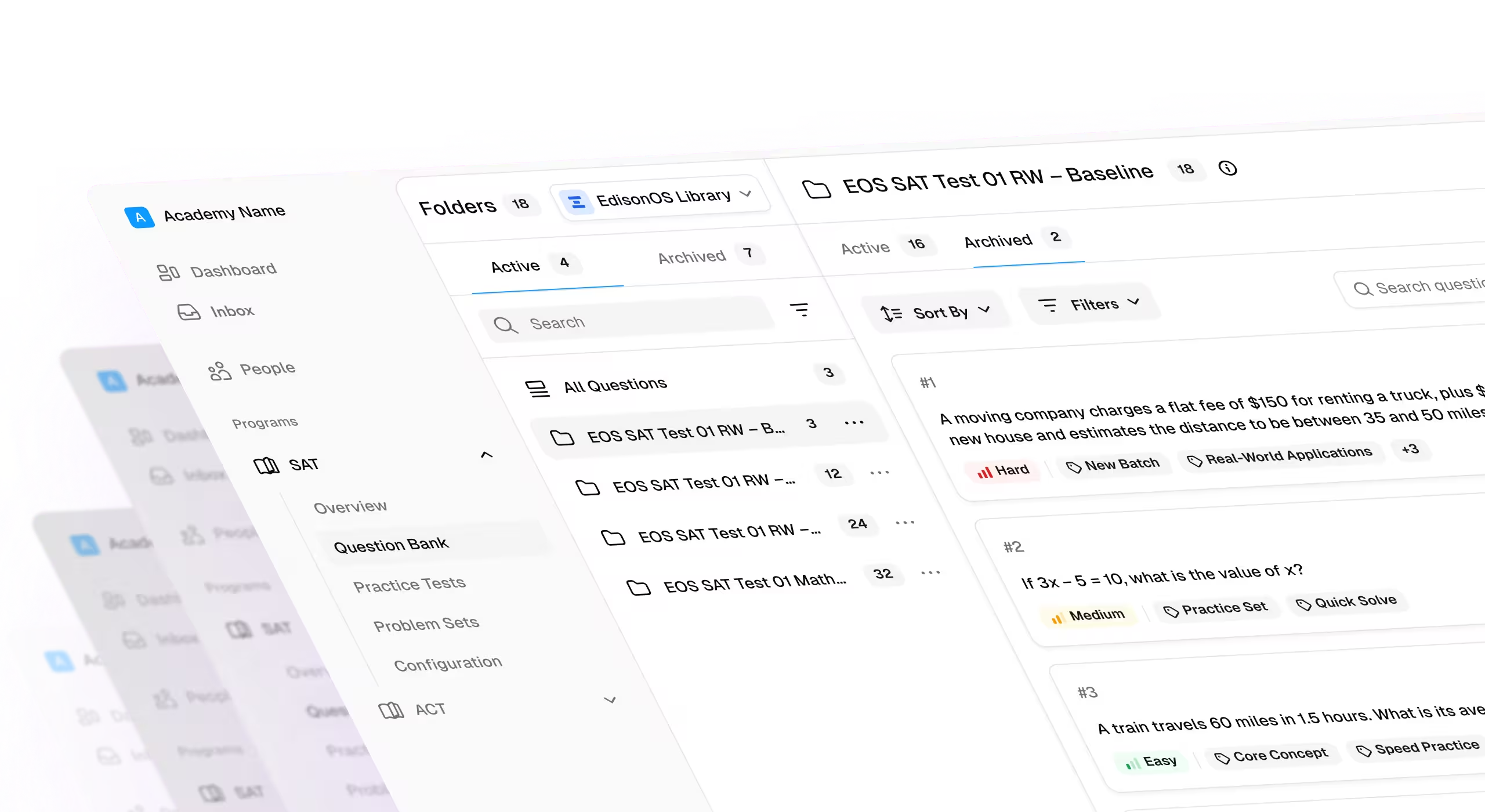
EdisonOS Tip: For a structured and efficient study plan, consider using EdisonOS. It offers targeted resources for mastering geometry concepts, practice questions to reinforce your understanding, and tools to track your progress. With EdisonOS, you’ll be well-equipped to handle the complexities of SAT Geometry and achieve your best possible score.
Try out free digital sat practice test.
Using these strategies and practicing with Edison OS, you’ll be prepared to navigate the Digital SAT Geometry section successfully and avoid the common mistakes that can cost you valuable points.

.png)

.png)