The Enhanced ACT Reading section gives you 40 minutes to answer 36 questions across 4 passages (Literary Narrative, Social Studies, Humanities, and Natural Science), averaging about 10 minutes per passage.
- Timing — 40 minutes total for 36 questions, or 9 questions per passage.
- Scoring range — Scaled from 1 to 36, matching the overall ACT composite scale.
- Content categories — Key Ideas and Details (44-52%), Craft and Structure (26-33%), and Integration of Knowledge and Ideas (19-26%).
- Question types — Specific Detail, Structure and Function, Inference, Main Idea, and Vocabulary in Context.
- Order of passages — Start with your strongest passage type (e.g., Natural Science or Literary Narrative) to lock in points on the questions you find easiest.
- Active annotation — Underline key details like names, dates, numbers, proper nouns, and author or character opinions, and jot a one-word margin summary for long paragraphs.
- Targeted reading pace — Slow down for transition words (however, because), time markers (initially, later), and contrast or absolute words (more, only).
- Process of elimination — Cross out common trap answers that are too extreme, too narrow, opposite to the text, or distorted.
- Error analysis (the review loop) — After every practice test, review each missed question to diagnose why (misread stem, timing error, trap choice) before taking another test.
The Digital ACT Reading section challenges students to read and analyze passages within strict time limits. With 40 questions to answer in 35 minutes, test-takers must refine their reading comprehension skills, adopt effective strategies, and become familiar with the test’s online format to maximize performance.
Success in this section depends on understanding passage structures, managing time effectively, and practicing with digital tools. This guide explores the ACT Reading format, strategies for improvement, and resources like EdisonOS to enhance preparation.
Digital ACT Reading Format
The ACT Reading section consists of four passages, each followed by ten questions. These passages cover different subject areas and require students to extract main ideas, interpret details, infer meanings, and analyze the author’s tone and purpose.
Key aspects of the Digital ACT Reading section:
- Passage Types: Includes prose fiction/literary narrative, social science, humanities, and natural science passages.
- Timing: 40 questions in 35 minutes, requiring efficient reading and answering.
- Question Types: Evaluates comprehension, inference, author’s intent, and the ability to compare perspectives.
- Scoring: Each question carries equal weight, making accuracy across all passages essential.
Practicing with online free ACT practice tests can help students become comfortable with the digital format and time constraints.
Sections of the Digital ACT Reading
Prose Fiction/Literary Narrative (~25% | 10 Questions)
- Focuses on character interactions, themes, and emotions.
- Requires analyzing literary elements like tone, mood, and perspective.
Social Science (~25% | 10 Questions)
- Includes history, economics, sociology, and political science topics.
- Questions focus on key ideas, supporting details, and author’s viewpoint.
Humanities (~25% | 10 Questions)
- Covers arts, literature, philosophy, and cultural discussions.
- Tests the ability to recognize rhetorical devices and argument structures.
Natural Science (~25% | 10 Questions)
- Includes biology, chemistry, physics, and earth sciences.
- Questions evaluate the interpretation of scientific explanations and evidence.
Strategies to Improve Digital ACT Reading Score
1. Develop Active Reading Techniques
- Identify Main Ideas: Focus on the passage’s purpose and overarching themes.
- Summarize Passages: Take brief notes to improve retention and comprehension.
- Highlight Key Details: Pay attention to arguments, opinions, and author’s tone.
2. Leverage Study Resources and Practice Tools
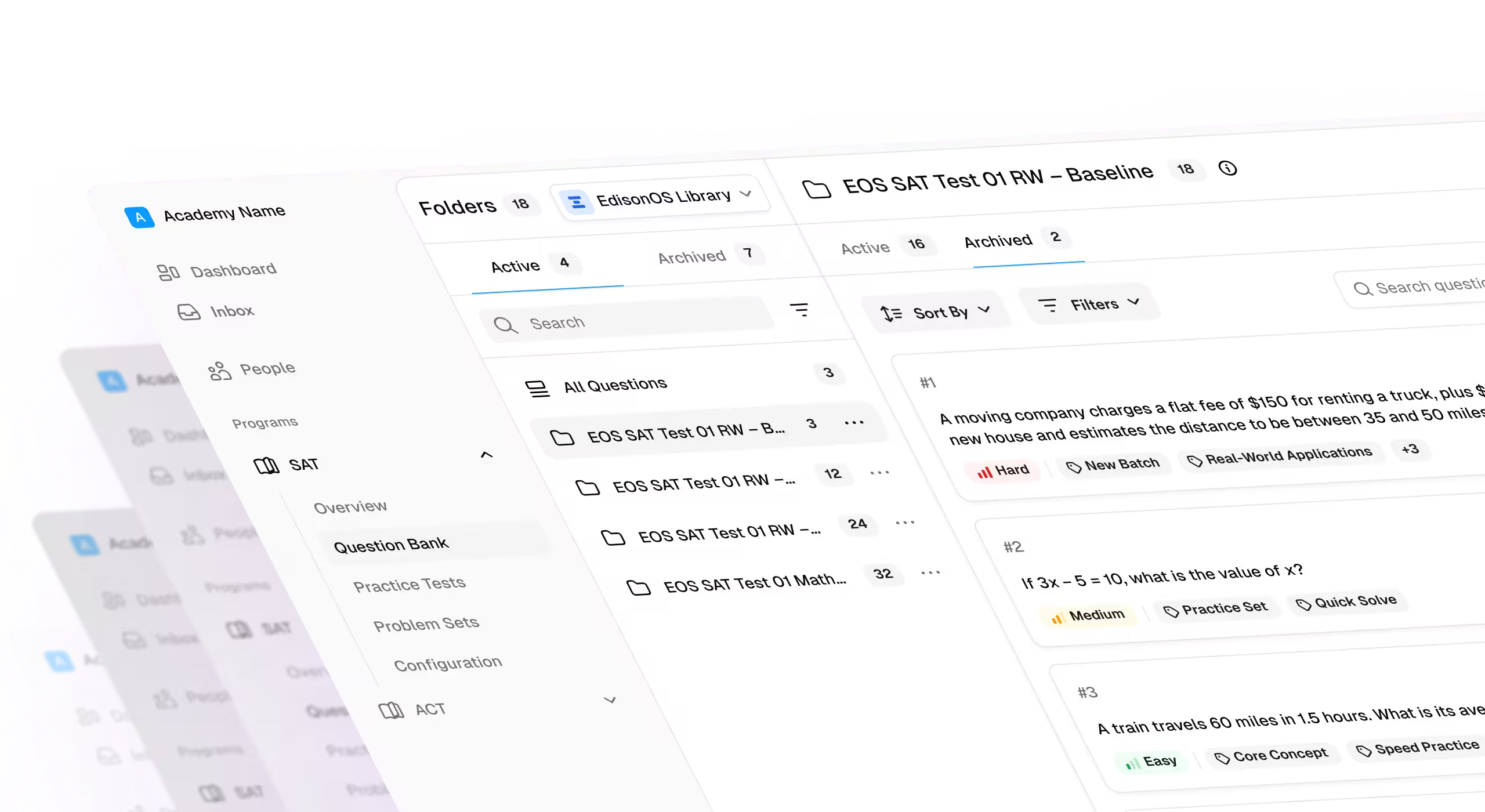
- EdisonOS: Provides personalized digital ACT practice with real-time feedback.
- ACT Official Practice Tests: Offers full-length tests that replicate real exam conditions.
- Khan Academy: Delivers video explanations and exercises tailored to ACT reading skills.
- Speed Reading Tools: Helps students increase reading speed while maintaining comprehension.
3. Improve Time Management Skills
- Skim passages strategically to grasp the main ideas before reading in-depth.
- Prioritize answering straightforward questions first and mark difficult ones for review.
- Use online free ACT practice tests to simulate test conditions and develop pacing.
4. Avoid Common Pitfalls and Mistakes
- Don’t get stuck on minor details—focus on overall arguments.
- Avoid making assumptions; rely solely on the passage’s information.
- Be cautious with answer choices that distort or misrepresent passage details.
5. Master Different Question Types
- Main Idea Questions: Determine the central focus of the passage.
- Detail-Oriented Questions: Locate and verify answers with supporting evidence.
- Inference Questions: Identify implied meanings and relationships between ideas.
- Author’s Purpose and Tone: Recognize the author’s intent and attitude.
- Comparative Questions: In paired passages, analyze differences and similarities.
6. Practice with Real Passages
- Work with official ACT reading passages to understand question styles.
- Practice under timed conditions to build endurance.
- Use digital ACT tools like EdisonOS to track progress and pinpoint weaknesses.
7. Analyze Your Performance
- Maintain an error log to track repeated mistakes.
- Use EdisonOS’s adaptive learning to identify and improve weak areas.
- Adjust strategies based on performance insights and recurring challenges.