- Acely makes SAT and ACT prep more accessible with personalized study plans and AI-driven practice for students who prefer self-paced, on-demand preparation.
- The main limitation is depth and consistency: AI-generated questions and explanations may not always provide the quality or depth needed for advanced students or sustained preparation.
- For tutoring institutes, the challenge is bigger than individual practice. They need reliable, expert-vetted content, realistic test simulations, and tools to monitor performance across multiple students.
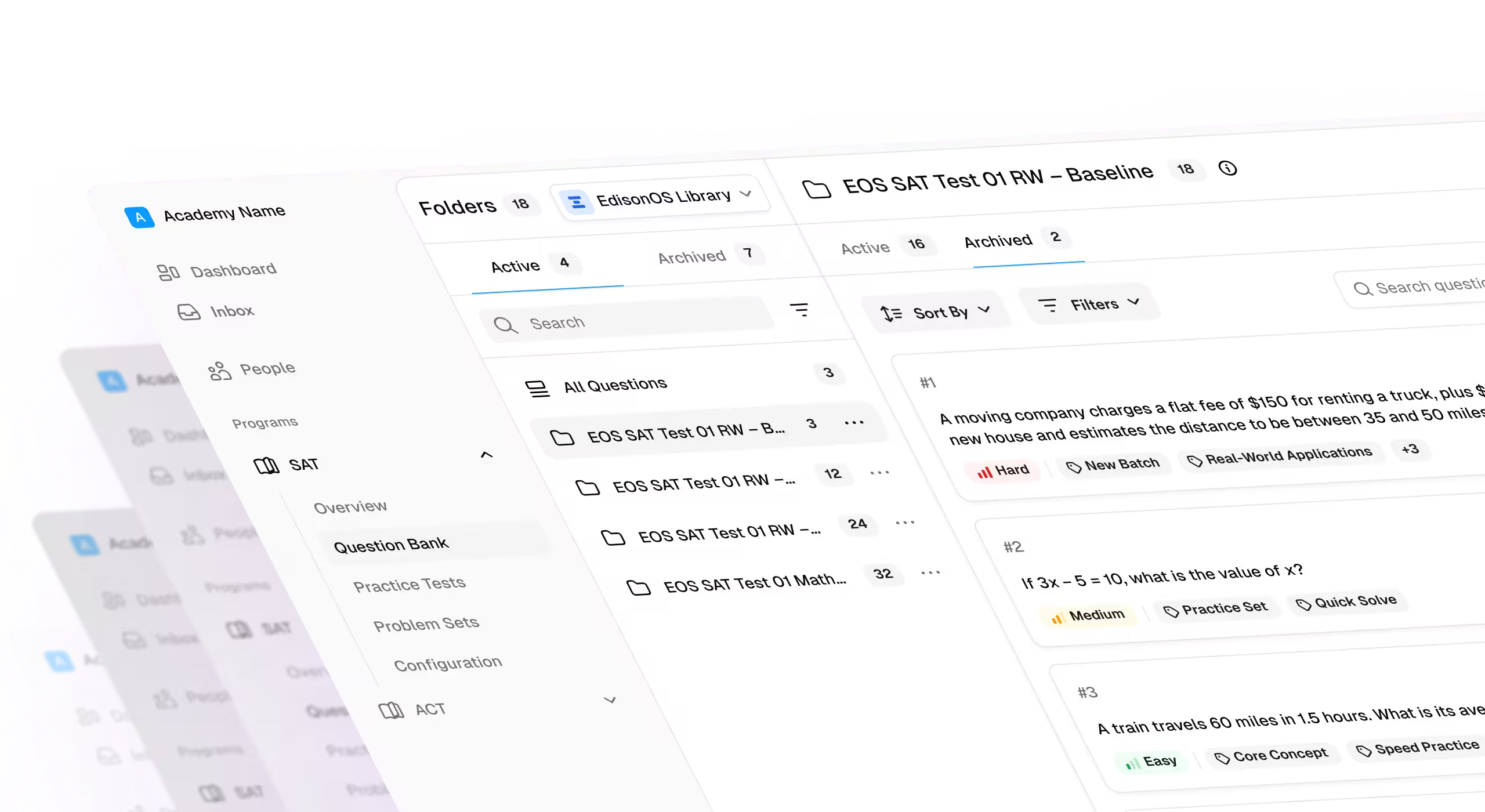
- EdisonOS addresses the professional tutoring use case with expert-vetted question banks, Bluebook-mirroring mock exams, and cohort-level analytics for managing and improving student outcomes.
Acely is a recognized AI-driven test prep platform that prep institutes and tutors may evaluate before adopting it for SAT, ACT, or PSAT preparation.
Operator sentiment is mixed, with experiences varying based on institute size, branch count, testing volume, and how much infrastructure a team requires.
This review covers:
- What operators consistently value
- Where institutes commonly hit limits
- When institutes start evaluating EdisonOS as infrastructure
Disclosure: This review is written from EdisonOS's perspective and uses publicly available feedback and operator sentiment.
Acely Pros and Cons at a Glance
How we analyzed Acely reviews
We analyzed public reviews, operator conversations, and recurring usage patterns to identify consistent strengths and limitations across different institute environments.
- Reviewed Trustpilot, Reddit, and other public review sources
- Looked for recurring praise, complaints, and feature requests across multiple sources
- Compared feedback from independent tutors, growing institutes, and larger test-prep operations
Recent Trustpilot feedback is notably positive overall, with users frequently mentioning Acely's practice resources, study plans, explanations, and value. At the same time, critical reviews raise concerns about practice-test accuracy, technical issues, and whether results always translate to official SAT performance.
What operators like about Acely
Most positive feedback focuses on early-stage testing value, straightforward adoption, and features that help tutors support students without building every practice workflow themselves.
- Personalized diagnostics: Acely's diagnostic and study-plan workflow can help tutors identify student weaknesses and structure targeted practice, similar to how Digital SAT diagnostics establish a student's baseline.
- Adaptive practice: Students receive focused work between sessions, reducing manual assignment coordination for tutors managing individual learners.
- AI feedback: Immediate explanations allow students to work independently instead of relying on tutors for every practice question.
- Multi-exam coverage: Tutors supporting SAT and ACT students can use one platform rather than managing separate practice systems, including resources aligned with the Digital SAT structure.
- Accessible pricing: Individual subscriptions can be easier to justify for smaller operations testing digital preparation before investing in dedicated infrastructure.


Acely's public tutor pricing also supports this smaller-scale use case. Its current pricing page lists SAT/PSAT access at $199 monthly, $299 for three months, $399 for six months, or $599 for twelve months.
Common complaints and limitations in Acely reviews
Most recurring concerns become more relevant when tutors use Acely extensively or begin moving from individual student support toward larger-scale testing operations.
- Question quality can vary: Recent users have questioned whether some English practice accurately reflects the difficulty and wording of the actual SAT.
- Explanation depth can vary: Some reviewers find AI explanations less useful when questions require deeper reasoning or conceptual instruction.
- Practice-test accuracy raises questions: Some users report differences between Acely practice scores and their official SAT results.
- Operational documentation is limited: Public information provides less visibility into centralized reporting, governance, and complex multi-branch administration.
- Technical support can become important: Some reviewers have reported site issues or difficulties getting timely support when problems affected their preparation.



These concerns do not mean Acely is ineffective. Rather, they show why the platform may be a stronger fit for individual preparation than for institutes that need tightly controlled assessment infrastructure.
Acely Reviews by Institute Type
1. For Single-Location Tutors
Acely can work well for independent tutors who need adaptive practice, diagnostics, and AI support without managing complex testing infrastructure or multiple branch-level workflows.
2. For Growing Multi-Branch Institutes
As institutes add branches and increase testing volume, centralized reporting, content consistency, test administration, and visibility across cohorts become more important, making Acely's fit less straightforward.
3. For Large Test-Prep Networks
At network scale, reviews can become more mixed because teams need standardized testing, centralized governance, secure administration, and consistent reporting across multiple locations and large student volumes.
Real Operator Review Highlights
The public feedback available for Acely is predominantly student- and parent-led rather than institute-led, so these are paraphrased themes from available user feedback, not direct operator quotations.
- Acely provides structured practice and study plans that make consistent preparation easier to manage.
- The platform offers strong value for independent preparation, but practice accuracy can become a concern for some users.
- Acely is convenient for individual preparation, while larger operations may need more centralized testing infrastructure.
When Acely is a good choice (based on reviews)
Acely remains a practical option for smaller teams that prioritize flexible digital practice and do not yet need extensive institutional testing infrastructure.
- Independent or small teams: Acely can suit tutors supporting limited student volumes without complex branch-level administration requirements.
- Multi-exam preparation: Institutes supporting both SAT and ACT students can evaluate dedicated resources such as a free ACT practice test alongside their existing prep workflows.
- Budget-sensitive operations: Smaller programs may prefer Acely before investing in dedicated institutional testing infrastructure.
Its current tutor offering also provides visibility into student activity, which can help tutors understand how much practice students complete outside sessions.
When Acely starts falling short
Acely becomes harder to justify when institutes move beyond individual student preparation and begin managing larger testing volumes, multiple branches, or standardized assessment operations.
- Content consistency becomes critical: Frequent assessment cycles require greater confidence in question quality, difficulty, and alignment with the target exam.
- Reporting requirements increase: Growing teams may need centralized cohort reporting, branch-level visibility, and standardized performance tracking.
- Testing administration becomes more complex: Larger operations require secure, consistent mock delivery and workflows designed around institutional test administration.
- Governance becomes essential: Multi-branch networks need centralized oversight to maintain consistent testing standards across locations.
Recent public discussions illustrate why this matters. Some users praise Acely's similarity to the SAT, while others describe certain practice tests as too easy or report meaningful differences between Acely and official scores.
How EdisonOS compares to Acely (based on common review gaps)
EdisonOS is positioned as a Digital SAT platform, testing infrastructure for tutors and institutes that need structured assessment operations across growing student cohorts and multiple locations.
- Expert-vetted content: A controlled question-development process can address concerns around AI-generated content quality and assessment consistency.
- Secure test administration: Bluebook-mirroring adaptive mocks support standardized assessment delivery across larger student groups.
- Centralized reporting and governance: Cohort, branch, and institute-level reporting gives leaders greater visibility into testing outcomes and operations.
Institutes evaluating Acely often shortlist EdisonOS when individual practice needs evolve into structured, scalable test administration.
Acely vs EdisonOS: which is the better fit?
The right choice depends on institute size, branch structure, testing volume, and required operational control.
Final verdict on Acely reviews
Acely performs well when tutors or smaller programs need accessible adaptive practice, diagnostics, AI-supported preparation, and a relatively straightforward digital workflow.
The biggest recurring concerns involve question consistency, practice-test accuracy, explanation depth, and the platform's suitability for larger institutional workflows.
EdisonOS becomes the stronger long-term choice for tutoring institutes that need standardized testing, secure test administration, centralized reporting, and scalable management across growing student volumes or multiple branches.
Ready to build a more scalable test prep operation? Book a Free Demo.
Frequently asked questions about Acely reviews
Is Acely worth it based on reviews?
Trustpilot ratings of 4 to 4.5 stars and numerous testimonials suggest many users find Acely effective. Independent reviewers consistently recommend it for self-motivated, digitally comfortable students seeking adaptive AI practice.
Whether it justifies the cost depends heavily on how the student uses it. Students who complete diagnostics, follow the study plan, and practice consistently tend to report the strongest outcomes. Those looking for deep instruction or institutional features may find alternatives more suitable.
What do users dislike most about Acely?
The most recurring complaints involve AI-generated questions that feel poorly worded or inaccurate, and an AI chatbot that users describe as not significantly better than free tools.
Content repetition after extended use is also a frequent concern. At the approximately 299 USD price point, some users feel the question quality and explanation depth do not justify the cost compared with competing resources.
Is Acely suitable for multi-branch institutes?
Acely can support digital preparation, but publicly available information provides less clarity around comprehensive multi-branch testing administration and governance.
Growing networks may therefore evaluate platforms built specifically for institutional assessment workflows, particularly when they need centralized visibility, standardized testing, and consistent administration across locations.
Why do institutes switch from Acely to EdisonOS?
Teams typically look for fully Bluebook-mirroring test interfaces, expert-vetted content, robust cohort analytics, and centralized test administration that Acely's current feature set does not fully document or provide.
Advanced users who grow dissatisfied with question quality and perceived content limitations begin evaluating platforms that emphasize stricter content vetting and institutional infrastructure. EdisonOS is positioned specifically to meet those operational requirements.
Are EdisonOS reviews more positive than Acely?
Acely has extensive star-rating data on Trustpilot, while EdisonOS relies on testimonials from named test prep companies and tutors rather than consumer review platforms.
Because review channels differ, direct quantitative comparison is not methodologically reliable. EdisonOS testimonials are uniformly positive but curated. Acely's public reviews show both strong ratings and visible critical feedback, particularly on Reddit, providing a broader but more mixed picture.