- AP Classroom alternatives offer different strengths, from digital exam simulation and analytics to free content and extensive question banks.
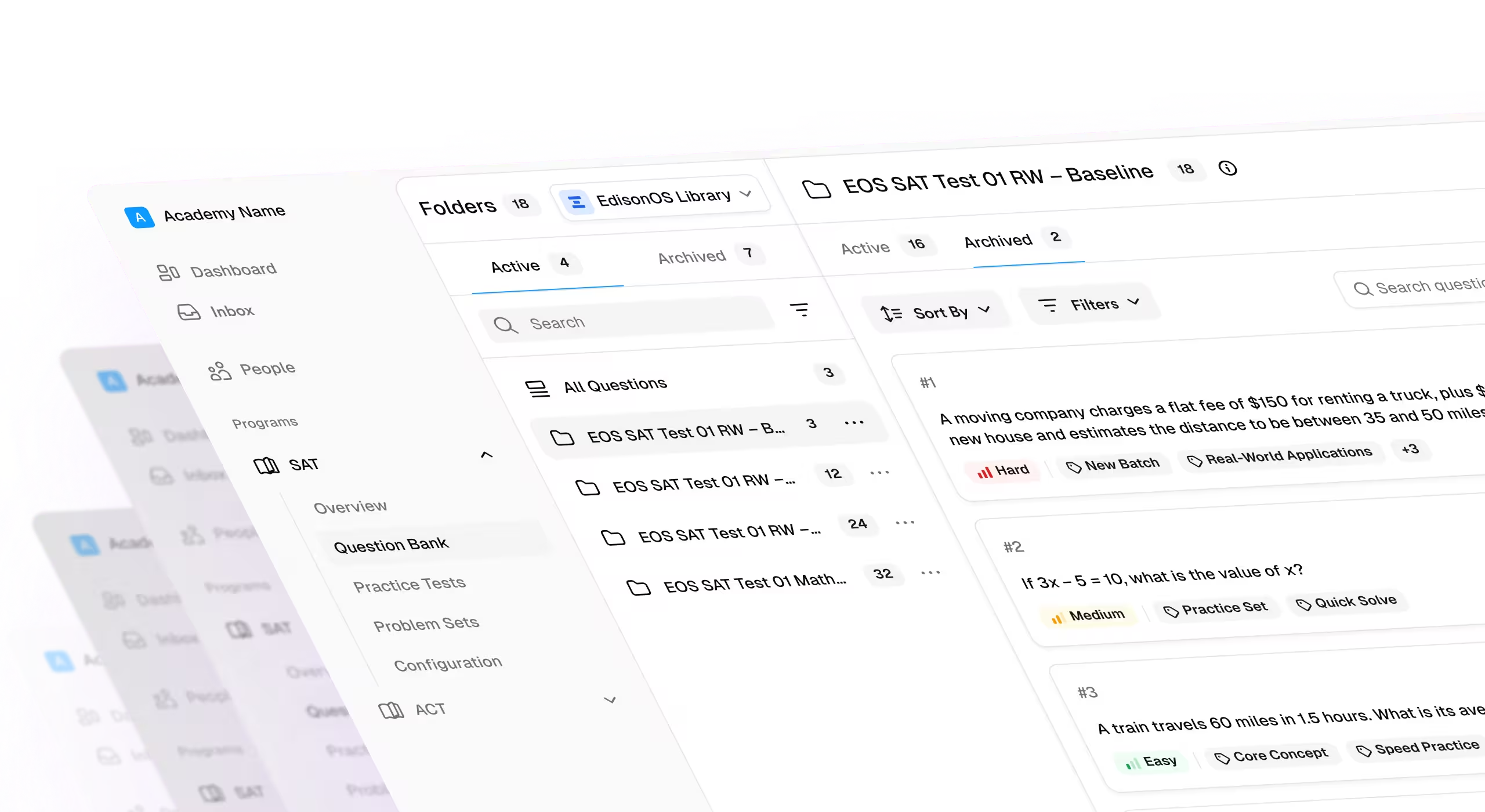
- EdisonOS is designed for AP tutors needing realistic digital exam simulations, custom assessments, scoring, and student performance analytics.
- Khan Academy is a good free AP resource for institutes seeking accessible, College Board-aligned content and independent learning support.
- Albert has a fairly extensive AP question bank, detailed explanations, customizable assignments, and teacher-focused reporting capabilities.
- UWorld focuses on AP practice, answer explanations, visual learning, customizable quizzes, and topic-level progress tracking.
- Princeton Review provides structured AP preparation through live courses, one-on-one tutoring, self-paced programs, and practice materials.
- When choosing an AP Classroom alternative, consider pricing, setup, integrations, reporting, support, and long-term scalability.
- EdisonOS is particularly suited to tutors and institutes seeking greater control over AP testing, assessment, and student performance.
AP Classroom is a popular choice for AP preparation. However, as tutoring businesses grow, many institutes begin looking for more AP Classroom alternatives. Particularly, flexible testing, reporting, and student-management options are much sought after.
Here, we have created a guide that compares the top AP Classroom alternatives by features, pricing, usability, and institute fit. Whether you run a solo tutoring practice or a growing institute, this guide will help you choose an option that fits.
Each platform is evaluated using:
- Hands-on product testing, demos, and feature comparisons
- Analysis of G2, Capterra, Reddit, and other review sites
- Operator interviews and buying conversations
While we’ve included our product EdisonOS in this comparison, we’ve evaluated it using the same criteria that we’ve used to assess other alternatives.
The Top AP Classroom Alternatives to Consider in 2026
1. EdisonOS: Best for Full Digital AP Exam Replication
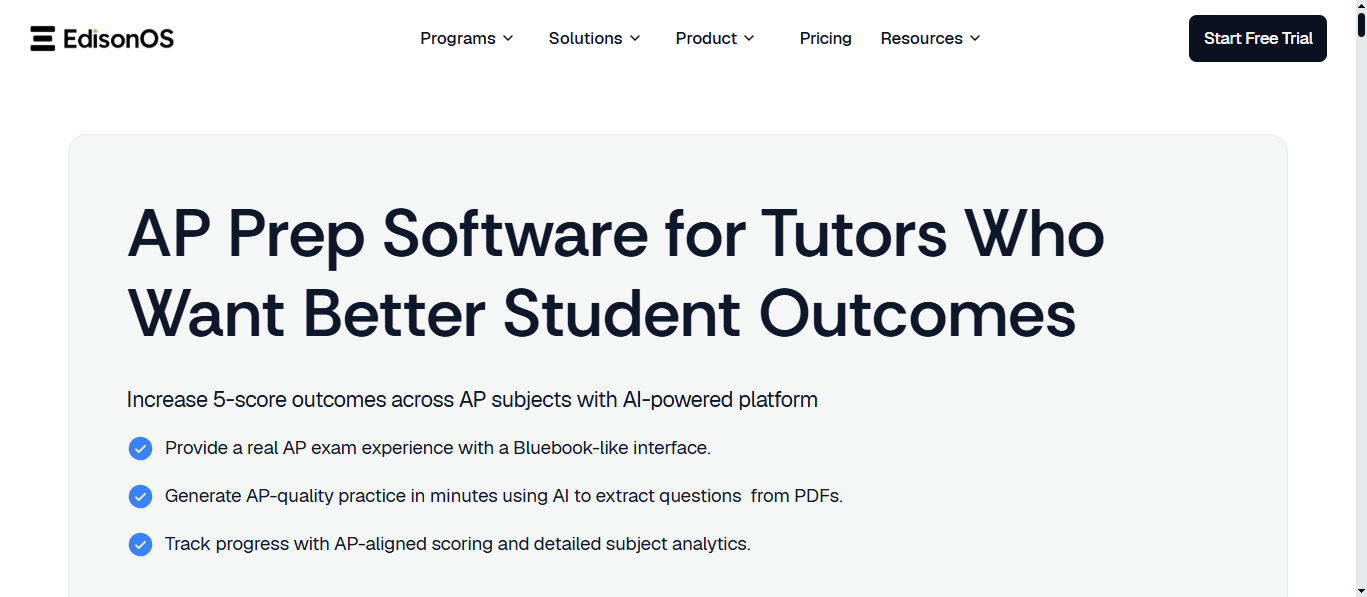
EdisonOS stands out among the alternatives because it has the digital testing environment. It offer more practice questions to students so they may fully familiarize themselves with the new format. EdisonOS is one of the few AP tutoring platforms that offers a screen-for-screen Bluebook-style testing experience for AP English, US History, Physics, Calculus, and Psychology.
It is built specifically for tutors who want to deliver realistic AP exam simulations while managing assessments, scoring, and reporting from a single system. Students get an exam environment that mirrors the real testing experience, while tutors get a platform designed to reduce administrative overhead and provide clearer visibility into student performance.
Key Features of EdisonOS
- 99% Bluebook-matched interface for AP exam practice
- Full-length digital AP practice tests for AP Chemistry, Physics, and Biology
- Build Your Own Test (BYOT) in as little as 15 minutes
- Skill and subject-specific analytics
- Performance trend tracking across assessments
- Desmos calculator and reference sheets available during review
Pros
- Gives students a realistic AP testing experience before exam day, helping reduce test-day anxiety
- Reduces assessment creation time from roughly 35 hours per week to 2–3 hours
- Early testers report saving 5+ hours per week on content preparation, allowing them to spend more time teaching and less time on administrative work
- Gives tutors greater flexibility over scoring and assessment design
- Makes it easier to identify performance gaps through detailed skill- and subject-level analytics
- Supports the hybrid workflows commonly used in AP science tutoring
- Centralizes test creation, student tracking, reporting, and performance analysis in a single platform
Cons
- More functionality than tutors looking only for a question bank may need
- Requires some initial setup to configure tests and reporting
- Best suited for tutors managing multiple AP students or cohorts
Rating: 4.5/5

2. Khan Academy: Best Free AP Resource
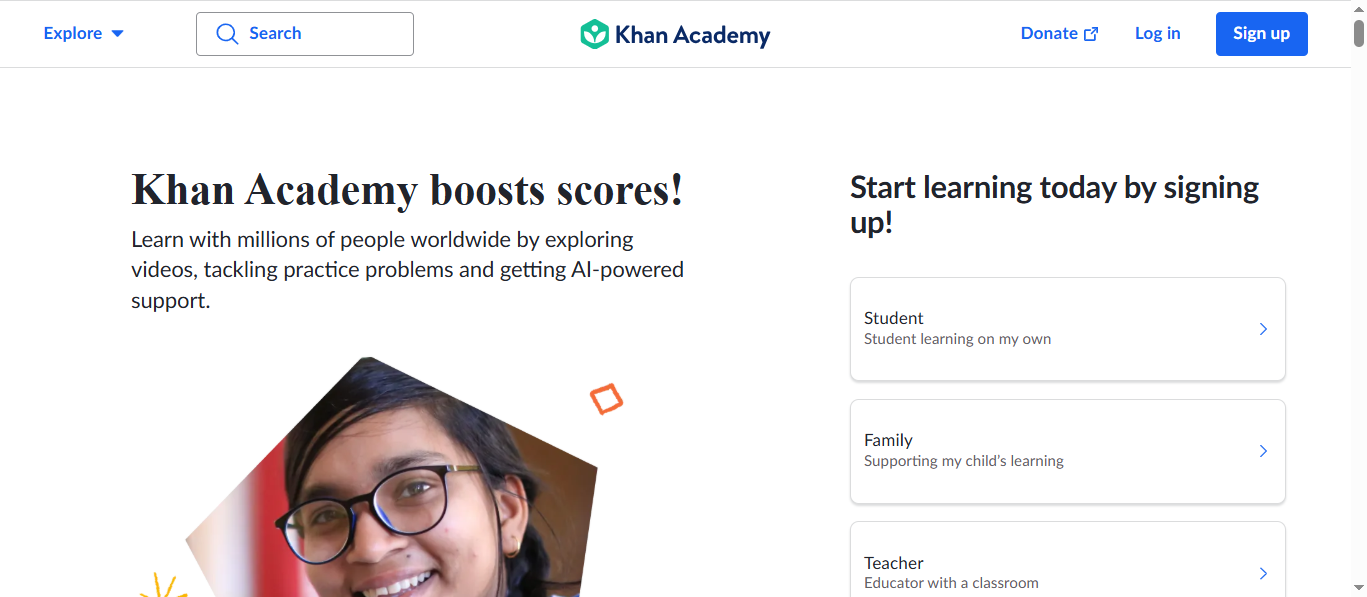
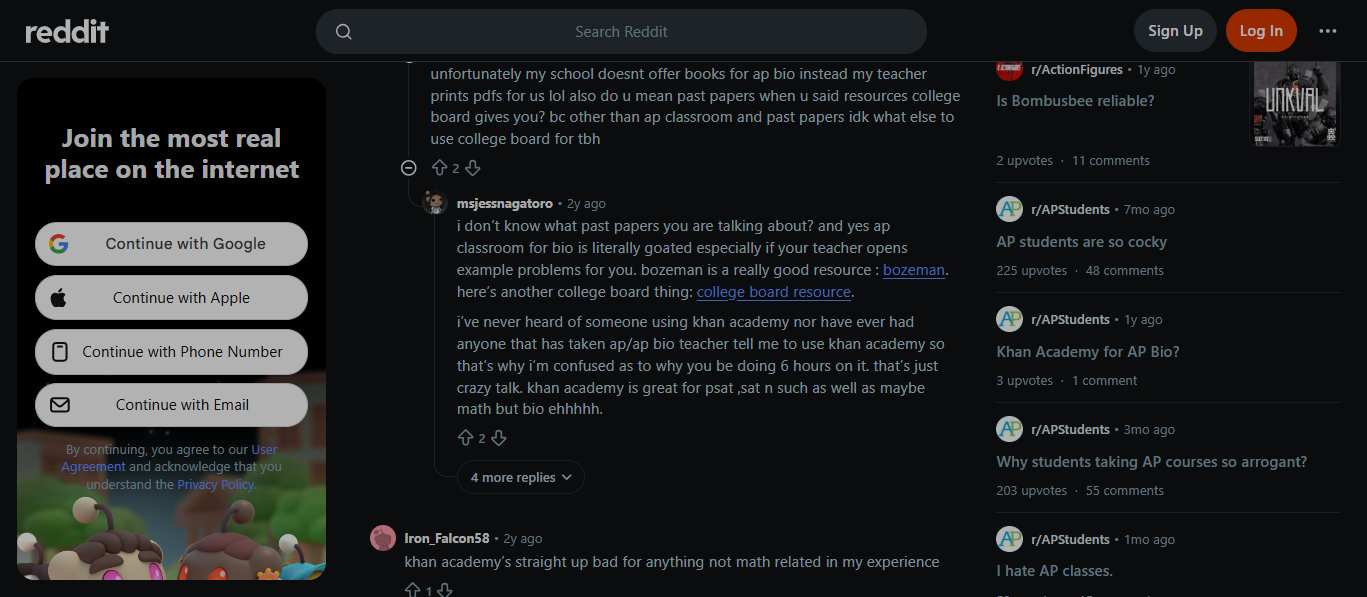
Khan Academy is a free learning platform best suited for students, teachers, and institutes seeking accessible AP content, guided practice, and independent learning support across multiple AP subjects and exam preparation needs.
For institutes, it provides ready-to-assign AP lessons, exercises, quizzes, and unit tests, with teachers benefiting most from its classroom-ready content and structured practice resources.
Its biggest differentiator is cost: Khan Academy delivers substantial AP-aligned learning content free iInstitutes looking for a deeper assessment workflow will soon turn to EdisonOS’s.
Key Features
- Free AP-aligned content removes the paid-content barrier, making supplemental learning easier to offer across larger cohorts.
- Unit tests and quizzes provide built-in practice - more around full assessment workflows than broad instructional content.
- Current College Board CED alignment reduces curriculum-mapping work
Pros
- Free access makes Khan Academy unusually cost-effective for institutes serving many students with limited supplemental learning budgets.
- Broad AP content supports independent study between sessions without requiring instructors to create every lesson or practice activity.
- College Board-aligned course structures help teachers connect assignments with AP expectations without extensive curriculum adaptation or additional planning.
Cons
- It lacks a full digital AP exam replication, limiting its usefulness when institutes need realistic exam-environment practice.
- Teacher-facing analytics are less comprehensive. Assessment-focused reporting is limited, reducing visibility into detailed cohort performance and individual skill gaps.
Pricing
Khan Academy’s core learning platform is 100% free for students, teachers, and families. For U.S. schools and districts, Enterprise Starter costs $10 per student annually for 1,000 or fewer licenses. Enterprise pricing for more than 1,000 licenses is quote-based.
3. Albert.io: Best for Question-Bank Depth
Albert.io is an AP test-preparation platform best suited to institutes that need extensive practice material, rigorous questions, and detailed explanations across a broad range of AP subjects.
For institutes, Albert provides teacher-controlled assignments, assessments, reporting, and question banks, making it particularly useful for instructors managing structured AP practice across multiple students.
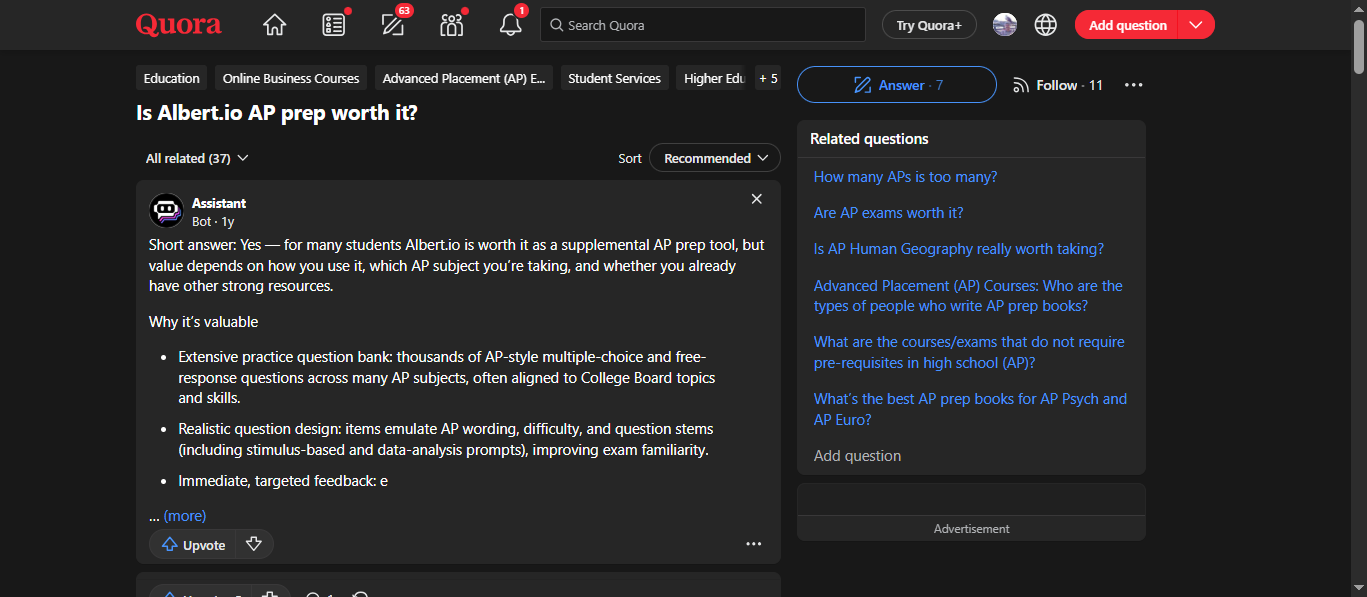
Its biggest differentiator is the sheer depth of its AP question bank: It claims a collection of about 40,000 practice questions.
Key Features
- Extensive question depth supports repeated, targeted practice where assessment-focused platforms offer less breadth.
- Narrative explanations help students understand mistakes rather than simply reviewing scores after completing assessments.
- Full-length exams and unit assessments provide ready-to-use practice, reducing the need to build every assessment from scratch.
- Instructors can select questions and create targeted assignments, giving greater content flexibility beyond fixed exam simulations.
- Reports drill into students, assignments, questions, and standards, offering instructional insights beyond basic assessment-level performance data.
Pros
- Extensive AP practice libraries available, giving institutes enough material for sustained year-round preparation.
- Hand-curated questions and explanations are reviewed by subject experts, supporting rigorous and consistently aligned AP practice.
- Teachers retain substantial control over assignments, question selection, and targeted practice for different student needs.
Cons
- Its primary strength is question-bank depth, rather than replicating the complete digital AP testing environment students encounter.
- Premium AP question banks require paid licenses, making Albert less suitable for institutes seeking completely free AP preparation resources.
Pricing
For individual students, AP access costs $79 per subject and includes practice questions, full-length exams and unit assessments for supported courses, free-response prompts, and detailed explanations.
For tutors, licenses start at $750+; homeschooler licenses start at $300+. Albert also offers school and district licensing, with pricing varying by implementation and volume.
4. UWorld: Best for Detailed Answer Explanations

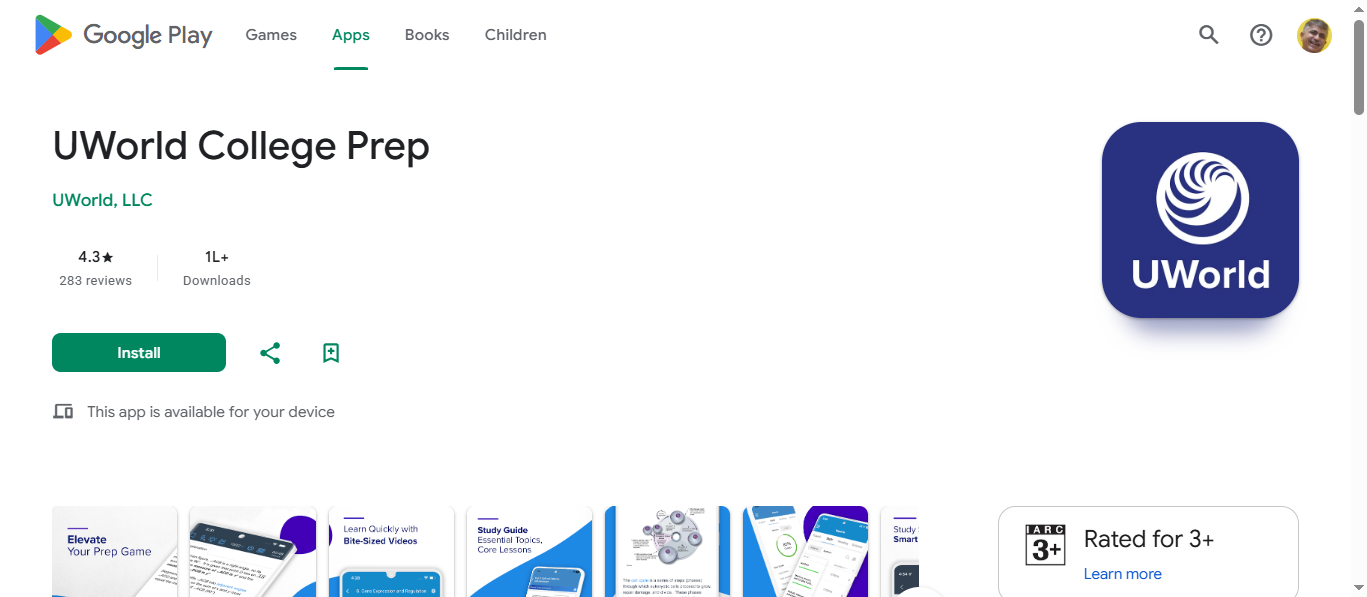
UWorld is an AP preparation platform best suited to students and tutors seeking rigorous practice questions, detailed explanations, and structured review across major AP subjects throughout the school year and during exam season.
For tutors, it combines question banks, customizable practice, progress tracking, videos, and study resources, supporting reinforcement between lessons and targeted exam preparation. Its biggest differentiator is explanation depth: UWorld emphasizes step-by-step reasoning and visual learning, making it useful for concept reinforcement but less compelling as an end-to-end tutoring platform
Key Features
- Detailed answer explanations help students understand why answers are right or wrong, addressing limited feedback in basic practice resources.
- Custom practice tests let students target topics and weak areas, offering more flexibility than fixed practice sets and assessment sequences.
- Visual explanations and worked solutions simplify difficult concepts, particularly useful for STEM students needing more than answer keys.
- Progress dashboards show performance by topic, helping students identify gaps, although the emphasis remains on study rather than tutor workflows.
- Video lessons and study guides combine instruction with practice, giving students a more complete review experience than a question bank.
Pros
- Strong explanations encourage students to learn from mistakes instead of simply checking whether an answer was correct.
- High-quality visuals and worked solutions are particularly useful for AP STEM subjects where application and reasoning matter.
- Custom quizzes and progress tracking let students focus practice on specific topics instead of following only fixed assessments.
Cons
- The platform remains primarily centered on student preparation, so independent tutors may need additional tools for broader program management.
- Custom practice is available, but it is built around UWorld’s question bank rather than fully customizable tutor-created assessment content.
Pricing
UWorld’s AP pricing varies by subject and package. Current AP question-bank offerings generally start at $39, while complete review courses start at $99; longer-duration plans cost more. For example, AP English Language currently ranges from $99 for 30 days to $169 for 360 days, while AP Calculus AB question-bank access ranges from $39 for 30 days to $69 for 360 days.
UWorld also offers a 7-day free trial for its AP products.
5. Princeton Review AP Courses: Best for Students Who Want Live Instruction
The Princeton Review is an AP test-preparation provider offering live courses, one-on-one tutoring, self-paced programs, and practice materials, making it better suited to students seeking structured instruction than independent tutoring institutes.
For institutes, its value lies mainly in the breadth of ready-made instructional and preparation resources. Its biggest differentiator is its instructor-led preparation model, with live classes, subject specialists, targeted drills, and test-taking strategies. That makes it a provider of AP preparation rather than a flexible technology platform for running tutoring operations.
Key Features
- LiveOnline AP courses provide instructor-led preparation, giving students structured teaching that self-directed practice platforms cannot offer.
- One-on-one AP tutoring provides personalized instruction, but the model is built around Princeton Review tutors rather than supporting an institute’s own instructors.
- Full-length practice tests and score reports help students measure readiness, although they remain part of a broader prep program.
- Targeted drills focus on key concepts and question types, supporting focused revision rather than giving tutors complete assessment-building flexibility.
- Self-paced AP programs allow students to study independently, but customization remains within Princeton Review’s predefined preparation structure.
Pros
- Live instruction gives students direct access to AP subject specialists and structured guidance throughout their preparation.
- Practice tests, drills, and strategy instruction combine several preparation resources within a single student-focused program.
- One-on-one tutoring provides personalized support for students who need more guidance than self-paced preparation offers.
Cons
- Its programs are designed primarily for students purchasing Princeton Review preparation, rather than tutors running their own digital classrooms or looking for white-label solutions
- The high cost of instructor-led options can make it impractical as the underlying technology for an independent tutoring business.
Pricing
Princeton Review currently lists AP Self-Paced at $299, AP Cram Course at $499, and the AP 4 Course at $1,299. Its AP 5 Tutoring costs $250/hour, with 24 hours included in the listed package.
Factors to Consider When Choosing an AP Classroom Alternative
Pricing Predictability at Scale
Evaluate how costs change as your institute adds students, branches, instructors, or testing volume. That’s because unpredictable pricing can quickly affect margins.
Setup and Adoption
A platform should be easy to set up and use. That would minimize training requirements and help instructors adopt it without disrupting existing teaching routines - basically a huge time-saver.
Integrations and Workflow Fit
Look for integrations, customization, and compatibility with your existing workflows. Without that, your institute would be forced to make too many changes, leading to wastage of resources.
Reporting and Visibility
Stronger reporting gives operators clearer visibility into student performance. It also helps them make better decisions and measure whether the platform delivers results and clear ROI.
Support and Long-Term Scalability
Responsive support and scalable infrastructure become increasingly important as institutes grow. Eventually it helps ensure the platform continues meeting operational and instructional goals over time, and becomes and remains successful.
Why EdisonOS Is a Strong Alternative to AP Classroom
EdisonOS AP test-prep software for tutors is best suited for AP tutors, tutoring centers, and schools that need greater control over testing, assessment, and student performance.
Unlike content-first platforms, EdisonOS brings
- realistic digital exam delivery,
- custom assessments,
- AP-aligned scoring, and
- tutor-focused analytics in one system
For independent tutors, EdisonOS outperforms AP Classroom by
- providing standardized score scaling,
- proctoring controls,
- detailed reporting, and
- organization-level management without relying on school access
It is particularly well suited to multi-student AP programs, tutoring centers, and institutes running structured exam-preparation programs. No matter what stage of growth your tutoring business is in, EdisonOS fits in and stays with you over the growth arc.
Conclusion: The Right Platform Depends on What You're Building
AP Classroom remains one of the most valuable AP resources available, but only if you're inside the school ecosystem. For independent tutors and tutoring centers, the challenge isn't finding great AP content but finding a platform that gives you ownership over the entire preparation process.
If your goal is simply assigning practice questions, platforms like Khan Academy, Albert.io, and UWorld can be excellent additions to your toolkit. But if you need to create assessments, replicate the digital AP testing experience, track student progress, and report outcomes to parents, you'll need a solution built specifically for tutors.
That's what makes EdisonOS stand out. It combines exam simulation, test creation, scoring, and analytics into a single platform, helping tutors spend less time managing workflows and more time helping students improve.
Want to try and see it for yourself at no cost? Sign up for a free trial and build your first AP practice test in a matter of minutes!
FAQ: AP Classroom Alternatives for Tutors
Can private tutors access AP Classroom?
No. AP Classroom is restricted to teachers at College Board-registered schools with active AP class rosters. Independent tutors, tutoring centers, and educational consultants typically cannot access the platform directly. While some tutors work with partner schools, it's not a practical or scalable solution for running a private tutoring business.
What do AP tutors use instead of AP Classroom?
Most AP tutors use a combination of platforms. EdisonOS is commonly used for digital exam simulation, assessment creation, and analytics, while Khan Academy supports content review. Many tutors also use question banks like UWorld and Albert.io for additional practice and homework assignments.
What are the top AP Classroom Alternatives alternatives?
EdisonOS is the strongest AP Classroom alternative for independent tutors and tutoring centers needing realistic digital exams, custom assessments, and analytics.
Other options include Khan Academy, Albert.io, UWorld, and Princeton Review, but they focus more on content, question banks, explanations, or instruction than complete tutor-led assessment workflows.
Which AP prep platforms support Chemistry, Physics, and Biology specifically?
EdisonOS supports AP Chemistry, AP Physics, and AP Biology with full-length digital practice tests, scoring, and analytics. UWorld and Albert.io also offer strong AP science question banks with detailed explanations. Khan Academy provides extensive instructional content but does not offer a full-length digital AP exam simulation.
How do AP tutors create custom practice tests?
Many tutors use EdisonOS's BYOT (Build Your Own Test) feature to create custom AP practice tests in as little as 15 minutes. Tutors can build tests from a large question library or upload existing PDFs for automatic question extraction. Most traditional AP study platforms do not offer the same level of tutor-focused test creation.
Is AP Classroom free?
Yes. AP Classroom is free for AP teachers at College Board-registered schools. However, it is not available as a standalone subscription for private tutors, tutoring centers, or independent educational consultants.
Is EdisonOS suitable for multi-branch institutes?
Yes. EdisonOS is designed to support tutoring businesses with multiple academies, locations, programs, tutors, and student groups from one account.
Each academy can maintain separate rosters, content, admins, tutors, and enrollments, while detailed reports provide visibility into student performance and progress. It also provides strong support for growth-driven activities.