- AP Classroom is College Board's official platform for AP resources, assignments, practice, assessments, and student progress tracking. Pasted markdown
- Full teacher access requires AP Course Audit authorization, which means independent tutors may not have access to the complete teacher dashboard. Pasted markdown
- Tutors can still use student-shared Progress Check results, AP Daily videos, and other accessible resources to inform tutoring sessions. Pasted markdown
- AP Classroom works best as the official source of AP practice, while additional practice and tutor-controlled analytics can fill gaps in an independent tutoring workflow. Pasted markdown
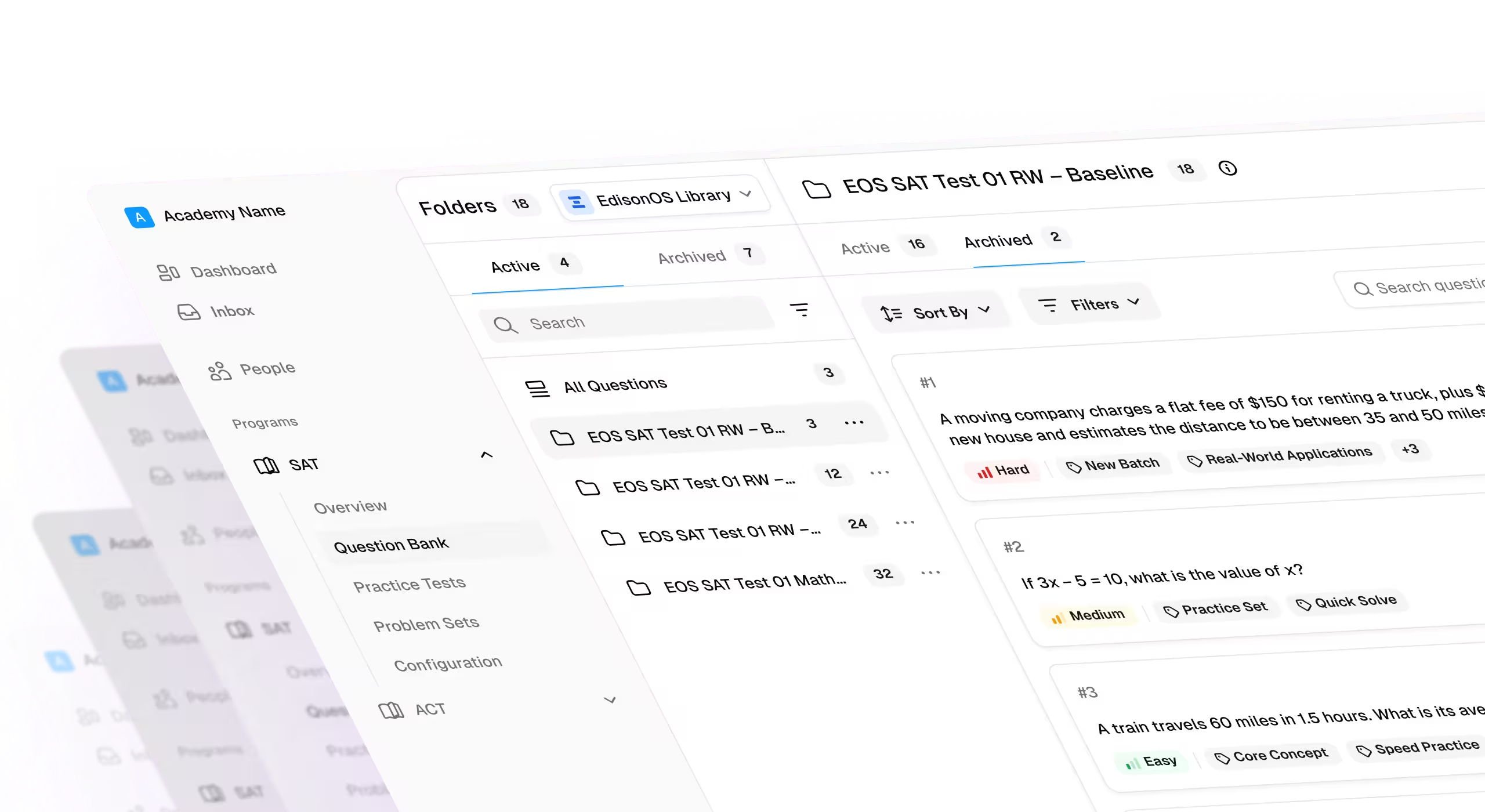
- EdisonOS gives independent tutors a separate environment for additional AP-aligned practice, student analytics, assignments, and progress tracking.
If you tutor AP students independently, you have probably encountered AP Classroom without having full access to it yourself. That can make it difficult to understand what your student is being assigned, what their results mean, and where your tutoring fits in.
AP Classroom is College Board's official digital platform for AP course resources, assignments, practice, and progress tracking. It is closely connected to the AP course and exam framework, including digital assessment experiences that prepare students for Bluebook.
The important distinction for private tutors is that AP Classroom was designed around the school classroom. Teachers with approved AP Course Audit access get the full set of instructional and reporting tools, while independent tutors may have to work through what the student can access or share.
This guide explains how to use AP Classroom effectively from a tutor's perspective, where its access model creates gaps, and how to build a complementary workflow around it.
What Is AP Classroom? And Why Tutors Need to Understand It
AP Classroom is College Board's online platform for AP courses. It provides course resources, topic questions, Progress Checks, practice exams, AP videos, a Question Bank, Bluebook-style assessments, and reports for teachers.
It serves two purposes at once: instructional support for AP teachers and authentic practice for AP students. That makes it particularly useful to tutors because the material is closely connected to what students are expected to know and do on the AP Exam.
In 2024, more than 1.2 million U.S. students took at least one AP Exam, making familiarity with the AP Classroom ecosystem increasingly relevant for tutors working with AP students.
AP Classroom was launched in 2019 and is used across the AP program. The content brief for this guide identifies it as covering all 42 AP subjects, with approximately 100–200 practice questions per course.
For a tutor, though, understanding the platform is only half the job. The other half is understanding who controls what.
The 5 Core Features of AP Classroom
College Board currently describes AP Classroom as including Progress Checks, Topic Questions, Practice Exams, AP Videos, Bluebook-style assessments, a Question Bank, and detailed reports.
Can Private Tutors Actually Access AP Classroom?
This is the biggest practical issue for independent tutors: AP Classroom is built around the AP classroom teacher, not the private tutor. Full teacher access is tied to AP Course Audit authorization, so an independent tutor generally cannot create a teacher account simply because they tutor AP students.
That creates a very specific workflow problem. Your student may be using AP Classroom every week, but you may not have your own dashboard, assignment controls, or direct access to the student's performance data. In practice, you often have to work through what the student can show you or coordinate with their AP teacher.
To access AP Classroom as a teacher, College Board requires an account and an approved AP Course Audit form. Teachers of previously authorized courses retain access when the course is renewed for the current school year.
That means an independent tutor cannot simply sign up for a teacher account because they tutor AP students. Full teacher access is connected to an authorized AP teaching role and the Course Audit process.
Your student, however, can access AP Classroom through their College Board account. Students join an AP class section using a join code supplied by their AP teacher or, for an exam-only section, their AP coordinator.
So the practical approach for an independent tutor is not to try to replicate the student's school account. It is to work with the information the student can legitimately access and share.
What Tutors Can and Cannot Access: A Quick Reference
AP Daily videos are visible to students, including students in exam-only sections. Topic Questions and Progress Checks are part of the teacher-assigned workflow.
The distinction matters because AP Classroom access is not the same thing as AP Classroom ownership. A student may have access to resources that an independent tutor cannot directly administer or monitor.
How to Use AP Classroom Data in Your Tutoring Sessions
If you do not have a teacher dashboard, you can still make AP Classroom useful.
The simplest workflow is to ask the student to bring their latest results into the tutoring session. Rather than spending the first 15 minutes asking how a unit went, use the available data to decide where that time should go.
The 5-Minute AP Classroom Session Opener
You don't need a full teacher dashboard to turn AP Classroom into useful tutoring data. Ask your student to open their latest Progress Check results at the beginning of the session and work through this sequence:
1. Look beyond the overall score. Identify the individual skills or topics where the student missed questions.
2. Look for patterns. One wrong answer may be noise. Repeated misses across related skills are more useful.
3. Ask the student to explain one missed question. This helps distinguish a knowledge gap from a careless error or misread.
4. Map the weakness to the session. Choose the concept, strategy, or question type you'll work on.
5. Give fresh practice. Don't simply repeat the same AP Classroom questions. Test whether the student can apply the skill to a new problem.
The goal is simply to turn AP Classroom's data into a tutoring decision within five minutes.
Step 1: Review PPC Results Before Each Session
Ask the student to open their most recent Personal Progress Check results before you start teaching.
Do not focus only on the overall percentage.
Look for:
- Which units or skills produced repeated errors
- Whether misses are concentrated in one skill category
- Whether the same weakness appears across multiple assignments
- Whether the student understands the concept but struggles to apply it
- Whether the problem appears to be content knowledge, interpretation, pacing, or response strategy
Progress Checks are designed as formative assessments. College Board describes them as tools for identifying content and skill gaps that can be addressed through further instruction and practice.
Your goal is not to turn the PPC into a grade. It is to turn it into a lesson-planning signal.
Step 2: Map AP Classroom Weaknesses to Practice Material
Once you identify a weak skill, map it directly to the next tutoring activity.
For example:
Student result: Difficulty interpreting evidence in AP English Language.
Tutor response: Spend 15 minutes reviewing the relevant skill, then assign several targeted questions requiring the same reasoning.
Or:
Student result: Repeated errors with equilibrium calculations in AP Chemistry.
Tutor response: Diagnose whether the issue is the underlying concept, mathematical setup, or interpretation of the question before assigning more practice.
This is where AP Classroom's authentic content becomes particularly useful. The Question Bank is searchable by course content and skills, allowing authorized teachers to create targeted assessments.
For an independent tutor, however, that creates an obvious limitation: you may know exactly what practice you need without having your own question-bank workflow.
That is where a supplemental tutor-controlled platform can help.
Step 3: Use AP Daily Videos as Between-Session Homework
AP Daily videos are short, course-specific videos designed to reinforce AP content and skills. Students can access them through AP Classroom, and College Board describes them as resources for instruction, homework, additional practice, or review.
Instead of assigning "watch some AP videos," make the homework specific.
For example:
"Watch the AP Daily video for Topic 3.4 before our next session. Then write down one concept you still cannot explain."
This gives you a concrete starting point for the next session.
AP Classroom Limitations Every Tutor Should Know
AP Classroom is valuable, but it was not designed as a complete operating system for independent tutoring.
That distinction is important.
1. The Tutor Access Problem
The biggest limitation for independent tutors is structural. Full teacher functionality is tied to the AP Course Audit and authorized teaching access.
If you are tutoring a student who already has an AP teacher, your workflow may depend on information the student can share with you rather than a dashboard you control.
2. Practice Volume Is Finite
The brief's research identifies approximately 100–200 practice questions per AP course.
That makes AP Classroom extremely valuable for authentic College Board practice, but it also changes how you should use it as a tutor. You don't want students burning through the most relevant official questions simply for repetition.
A better workflow is:
Use AP Classroom for authenticity → diagnose the skill → use additional practice for repetition → return to official material to validate readiness.
This preserves the value of official questions while giving students enough repetition to actually improve.
3. AP Classroom Results Are Formative, Not Grades
Personal Progress Checks and Topic Questions are intended to reveal understanding and identify areas for additional instruction. They should not be treated as formal course grades.
For tutors, that distinction is useful. A 72% PPC result does not automatically mean "the student has mastered 72% of the material."
Look at which skills produced the errors and what kind of errors they were.
4. Students May Encounter Answer-Sharing Problems
A student's AP Classroom result is only useful as a diagnostic signal if the student completed the work independently.
If answers or explanations are available elsewhere online, a surprisingly high score can sometimes create a false impression of mastery. The tutor's job is to validate the result through follow-up questions and fresh practice.
Ask:
"Show me how you arrived at this answer."
If the student can explain the reasoning, the result carries more weight. If they cannot, treat the score cautiously.
5. Secure Practice Exams Have Additional Restrictions
College Board provides secure AP Practice Exams to authorized teachers, and these materials have specific security and distribution requirements. They are not simply resources to download and distribute as take-home worksheets.
For tutors, this is an important distinction.
Do not build your independent tutoring workflow around distributing secure College Board practice exams outside the permitted conditions. Use the resources according to College Board's access and copyright requirements.
6. LockDown Browser Is a Separate Consideration
College Board says Respondus LockDown Browser is not required for the actual digital AP Exam, but it can be used to administer secure practice assessments assigned through AP Classroom.
That distinction matters if you are running practice exams independently.
If you need to replicate secure testing conditions in your own tutoring environment, check the specific device and administration requirements rather than assuming the student's normal browser setup will work.
How to Supplement AP Classroom as a Tutor
AP Classroom and a tutor-controlled platform serve different purposes.
AP Classroom gives you the official College Board environment. EdisonOS gives you the layer you control.
For an independent tutor, that distinction matters. EdisonOS gives tutors their own analytics dashboard without requiring school affiliation, alongside AP-aligned mock testing, skill-level performance breakdowns, independent assignment, session tracking, and cohort-level visibility.
That means you can keep using AP Classroom for authentic College Board resources while handling the parts of your tutoring workflow that AP Classroom was not designed to manage.
A useful supplement should give you:
- Your own student dashboard
- Skill-level performance data
- Additional practice beyond the official question pool
- AP-aligned mock testing
- The ability to assign practice independently
- Progress tracking across multiple sessions
- No dependency on your student's school teacher for basic tutor workflow
AP Classroom vs. EdisonOS for Private Tutors
EdisonOS provides 8,000+ expert-crafted questions, including problem sets, supports 10+ programs and exams, and includes 15 SAT, 10 ACT, 4 PSAT, and 2 SHSAT full-length tests, plus hundreds of problem sets.
For AP tutors, the important point is not that EdisonOS replaces AP Classroom. It doesn't.
It gives tutors a separate environment they can control for additional AP preparation and student analytics.
Frequently Asked Questions