- Start with a diagnostic test to understand each student’s strengths and weaknesses before planning lessons.
- Look beyond the overall score to identify the specific skills, question types, or content areas causing trouble.
- Separate content gaps from pacing and test-taking strategy issues. They may look similar in a score report, but they need different solutions.
- Use timing and question-level performance to understand where students hesitate, rush, or spend too long on a problem.
- Turn assessment results into targeted practice, then use later tests to check whether the approach is working.
A practice test can tell you how a student performed. The more important question is why they performed that way, and what your tutoring team should do next.
For tutoring centers, that’s where practice test data becomes valuable. Instead of relying on an overall score or a tutor’s first impression, you can use a student’s performance to identify the exact skills that need attention, understand what is slowing them down, and build a study plan around their actual needs.
This idea comes through clearly in John Brown’s conversation on The Knowledge Entrepreneurs Show, where the PrepTopia Test Prep founder discusses how he uses diagnostic testing to understand students’ content knowledge, skills, and timing before deciding what they should work on.
For tutoring centers preparing students for the SAT, ACT, or other standardized exams, the goal isn’t simply to administer more practice tests. It’s to make every test useful enough to inform the next lesson.
1. Start With a Diagnostic Test, Not Assumptions
When a new student joins your tutoring center, it can be tempting to start with the topics they say they struggle with or the areas that seem weakest during the first session. That information matters, but it doesn’t always give you the full picture.
A diagnostic test gives you a starting point. It helps you see what the student can already do, where their understanding breaks down, and which areas deserve attention first.
For example, two students might have similar SAT scores but need completely different study plans. One might struggle with algebra and advanced math concepts. The other might understand the material but lose points because they misread questions or spend too much time on difficult problems.
Giving both students the same sequence of lessons would overlook those differences.
A diagnostic assessment helps tutors make a more informed decision before committing to a study plan. It also gives you a baseline to compare against future practice tests.
If you need an assessment workflow for your center, EdisonOS diagnostic tests can help identify student learning gaps and provide performance information to guide instruction.
The key is to treat the first test as a source of information, not a final judgment of a student’s ability.
2. Look Beyond the Overall Score to Find the Real Problem
An overall score is useful, but it doesn’t tell you everything you need to know as a tutor.
If a student’s score isn’t where they want it to be, you need to dig deeper. Which questions did they miss? Were the errors concentrated in one skill area? Did they struggle with a particular question format? Were they getting easier questions wrong despite handling harder ones correctly?
These details can point you toward the next step.
For example, a student preparing for the ACT might perform well on most English questions but repeatedly miss punctuation or sentence-structure questions. Another student might have a broader understanding of the material but make inconsistent errors across several question types.
The first student may benefit from focused practice on a small set of skills. The second may need a closer look at how they approach questions and review their answers.
John Brown’s approach reinforces the importance of identifying the underlying issue before deciding what to teach. As he explains in the episode, “Your job is to figure out what they are, and then those decisions happen much faster.”
That principle applies directly to practice test analysis. Once you understand what is causing the problem, it becomes easier to choose the right lesson, exercise, or strategy.
For tutoring centers, the practical takeaway is simple: don’t stop at recording the score. Look for patterns that explain it.
3. Separate Content Gaps From Pacing Problems
One of the most useful things practice test data can reveal is whether a student needs to learn the material or learn how to work through it more efficiently.
These are two different problems, even when they lead to the same result: unanswered questions or lost points.
A content gap means the student doesn’t fully understand a concept or skill. They may need a tutor to explain the idea, demonstrate worked examples, or provide guided practice.
A pacing or strategy issue means the student may understand the material but struggle to apply that knowledge efficiently under test conditions. They might spend too long on a question, hesitate between answer choices, or use an inefficient approach.
Brown describes a student who was strong in ACT English but took roughly 75 minutes to complete a section designed for 45 minutes. The problem wasn’t simply that the student lacked English knowledge. He was hesitating and taking too long to make decisions. After working on the patterns behind the questions, the student became much faster over the following weeks.
That example highlights why timing matters. If a tutor only looks at the number of correct answers, they might miss the real obstacle.
Consider a student who answers grammar questions accurately during untimed homework but struggles to finish the section during a timed test. Giving that student more grammar explanations may not address the main issue. They may need to recognize recurring question patterns, make decisions more efficiently, and practice moving on when a question takes too long.
On the other hand, a student who answers incorrectly even with plenty of time may need more direct instruction.
The distinction helps tutors choose the right intervention rather than assigning more work by default.
4. Use Timing Data to Understand How Students Approach Questions
Time spent on a question can tell you more than whether a student finished the test.
A student might answer correctly after spending too long on a question. Another might answer incorrectly after rushing through it. Both outcomes matter, but they suggest different next steps.
When reviewing practice test data, look for questions where students:
- Spend significantly longer than expected.
- Answer quickly but incorrectly.
- Leave questions unanswered.
- Change answers after initially selecting a response.
- Get stuck on one question and have less time for the rest of the section.
These patterns can help tutors start a more useful conversation with students. Instead of saying, “You need to work faster,” ask what happened on a specific question. Did they not know how to solve it? Did they recognize the concept but struggle to choose a method? Were they second-guessing an answer they already understood?
Brown describes the goal as being “time aware” rather than “time dependent.” In other words, students should understand how they’re using their time without allowing the clock to dictate every decision.
That distinction matters. Speed alone isn’t the goal. Students need to know when to keep working, when to move on, and how to use their available time effectively.
For a tutoring center, timing data becomes most useful when it’s discussed alongside accuracy and the student’s reasoning. The number alone won’t explain everything, but it can show you where to investigate.
5. Identify Repeated Patterns Across Question Types and Skills
A single missed question may not mean much on its own. Repeated mistakes are more informative.
When reviewing a student’s results, group errors by the skill or concept involved. For example, an SAT student might repeatedly struggle with linear equations, while another has difficulty interpreting information from charts. An ACT student might understand a passage but struggle to identify the most efficient answer to a particular type of English question.
Looking at these patterns helps you distinguish an isolated mistake from a skill that needs more work.
It also helps prevent tutoring sessions from becoming a series of unrelated corrections. Instead of reviewing each missed question individually and moving on, tutors can identify the common skill behind several errors and teach that skill directly.
This is especially helpful when students make mistakes for different reasons. Two incorrect answers in the same section don’t necessarily indicate the same weakness. One might result from a content misunderstanding; the other might come from misreading the question or running out of time.
A useful review process asks three questions:
- What happened? Identify the question, skill, or concept where the student struggled.
- Why did it happen? Determine whether the issue was content knowledge, question interpretation, pacing, or strategy.
- What should happen next? Choose an explanation, targeted exercise, or strategy to address the issue.
Over time, this approach gives tutors a clearer picture of how students learn and where instruction can make the biggest difference.
6. Turn Practice Test Results Into Personalized Study Plans
Once you’ve identified a student’s weaknesses, the next step is to turn those findings into a plan.
The plan should reflect what the student actually needs—not simply follow the same sequence for every learner.
If a student has a content gap, the next step might be a lesson that explains the concept, worked examples, and focused practice. If the student understands the content but struggles with pacing, the plan might focus on recognizing question patterns, choosing efficient methods, and practicing under timed conditions.
For students with several areas to improve, prioritization matters. Trying to address every weakness at once can make the study plan difficult to manage. Start with the skills that are most relevant to the student’s goals and current performance, then adjust as new information comes in.
A simple plan might include:
- Skill to improve: The specific concept or question type identified in the diagnostic.
- Reason for the difficulty: What the student’s answers and timing suggest.
- Instructional response: The lesson, strategy, or targeted practice needed.
- Progress check: A follow-up exercise or assessment to see whether the student is improving.
This gives each session a clear purpose. It also makes it easier for tutors to explain why they’re assigning a particular activity rather than giving students another worksheet without context.
For centers that prepare students for the digital SAT, the EdisonOS Digital SAT platform offers practice tests and skill-level reporting that can support this type of targeted workflow.
The important part is connecting the data to an instructional decision. A report is useful only when it helps the tutor decide what to do next.
7. Track Progress Across Multiple Practice Tests
A single diagnostic gives you a baseline. Follow-up assessments help you understand whether the study plan is working.
After a student has spent time on a targeted skill, review their next results. Are they answering more questions correctly in that area? Are they completing questions more efficiently? Have the same mistakes appeared again? Has progress in one area exposed another weakness?
These comparisons help tutors decide whether to continue with the current approach or adjust it.
For example, a student might improve their accuracy on algebra questions but still take too long to complete them. That suggests the student has made progress with the content but may need more work on efficient problem-solving. Another student might become faster but start making careless mistakes, which calls for a different response.
It’s also important not to overinterpret one test. A score can fluctuate, and one result may not explain the reason for a change. Review the broader pattern and, when needed, look more closely at the questions and timing behind the score.
The purpose of follow-up testing is not simply to collect a higher score. It is to see what has changed and use that information to guide the next stage of preparation.
That makes practice tests part of an ongoing teaching process rather than a series of disconnected assessments.
8. Help Students Understand Their Own Results
Practice test analysis shouldn’t happen only between tutors and staff. Students need to understand what their results mean, too.
When students can recognize their own patterns, they become better equipped to make decisions during independent practice. They can identify which skills need more attention, notice when they are spending too long on a question, and apply strategies they have worked on with their tutor.
Brown’s philosophy of teaching independence comes through in his reminder that tutors won’t be beside students on test day:
“I'm not gonna be there when, on test day, I'm not gonna be sitting by them saying, ‘Right. Now remember what we studied.’”
The point is not to make students dependent on a tutor to interpret every result. It is to help them understand the reasoning behind their study plan and learn how to use feedback on their own.
After reviewing a practice test, ask students to explain what they noticed. Which mistakes surprised them? Which questions took longer than expected? What would they do differently next time?
These conversations help students connect practice to action. They also give tutors a chance to check whether students understand the strategy being taught—not just whether they can follow it during a lesson.
For tutoring centers, that can make the feedback process more valuable for both sides. Tutors gain insight into students’ thinking, and students become more active participants in their preparation.
9. Make Practice Test Analysis a Repeatable Workflow
For a tutoring center, the challenge is not just analyzing one student’s test. It’s making the process manageable across different students, tutors, and programs.
A repeatable workflow helps ensure that assessment results lead to useful action rather than sitting in a report that nobody revisits.
A practical workflow can follow these steps:
- Assess: Give the student an appropriate diagnostic test to establish a baseline.
- Review: Examine accuracy, skill-level performance, question types, and timing.
- Diagnose: Decide whether the main issues involve content knowledge, strategy, pacing, or a combination.
- Plan: Choose targeted lessons and practice based on the findings.
- Retest: Use follow-up assessments to check progress.
- Adjust: Continue, revise, or reprioritize the study plan based on what the new results reveal.
Having a consistent process also makes it easier for tutors to communicate with one another and explain progress to students and parents. Everyone can refer to the same evidence when discussing what has improved and what still needs attention.
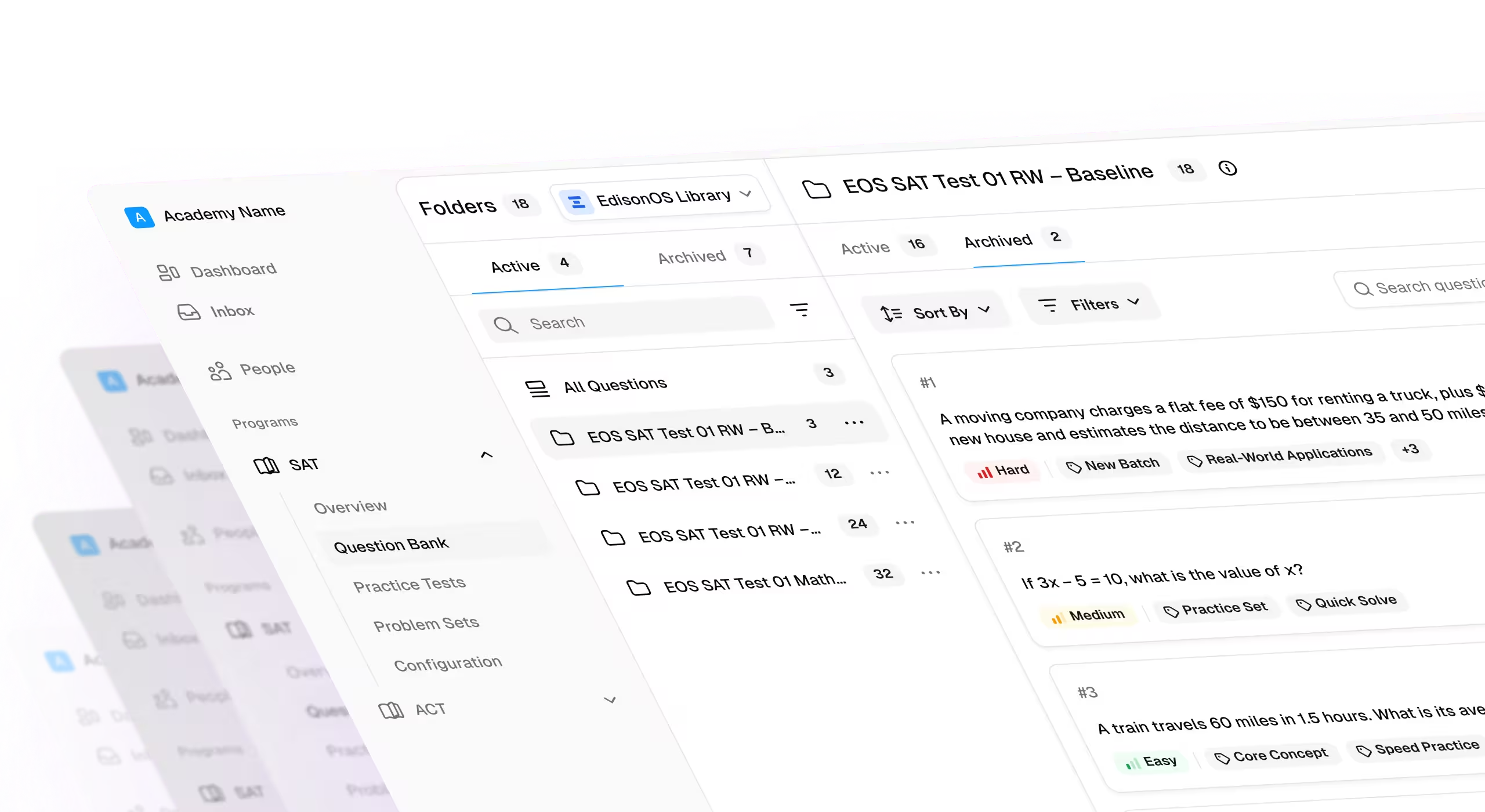
Technology can help make this workflow easier to manage. For example, EdisonOS diagnostic tests provide skill and difficulty analysis, timing insights, and answer-change tracking, while its platform for tutors brings test practice and performance reporting into a test-prep workflow.
The goal isn’t to replace a tutor’s judgment with a dashboard. It’s to give tutors better information to work with and make it easier to track the decisions that follow.
Make Every Practice Test Count
Practice test data becomes useful when it changes what happens next.
For tutoring centers, that means looking beyond scores, identifying the reasons behind student mistakes, separating content gaps from pacing problems, and building study plans around the findings. Follow-up assessments then help you understand whether those decisions are working.
John Brown’s approach offers a valuable reminder: students don’t all need the same kind of help, even when their scores look similar. The more clearly tutors can identify what is holding each student back, the more focused their instruction can become.
With a consistent review process and the right assessment tools, tutoring centers can make practice tests a meaningful part of instruction—not just another task on the student’s preparation schedule.
If you want to make diagnostic testing and student performance analysis easier to manage, explore EdisonOS for tutors and see how its test-prep tools can support your center’s workflow.