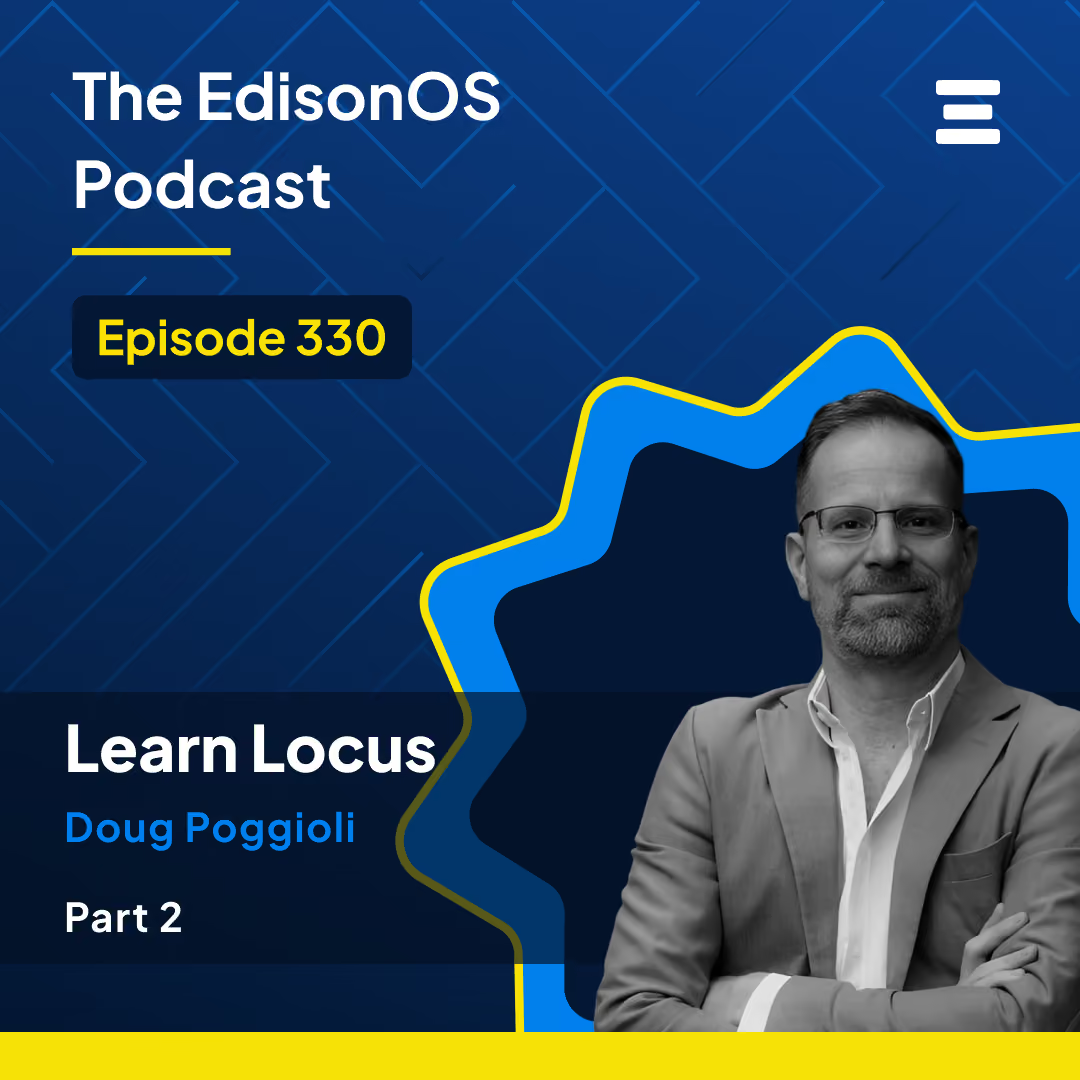
Episode 330 | Doug Poggioli | Learn Locus | Part 2 | The EdisonOS Podcast
Learn More About Doug Poggioli
Explore Doug's expertise through the following links:
- LinkedIn: Connect with Doug's professional network and experience
- Learn Locus: Discover Doug's math tutoring service offering expert one-on-one support across high school and university math, from algebra two through AP Calculus AB and BC
- Meet the Team: Explore the personally selected and trained tutors Doug has built around his philosophy of deep understanding over rote memorization
Episode Description
Key Topics Covered
AP success is about flexibility, not just knowing the material. Doug says students who do well on AP exams are adaptable, know how to extract information from a question they have never seen before, are good readers, and are not thrown off when a question is phrased differently than they expected, because the AP will always test you in unfamiliar forms.
Every AP calculus problem can be approached graphically, numerically, or algebraically. Doug explains that the AP itself communicates to teachers that students should be skilled in all three approaches, and that students who resist this and insist on doing everything one way will inevitably get stuck, while the students who ask how they would draw a picture of something or plug in numbers are the ones who solve things quickly.
Related rates require extracting every piece of given information before doing anything else. Doug says the biggest mistake students make on related rate problems is not reading the paragraph carefully enough, and that his first instruction to every student is to draw a diagram, write the word given, and explicitly write out every rate of change and every value the problem tells them before touching the algebra.
The hardest topic in AP Calculus AB is optimization, followed closely by fundamental theorem part two. Doug identifies the optimization chapter as the most complex because every problem is large, requires a variety of pre-calc skills, and demands that students think about details like asymptotes and limited domains, and he says fundamental theorem part two is something he ends up re-explaining a dozen times to every student throughout the year.
Poor pre-calc skills, not poor calculus skills, are why most students struggle. Doug says that in the majority of cases when a student is struggling with calculus, the root cause is that they cannot solve equations, graph functions, simplify expressions, or work with logarithms and trig with confidence, and that students who have a weak pre-calc foundation and sign up for BC are setting themselves up for a nightmare.
Take the course you can get a five in, not the one that looks impressive. Doug says someone told him this and he thinks it is exactly right: if a student takes BC knowing it will be a struggle and ends up with a low AP score, they have just shown universities what they cannot do rather than what they can, and his recommendation is to only take BC if pre-calc skills are sharp and ideally came from an honors course.
A tutor can find your weak spot and fix it, but cannot replace your own time with the material. Doug is direct with parents that he can identify exactly what a student is missing, give them the right problems to fix it, and critique their notation line by line, but that retention cannot be outsourced and a student who is looking for a tutor to fix everything in two sessions before a test will almost always be disappointed.
The best summer preparation for calculus is simply doing a summer packet. Doug says any good math teacher or math department can provide one, that he gives one to every student he works with over the summer, and that hitting the ground running in the first quarter makes a real difference because the course moves fast and does not stop to wait.
Conclusion
This conversation is a detailed and honest look at what AP Calculus actually requires from a tutor who has spent years watching students succeed and struggle up close. Listen to the full episode for the complete methodology and actionable strategies that could transform how any student approaches AP Calculus AB or BC, placement decisions, and the study habits that build the kind of flexibility the exam is actually designed to reward.
Not sure where to start? Let's figure it out together.