- Teach students to read for evidence, not just understanding: The digital PSAT Reading and Writing section uses short passages paired with individual questions, so students need to identify the exact information that supports an answer.
- Build speed through question-specific strategies: Teach students how to approach words in context, central ideas, command of evidence, cross-text connections, transitions, and rhetorical synthesis.
- Use practice data to guide instruction: Track accuracy, pacing, question types, and recurring mistakes to identify exactly where each student needs support.
Students try to gather as many PSAT Reading tips as they can, because the Reading and Writing section is worth half the total score of the PSAT. The section is text-heavy, so without the right PSAT reading comprehension techniques, students are quite likely to experience fatigue.
Besides, there is the time-pressure that’s omnipresent in such tests.
All this means that students will need three things to do well in the PSAT Reading section: Strategies that leverage the student’s strengths, practice material that’s relevant, and structured tutoring that’s focused on the result.
In this article, we look at the most important PSAT reading section tips for tutors. Along with that, we’ll examine the challenges tutors face while helping their students for this section and how the right tools can make a huge positive change to that. But first, we’ll quickly summarize everything you need to know as PSAT tutors and how the PSAT reading differs from regular classroom reading.
What tutors should know about the PSAT Reading section
The PSAT Reading section is now part of the combined Reading and Writing section. Students do not take a separate Reading section. The digital PSAT/NMSQT Reading and Writing section contains 54 questions across two 32-minute modules, for a total of 64 minutes. The test is adaptive, meaning a student's performance in the first module helps determine the difficulty of the second module. SAT Suite
Each question is paired with a short passage rather than a long reading passage followed by several questions. Questions test four content domains:
- Craft and Structure
- Information and Ideas
- Standard English Conventions
- Expression of Ideas
For tutors, this means PSAT Reading preparation should focus on short-passage analysis, evidence-based reasoning, vocabulary in context, and efficient decision-making, rather than simply assigning long reading passages
How PSAT Reading differs from standard classroom reading
Classroom reading often rewards deeper interpretation, discussion, and consideration of multiple perspectives. PSAT Reading and Writing questions require students to make a specific, evidence-based decision under strict time limits.
A student may understand a passage but still miss a question because they:
- Choose an answer that sounds reasonable but is not supported by the text.
- Overinterpret a detail.
- Spend too long reading before identifying what the question asks.
- Confuse the author's purpose with the passage's main idea.
- Select a vocabulary answer based on its common meaning rather than its meaning in context.
- Miss the relationship between two short texts.
Tutors should therefore teach students to ask:
“What does the text actually support?”
That question helps students move away from personal interpretation and toward evidence-based reasoning.
Types of questions for PSAT Reading
The PSAT tests Craft and Structure, Information and Ideas, Standard English Conventions, and Expression of Ideas. When students ask how to prepare for PSAT reading, Edison’s free practice PSAT is a great way to train them on relevant question types.
Let’s explore the most common ones.
1. Filling the blank contextual
The most common phrase students will see on the question is ‘Which choice completes the text with the most logical and precise word or phrase?’
Sometimes, two choices are close in meaning, like the choices ‘compromises’ and ‘hinders’ in the adjoining screenshot. At that point, it’s best to ask ‘Should I be looking for a negative word (like ‘hinders’) or a positive word (like ‘enhances’)?’

2. Finding the best support
Some passages take a clear stand on a given topic. For instance, an author might be arguing that leadership is a learned and acquired skill rather than something you’re born with. The question asks the test-taker to select an option that best supports the author’s point of view.
The adjoining image is a great example for such questions.

3. Conventions of Standard written English
English conventions evolve over time. So what was correct decades ago may now be outdated (thought not incorrect). Since this is an American exam, ensure students understand American English rules.
Some questions follow routine grammar rules, while others need a nuanced approach where strong tutoring and quality prep material matter most.

4. Correlating two pieces of text
It’d be safe to say that these questions are unique to the section of PSAT reading. Tutoring strategies need to be really specific for answering these questions.
The sample question shows two texts: Text 1 challenges a traditional theory, while Text 2 mentions experts suggesting additional observation methods. The question asks how they relate to each other.

17 PSAT Reading tips tutors should teach for maximum results
To help tutors support students with high-impact PSAT Reading prep, here are over 17 practical strategies to integrate into sessions.
1. Encourage active reading, with notes
Teach students to engage with the text by questioning the author’s choices, tone, and purpose. Encourage them to note key phrases and consider why the author chose specific wording and how contextual usages matter.
Example: In his short story Sometimes They Come Back, the famous writer Stephen King writes… “Period six was a grammar course, dry as chalkdust.” This is significant, because the protagonist was a teacher, so chalkdust was a relevant and interesting usage. A chef would have described a dull, uninteresting movie as “...bland as unseasoned tofu.”
2. Teach avoiding personal biases
Your PSAT reading tutoring strategies must help answer questions based only on the passage, not their own beliefs or outside knowledge. This keeps responses aligned with test logic. As an example, the minimum driving age, without supervision, in the US is 16 or 17 (depending on the state). However, other countries may have a higher limit, typically for specialized vehicles.
Example: If a passage says a controversial law reduced crime, the answer must reflect that claim, even if the student disagrees in real life.
3. Help identify direct and implied stand
Just when your students start reading practice material and figuring out their own ways on how to prepare for PSAT reading, explain to them what’s clearly stated and what’s implied.
Show students how to spot the author’s explicit stance (direct) and the subtle hints that reveal underlying opinions (implied).
Example: “I oppose the policy” is a clear and direct stand. Contrast it with this “The policy, though well-intentioned, failed to address the core issue” hints at disapproval without stating it outright. This is an implied stand.
4. Aim for a strong performance in the 1st module
In the adaptive PSAT, the second module’s difficulty as well as the student’s
scoring potential depends on the first module’s performance. Doing well early unlocks a more challenging second module. Understanding how PSAT scoring works is vital.
But that is actually good, and here’s why: Once the student gets a difficult 2nd module, their minimum overall score will always be higher than the maximum overall score if the 2nd module had been easier.
Teach students to focus on aiming for more accuracy and speed in the first module.
Example: A student who answers 80% correctly in Module 1 might face harder passages in Module 2, but those questions carry more scoring weight, raising their potential score range.
5. Explain how numbers are critical
Numbers in passages often carry precise meaning and can change the answer entirely. Students must pay attention to data, comparisons, and qualifiers.
Example: “Sales rose by 35%” is different from “Sales nearly doubled.” Against that, some words, even without a number, can suggest a certain threshold. For instance, when you read ‘most students opted for biology’, you can safely interpret that more than half, i.e. more than 50% of the students opted for biology.
6. Practice paraphrasing
In a sense, this tip is about active reading. Have students practice PSAT reading comprehension techniques by restating sentences in their own words. This will immediately expose if there are gaps in their understanding. Alongside that, paraphrasing helps avoid misreading complex phrasing.
Example: Original: “The treaty curtailed, but did not eliminate, emissions.” Paraphrase: “The treaty reduced emissions, but some still occurred.”
7. Spot error patterns and weak areas
Encourage tracking of recurring mistakes so tutoring sessions can target those skills directly. This both personalizes your teaching (thereby adding value) and ensures score improvement.
Example: If a student repeatedly misses “vocabulary-in-context” questions, dedicate extra practice to that type. Suggest some extra practice material.
8. Work with diverse topics
Expose students to a range of genres - science, literature, history, art movement - so unfamiliar topics don’t cause panic on test day. However, this is one of the slightly misunderstood PSAT reading tutoring strategies. The goal is not to provide additional knowledge to the student; the goal is to familiarize them with different subjects and writing styles.
Example: Practice reading both an 1800s political speech and a modern scientific article. A piece of literature from the early 20th-century will, for instance, be quite different from the fiction pieces that The New Yorker currently publishes.
9. Stop students from generalizing
It’s a fact that under the test pressure, students often make sweeping assumptions beyond the text. They are quite likely to misinterpret a few examples as universal expressions.
Example: If the passage says “Many students enjoy online learning,” don’t assume all students do. This can also get culture-specific or gender-biased based on images nurtured in popular media. ‘A brave soldier’ often brings to mind the picture of a male.
10. Carry out grammar drills
While this is one of the most common PSAT Reading tips, we cannot emphasize it enough.
Reinforce grammar skills that support clarity in comprehension and eliminate wrong answers in detail-focused questions.
Example: Understanding subject-verb agreement can help identify why “The results of the experiments was surprising” is incorrect. See our earlier blog on specific ACT grammar rules for a complete discussion.
11. Teach time management for each passage
Students should learn to allocate time evenly so that they don’t rush at the end. Use practice tests to help them stick to time limits.
How: There are 27 questions to be completed in 32 minutes; that’s about 71 seconds per question. But keep reminding students that they can save time on easier questions, and thus allocate more time to lengthy or challenging questions.
12. Practice eliminating wrong answer choices systematically
This is one of our favorite PSAT reading section tips for tutors. Encourage students to identify and cross out options that are too extreme, off-topic, or unsupported. This narrows the guess range when unsure. Sometimes, a systematic elimination is all that’s required to arrive at the correct answer.
Example: If a choice says “all scientists agree” but the passage shows only “most scientists,” eliminate it as too absolute.
13. Show why pointer words matter
Certain words like however, although, hence, or despite clearly point the direction in which the next set of arguments the author will take in a passage. That’s why we call them pointer words. Some pointer words (like hence) will continue the line of reasoning, while others (like however) completely reverse the direction.
Example: The army was about to win the battle easily. However, their commander … When you reach this stage, you know you can expect a contradictory statement. Perhaps the commander committed a blunder, perhaps the commander had overlooked certain risks… whatever. But it’s sure that the moment the word “however” appears, it will steer things into a different direction.
14. Make sure students use online tools
Train students to use all available digital features (like highlighting, underlining, annotation, and answer review) to stay organized and improve accuracy.
Example: Highlighting “however” or “despite” in a passage helps spot shifts in tone or argument quickly during review.
15. Explain general limitations of theories
Most theories hold true only within specific timelines or groups, but exceptions are possible. Since they’re developed while keeping certain factors constant and are tested in controlled environments, real-world results often vary.
Example: A passage mentions a car advertising a mileage of 38 miles a gallon. However, you should remember that this mileage was recorded under test conditions. Real driving would be different, so the mileage wouldn’t necessarily be 38 miles a gallon.
16. Train for vocabulary-in-context questions
Teach students to use surrounding sentences to find meaning. Make sure they do not rely on any prior knowledge. Over time, your students would learn to pick up the nuances of how the same word can be used to evoke different reactions.
Example: If the sentence reads, “Her remark was caustic, stinging the pride of her opponent,” context shows “caustic” means “harsh” or “biting,” not “acidic.”
17. Emphasize finding textual evidence before answering
One of the key PSAT Reading tips is to have students locate the exact phrase, sentence, or paragraph supporting their answer. This is especially true for evidence-based questions.
Even when confident, have your students ask: “Is this truly evidence or just my bias?” This is often crucial for older passages; for instance, an early 19th-century text might claim atoms are indivisible, and students must accept it within that context.
Example: If asked “Which choice best supports the claim that…?”, they should scroll to the relevant lines, not rely on memory.
Main challenges tutors face in PSAT Reading prep
How tutors can use EdisonOS to optimize PSAT Reading prep
PSAT preparation becomes more manageable when tutors can see where students are struggling instead of relying only on overall scores.
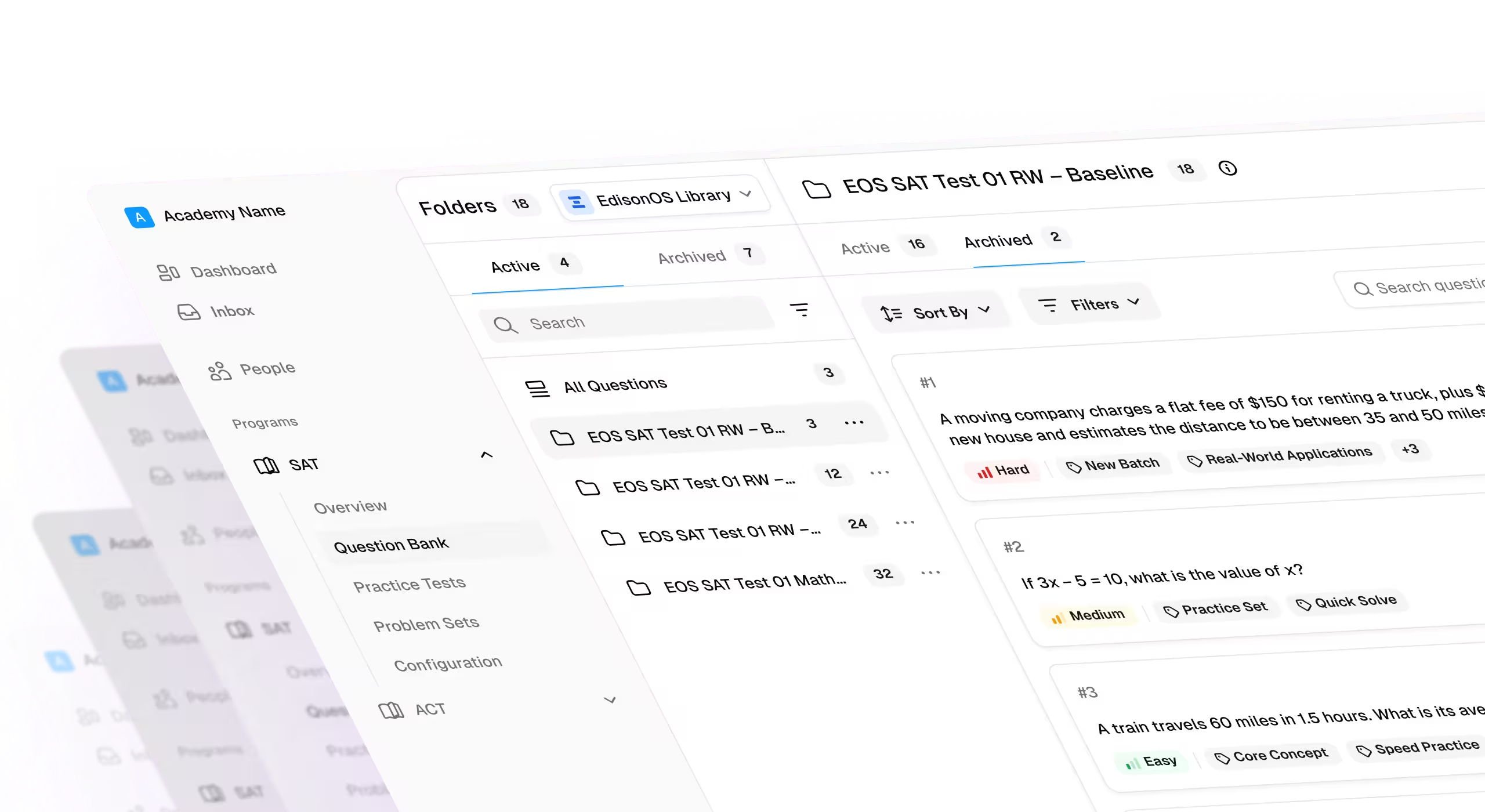
With EdisonOS, tutors can use structured digital assessments and performance data to identify learning gaps, assign targeted practice, and monitor progress over time.
Use diagnostics to identify starting points
A diagnostic assessment can help tutors determine which students need support with vocabulary, evidence, inference, cross-text reasoning, or other Reading and Writing skills.
Turn performance data into targeted practice
Instead of assigning the same reading practice to every student, tutors can use performance insights to identify areas that need more attention.
Track student progress
Performance data gives tutors a clearer view of whether a student is improving after targeted instruction and practice.
Create a more structured prep workflow
Tutors can bring assessment, practice, assignments, and student performance tracking into one digital environment instead of managing disconnected tools.
Conclusion: Help your students master the PSAT Reading with strategic instructions
PSAT Reading and Writing preparation is not simply about reading faster. Students need to understand what each question is asking, where the evidence is located, and how to eliminate unsupported choices efficiently.
For tutors, the biggest opportunity is to turn practice results into instruction. Instead of looking only at a student's overall score, identify the question types and skills that repeatedly cause difficulty.
Teach students to work with evidence, recognize question patterns, manage their time, and practice in the same digital environment they will encounter on test day.
With a structured approach and consistent performance tracking, PSAT Reading preparation can become more focused for both tutors and students.
Frequently Asked Questions
How is the PSAT Reading and Writing section structured?
The PSAT/NMSQT Reading and Writing section has 54 questions across two 32-minute modules, giving students 64 minutes total. The section is adaptive, so performance in the first module helps determine the difficulty of the second. Questions cover four content domains: Craft and Structure, Information and Ideas, Standard English Conventions, and Expression of Ideas. SAT Suite
What types of questions are on PSAT Reading and Writing?
PSAT Reading and Writing includes questions on Words in Context, Text Structure and Purpose, Cross-Text Connections, Central Ideas and Details, Command of Evidence, Inferences, Transitions, and Rhetorical Synthesis. These question types are distributed across the section's four content domains. SAT Suite
How can students improve their PSAT Reading score?
Students can improve by practicing each question type separately, reviewing mistakes, learning to identify textual evidence, and completing timed digital practice. Tutors should track recurring weaknesses rather than relying only on overall practice-test scores.
What is the best strategy for PSAT Reading questions?
The best approach depends on the question type, but students should consistently identify what the question asks, use evidence from the passage, eliminate unsupported choices, and manage their time. Practicing these steps across different question types helps students develop a repeatable approach.
How much time do students have for PSAT Reading and Writing?
Students have 64 minutes total, divided into two 32-minute modules, to answer 54 Reading and Writing questions. That averages approximately 1 minute and 11 seconds per question, although some questions will take longer and others can be answered more quickly. SAT Suite
How can tutors track PSAT Reading progress?
Tutors can track progress by recording performance by question type, accuracy, pacing, and recurring mistakes. A diagnostic followed by targeted practice and another assessment can help show whether instruction is addressing the student's specific weaknesses.