- With the right strategy, it is certainly possible to improve SHSAT math scores.
- High SHSAT math scores don't come from more worksheets; they come from identifying recurring error patterns and fixing them systematically.
- Strengthening key impact areas like percentage, ratio and proportion, and multi-step word problems leads to the biggest score improvements.
- In order to practice with digital adaptive tests, it is important to use quality mock SHSATs like EdisonOS’s tests.
As a tutor who has always aimed to help students improve SHSAT math scores, you always look closely at what your students do wrong. Broad reviews don’t offer any real help; you need strong analytics to spot every single mistake. Students tend to follow a pattern while committing errors, and when you categorize those mistakes, practice tests begin to deliver value.
If three incorrect answers are related to the same concept, it makes more sense to treat them as one teaching problem, not a bunch of three mistakes. That’s exactly why focused tests, even if fewer in number, can deliver better results than a larger number of random tests.
In this article, we discuss the best ways to raise SHSAT math scores. We start with how the 2026 adaptive format impacts practice test design. We then list out the high-impact areas of SHSAT math and explain how to work with each of them. From there, we discuss the key strategies tutors should teach. We conclude by answering some of the most frequently asked questions.
But first, we examine why SHSAT math scores plateau and what tutors need to know in that context.
Why SHSAT Math Scores Plateau (And What Tutors Miss)
It’s a fact that the score plateau is almost always a diagnostic problem, not an effort problem.
As we said earlier, mere volume of practice won’t bring gains beyond a point. Your students need practice tests that directly attack - and minimize - their regular errors.
But there are two more reasons, among others.
Firstly, lack of time-management strategy. Your students might be staying too long on early or easier questions. That leaves them with a time-crunch for other questions. They’ll have to rush through the later questions, many of which could be more challenging. And that’s where their scores begin to fall.
And secondly, there’s over-reliance on using long methods, typically algebra. Sometimes they’re necessary, but mostly there are better ways. Backward-solving and estimation, can, for instance, solve those questions faster.
Diagnostic teaching creates measurable score gains, because it aims to find the weak spots quickly, build error-pattern teaching, and prevent scores from flattening out.
The SHSAT Math Section in 2026: What Tutors Need to Know
Out of the total 57 math questions, 47 are multiple choice questions, 5 are grid-ins, and 5 are unscored questions. The test is adaptive in nature, so if a student gets one question correct, they’ll be served a slightly more difficult question. Conversely, if they get a question wrong, the next question will be slightly easier. This pattern continues throughout the test.
The test allows 180 minutes for the entire test (114 questions in all), but it lets the student decide how they’d like to split time between the two sections. While the general consensus is to allocate 90 minutes to each section, some students may need to allocate time a little differently.
Another aspect is the TEI items. They include graphing, multi-selecting, and ordering question formats.
Finally, you cannot emphasize enough the importance of not using calculators. The SHSAT doesn’t allow calculators, so your students need to practice without calculators right from day one.
To make sure your students go beyond mere familiarity with the test, you need mock SHSAT tests that mirror how the exam behaves digitally.
Here’s a etailed break-down of the SHSAT, if you’d like to quickly see the nitty gritty as well.
What the 2026 Adaptive Format Means for Practice Test Design
Here’s a direct answer: a simple PDF with test questions won’t work, no matter how good the questions. You need the digital format that mimics the adaptive nature of the test.
Familiarity with the digital interface of the test will build comfort and confidence. You want your students to feel at home when they sit for the actual test. And only digital practice tests can do this.
Importantly, students need to experience first-hand how the difficulty level of questions keep changing based on whether they answer a question correctly. And how they can use this learning can only come from deep analytics that go beyond just raw scores. A score tells tutors how a student performed. Adaptive analytics explain why they finished there.
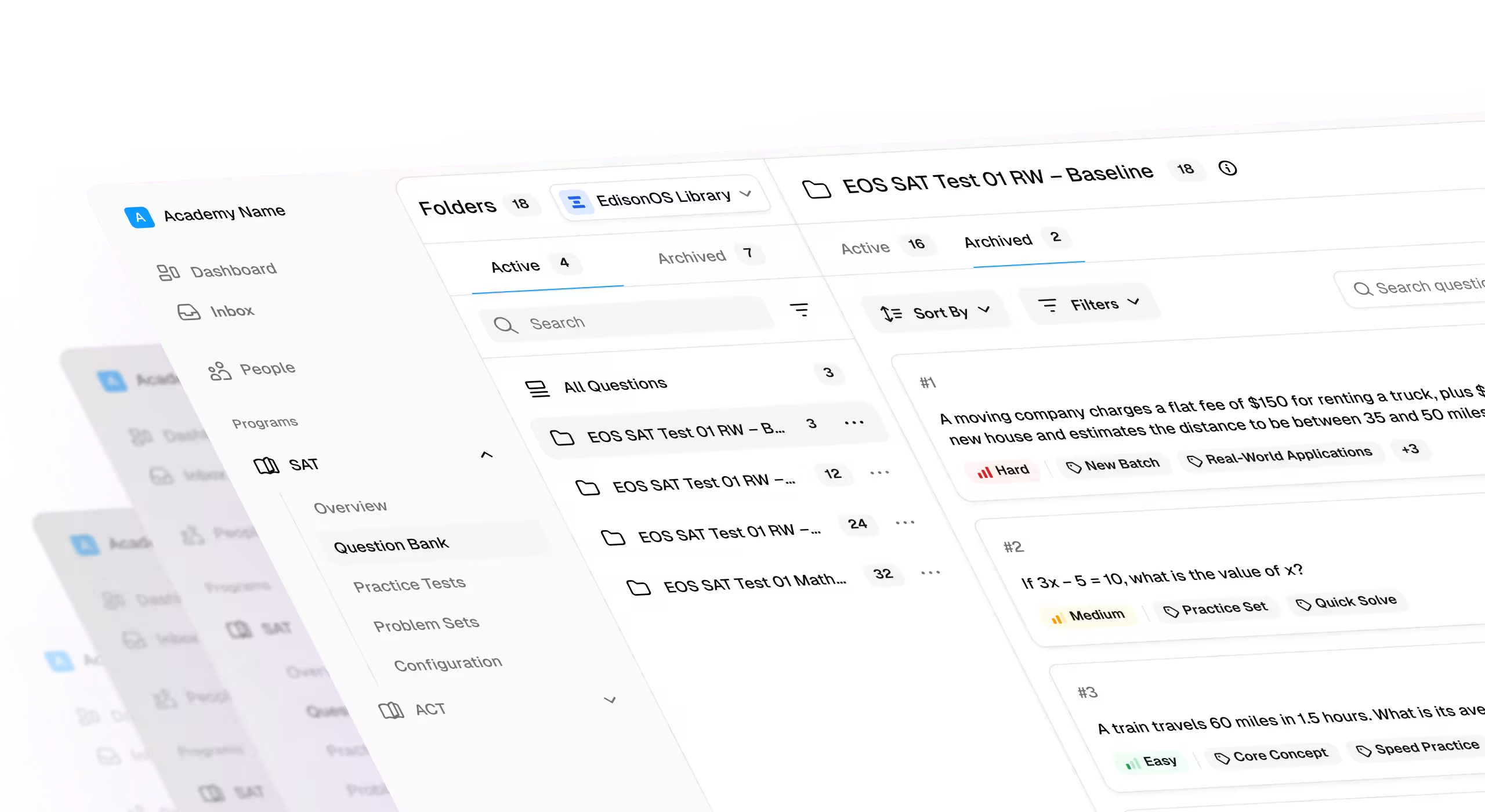
For various reasons like this, tutors are increasingly relying on EdisonOS’s practice SHSATs. In addition to the high-quality SHSAT questions, these mock SHSATs:
- Are adaptive: This precisely replicates the actual experience.
- Include drag-and-drop, and hot test: These questions are not inherently more difficult, but the experience is entirely different. Your students need extensive practice to be comfortable.
- Have SPR: Student-produced Response questions are subtly different. EdisonOS makes sure your students excel there as well.
You can learn more on how a strong digital platform helps tutors serve high-quality questions, simulate tests, and enhance test-prep.
The 5 High-Impact SHSAT Math Topics (And the Exact Errors Students Make)
The SHSAT math covers a wide canvas of topics. Obviously all topics don’t carry the same weight; some topics occupy way more questions than other topics do.
Hence it’s important that you don’t have your students spend the same time across all topics. Working on high-impact SHSAT math topics - the ones that will leave the biggest on the overall scores - produce quick and significant score improvements.
Here are the 5 topics that you should have your student work on in order to improve their SHSAT math score. Under each topic, we’ve listed the errors students and ways to make sure they avoid those errors:
1. Ratios and Proportions
Students mistake the ratios and start treating them as actual numbers. Most errors arise from that.
Reversing the ratios: Students reverse the ratio (boys:girls instead of girls:boys).
Prevention: Ask students to write the labels first, then fill in the numbers.
Comparing ratios instead of numbers: Students assume larger numbers always mean a larger ratio (e.g., 8:6 > 5:3).
Prevention: Teach students to simplify or convert ratios before comparing them.
Missing hidden ratios: Students fail to recognize ratio questions disguised with phrases like "for every" or "per."
Prevention: Train students to circle ratio keywords before solving.
Incorrect proportion setup: Students pair the wrong quantities while forming a proportion.
Prevention: Have students write the units beside every value before cross-multiplying.
2. Percentages and Percent Change
Percentage questions are less about arithmetic and more about identifying the correct base value. Most errors occur before students begin calculating.
Wrong base value:Students apply the percentage to the new value instead of the original value.
Prevention: Train students to identify and label the original, change, and final values before calculating.
Confusing percentage increase and decrease: Students add or subtract percentages without considering whether the question asks for an increase or a decrease.
Prevention: Encourage students to underline words like increase, decrease, discount, and markup before solving.
Struggling with reverse percentage problems: Students calculate the percentage of a number instead of finding the original value (e.g., "After a 20% increase, the price is $84").
Prevention: Give dedicated practice on reverse percentage questions rather than mixing them with standard percentage problems.
Assuming equal percentage changes cancel out: Students think a 20% increase followed by a 20% decrease returns to the original value.
Prevention: Use simple numerical examples to show that each percentage is calculated from a different base value.
3. Multi-Step Word Problems
Multi-step word problems test reasoning as much as mathematical ability. Students often know the required concepts but lose marks because they misread or misinterpret the question.
Stopping at an intermediate answer: Students solve the first part of the problem and select a trap answer without answering the final question.
Prevention: Teach students to read the last sentence first and underline what the question actually asks.
Missing key information: Students overlook words like remaining, total, at least, or each, leading to the wrong solution.
Prevention: Encourage students to circle keywords and annotate important information before solving.
Using the wrong operation: Students know the numbers but choose the wrong operation because they misinterpret the context.
Prevention: Ask students to explain their solution plan in words before performing any calculations.
Getting overwhelmed by lengthy questions: Students rush through long word problems and miss critical details under time pressure.
Prevention: Train students to break the problem into smaller steps and solve one piece at a time.
4. Probability and Statistics
Probability and statistics are often overlooked during preparation, leaving students unfamiliar with key concepts. Targeted instruction can turn this into a reliable scoring opportunity.
- Miscounting possible outcomes: Students overlook possible outcomes or count the same outcome more than once.
- Prevention: Teach students to list outcomes systematically using tables or tree diagrams before calculating probability.
- Confusing mean, median, mode, and range: Students apply the wrong measure because they don't understand what each represents.
Prevention: Use comparison exercises that require students to identify the most appropriate measure for different datasets.
Misreading charts and graphs: Students misinterpret box-and-whisker plots, tables, or graphs and draw incorrect conclusions.
Prevention: Include quick graph-reading exercises in every practice session to build familiarity.
Adding instead of multiplying probabilities: Students use the wrong operation when solving multi-event probability questions.
Prevention: Teach students to identify whether the question involves "or" (addition) or "and" (multiplication) before solving.
5. Grid-In and Digital Free-Response
Grid-in and digital free-response questions test both mathematical accuracy and digital fluency. Without answer choices, even small mistakes can cost valuable marks.
Incorrect answer entry: Students solve the problem correctly but enter the answer incorrectly.
Prevention: Build a habit of checking the entered response against the written solution before submitting.
Not simplifying fractions: Students enter an equivalent but unsimplified fraction, resulting in an incorrect response.
Prevention: Remind students to simplify every fraction to its lowest terms before entering the answer.
Missing signs or decimal points: Students omit a negative sign or misplace a decimal while typing the answer.
Prevention: Encourage students to verify signs and decimal placement during their final review.
Lack of digital practice: Students lose time because they are unfamiliar with the digital response interface.
Prevention: Include regular practice using digital mock tests so answer entry becomes second nature.
How to Build Sessions Around This Data
The goal of every tutoring session should not simply be to complete another worksheet. Instead, the goal should be to eliminate recurring mistakes, because targeted instruction consistently delivers better score improvements than broad content review.
Start with a full-length diagnostic test. Identify which of the five high-impact topics are responsible for most of the lost marks and look for patterns rather than isolated errors.
Build the next few sessions around those specific weaknesses. Assign focused drills and homework between classes. This way, students will strengthen one concept at a time instead of practicing everything equally.
After a few targeted sessions, administer another full-length practice test to measure progress. Repeat the cycle by identifying new weak areas and refining the learning plan.
Using a platform like EdisonOS makes this process much more efficient by automatically highlighting skill accuracy, performance across difficulty levels, and topic-wise strengths and weaknesses. This will enable tutors to spend less time reviewing tests manually and more time delivering personalized instruction.
Pacing and No-Calculator Strategy Tutors Should Teach
Contrary to what some people believe, calculating without calculators isn’t an innate ability. It’s not one of those ‘Either you have it or you don’t’ things. It’s very much teachable.
Strong SHSAT math performance depends as much on pacing and number sense as on conceptual understanding. You should build mental math skills into every lesson instead of treating them as a by-product of regular practice.
Teach students to estimate answers before calculating. Use shortcuts like finding 15% by combining 10% and 5%. Show how to use mathematical common sense (e.g. ‘Any number multiplied by an even number will always result in an even number’) to eliminate one or more answer choices.
These habits reduce calculation time, improve confidence, and help students eliminate unreasonable answer choices before they spend valuable time working through every step.
And be sure to teach mental math progressively rather than through random speed drills.
Over to you
Improving SHSAT math scores requires more than broad content review. You’ll deliver better results consistently by relying on a structured framework: diagnose recurring error patterns, focus on the highest-impact topics, teach no-calculator strategies, and use data to refine instruction after every assessment.
As the SHSAT continues evolving with a digital, adaptive format, you can’t rely on instinct. You’ll need accurate performance data to identify where students are losing marks. That will help you adapt lesson plans quickly and ensure that every practice session addresses the skills that will have the greatest impact on score improvement.
EdisonOS is the only platform built for SHSAT tutoring businesses, with full support for 2026 digital question types, custom mock SHSATs, and skill-level analytics that show you exactly which topics to fix next.
Whether you're managing a single tutoring cohort or an entire test prep program, EdisonOS gives you the tools to deliver personalized instruction at scale while reducing manual effort. Speak to an expert today to learn how you can build a smarter, data-driven SHSAT tutoring program.
Frequently Asked Questions
1. How can tutors help students improve SHSAT math scores?
Administering a diagnostic SHSAT, building custom learning plans, identifying frequent errors from practice tests, helping with no-calculator skills, and creating targeted tests to attach those errors are the key elements of improving SHSAT scores. As a tutor, you want to prioritize tutoring around high-impact areas rather than random practice.
2. What math topics appear most on the SHSAT?
The topics that SHSAT covers most are ratios and proportions, percentages and percent change, multi-step word problems, probability and statistics, and linear equations.
3. How do you teach SHSAT math without a calculator?
Help develop mathematical common sense. Start with mental math foundation, then stress on approximation (e.g. rounding off 9.8 to 10) and quick estimation, and then discuss inherent properties of numbers that can often quickly eliminate some answer choices. Keep reminding students that since the SHSAT doesn’t permit calculators, the test-maker doesn’t expect students to go down to precise calculations every time.
4. How many practice tests should SHSAT students take?
Depending upon the dream specialized school and where they currently stand in terms of preparedness, students would need between 5 and 8 practice tests. It is important to remember that analysing one’s performance in these practice tests in order to improve the score for the next test is as important as writing practice SHSATs.
5. How do tutors track SHSAT math progress?
Tutors begin by analysing a student’s performance in a diagnostic SHSAT test. They identify all the weak spots that are holding back the student’s performance. Next, they assign targeted practice and homework. After that, they administer practice tests to determine how much the student has improved. This cycle is repeated till the student consistently scores well in practice tests.
6. How do you help a student improve SHSAT grid-in accuracy?
Three factors play a key role in improving a student’s grid-in accuracy in the SHSAT: meticulous scratch work, platform familiarity, and proper formatting. Students would need to arrive at the exact answer. Using practice tests, students need to have built absolute familiarity with the interface. For instance, you may conduct 10 minute drills for 5 grid-in questions. Finally, they should type and align their numbers correctly.
7. What is a competitive SHSAT math score?
In general a student must get at least 40 questions correct - a score of approximately 270 - in Math to achieve a competitive SHSAT math score. However, there’s no pass/fail in the SHSAT, so scores depend entirely upon the type of school a student is targeting. Also,the applicant pool and the difficulty level of questions (the SHSAT scores are calculated on a curve) influence what could be a great score.