10 Best Test Prep Software in California (2027) | EdisonOS

California’s 2024–25 statewide assessment results showed that 48.8% of students met or exceeded the standard in English language arts and 37.3% did so in mathematics. Those results make targeted practice and useful performance data relevant considerations for schools and educators, though software alone cannot guarantee better outcomes. (California Department of Education, 2024–25 results)
Tutors, test prep centers, institutes, and schools across California need reliable ways to create assessments, deliver practice, and understand student progress. The right platform can save instructors time while helping students prepare for exams with a clearer plan.
But not every tool solves the same problem. Some platforms help businesses manage students, customize assessments, and deliver tests under their own brand. Others focus on adaptive practice, official SAT preparation, or detailed explanations for individual learners.
This comparison looks at ten options through a practical lens: what each tool does, who it suits, its main strengths and limitations, and what pricing information is available.
Disclosure: EdisonOS is our product and appears first. We considered publicly available product information, assessment workflows, fit for different organization sizes, pricing pages, and available documentation. Features and prices should be confirmed with each vendor before purchase.
Use this guide to shortlist platforms based on your exam mix, student volume, reporting needs, budget, and whether you need a branded business platform or a student-focused study resource.
Best Test Prep Software in California at a Glance
Pricing is a starting point, not a like-for-like total-cost comparison. Some platforms charge per student, exam, license, or organization. Confirm current offers and any additional fees before purchasing.
10 Best Test Prep Software for Tutors, Institutes & Schools in California
1. EdisonOS
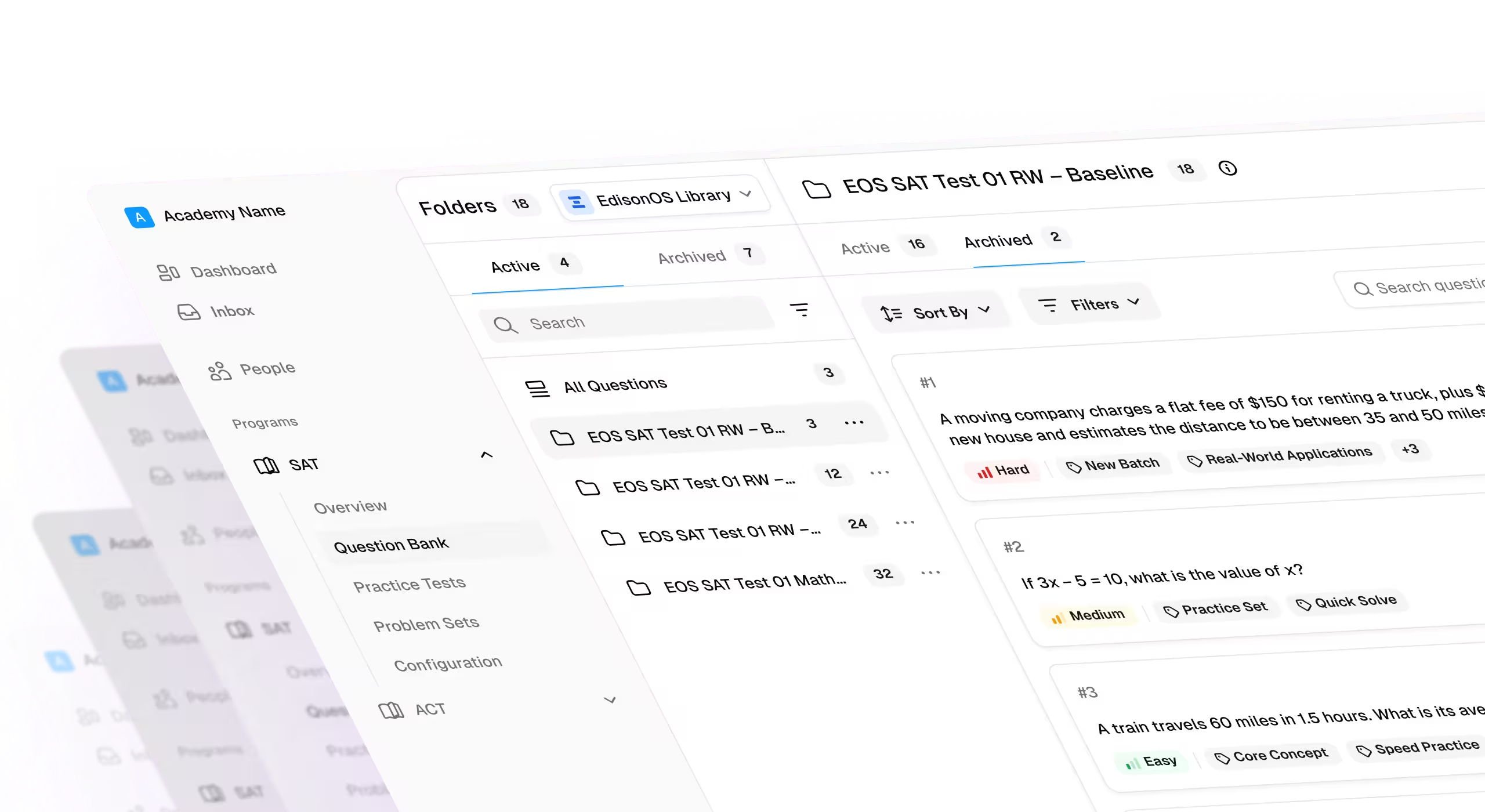
EdisonOS is a white-label test prep and assessment platform for tutors, institutes, schools, and community organizations that want to run exam-preparation programs under their own brand. It supports programs including the Digital SAT, ACT, PSAT, SHSAT, and AP.
Tutors can assign diagnostics and practice tests, enroll students, and use performance reports to plan lessons. Institutes can organize work across instructors and cohorts, while schools can evaluate student progress through reporting and administrative dashboards.
Its main differentiator is the combination of assessment delivery, student analytics, and branding. That makes it worth considering for organizations that want to operate a test prep program rather than simply recommend a practice website to students.
Key features
- Create full-length tests, sectionals, and problem sets, then assign them to individual students or groups.
- Use the question library or upload existing material through the AI Question Extractor workflow.
- Review performance data such as accuracy, pacing, skill gaps, and answer changes to inform instruction.
- Offer students and families a branded experience with role-based dashboards and a custom domain.
- Deliver SAT, ACT, PSAT, SHSAT, and AP practice through supported exam-specific workflows.
Pros
- White-labeling lets organizations deliver practice and reports under their own identity.
- Multiple exam programs can be managed within one assessment platform.
- Reports can help tutors move from overall scores to specific areas for improvement.
Cons
- Basic limits the team to one admin and three tutors, so larger organizations may need Pro or Enterprise.
- The subscription is not the only cost; test credits or student licenses can affect total spend.
Pricing: The official pricing page lists Basic Early Bird at $49/month or $299/year, Pro at $149/month or $1,499/year, and custom Enterprise pricing. Credits and licenses are additional; for example, a full-length SAT or ACT test credit is listed at $6. Confirm current terms on the EdisonOS pricing page.
2. StudySpaces
StudySpaces is a white-label curriculum and student-portal platform built for tutoring companies and test prep businesses. It is designed for organizations that want to deliver their own learning programs, rather than send students to a separate consumer-facing prep service.
A tutoring team can use the platform for one-to-one sessions, cohorts, and packaged learning programs. It combines a branded student portal with curriculum and assessment tools, making it relevant to businesses that teach live as well as assign independent practice.
Its strongest differentiator is the business workflow: organizations can use their own curriculum, combine it with included content, and deliver the experience under their brand. It is particularly worth evaluating if your team wants live teaching and student practice in one place.
Key features
- Create a branded portal for students using the tutoring company's identity.
- Support one-to-one tutoring, cohorts, and packaged learning programs within one platform.
- Use included SAT, ACT, PSAT, SSAT, and ISEE content where relevant.
- Combine the platform's materials with your own curriculum and assignments.
- Run live lessons with tools such as a whiteboard and student-facing learning workflows.
Pros
- Supports tutoring businesses rather than competing directly for their student customers.
- Included content has no per-exam or per-attempt fees, according to its pricing information.
- Costs are linked to active students, which can help businesses manage variable monthly enrollment.
Cons
- The active-student model means monthly costs rise as more students use the platform.
- Teams should confirm whether its assessment tools cover their exact exam, reporting, and customization needs.
Pricing: The official site lists plans from $100/month for up to 10 active students, with an additional $10 per active student per month. Confirm current details on StudySpaces.
3. ScoreSmart
ScoreSmart provides adaptive digital practice and analytics for exams including the SAT, ACT, ISEE, and SHSAT. Its tools are relevant to tutors and tutoring companies that need more than a final score to understand how students are performing.
Students complete practice tests, review results, and use targeted recommendations to guide their next study sessions. Tutors can monitor multiple students, share reports with families, and use the results to plan lessons around specific weaknesses.
A key differentiator is its Par Time feature, which helps show whether a student spent an appropriate amount of time on a question. This can make ScoreSmart useful for tutors who see students lose points because of pacing, not just content knowledge.
Key features
- Adaptive practice tests for supported exams, including SAT, ACT, ISEE, and SHSAT.
- Performance reports that break down errors and help identify topics for follow-up.
- Par Time analysis to compare time spent with a target pace.
- Student tracking and report sharing for tutor-led preparation.
- Bluebook practice-test upload and scoring workflows described on the vendor's site.
Pros
- A free practice test offers a way to evaluate the platform before buying.
- Pacing insights add context beyond the student's overall score.
- The product is built around both student practice and tutor use.
Cons
- Published pricing varies by exam and package, so the full cost depends on the testing volume.
- Confirm whether the specific white-label, multi-instructor, and administrative features you need are included in your plan.
Pricing: ScoreSmart currently lists a free test and paid test packages; its pricing page lists, for example, a 19-test SAT package at $475. Do not use older package prices or white-label fees without confirming them directly. See ScoreSmart pricing.
4. Test Innovators
Test Innovators offers adaptive practice tests and targeted preparation for admissions exams, including the SAT and ACT. Its tools are used by individual learners as well as schools, tutors, and community-based education programs.
Students can take diagnostic tests, receive explanations, and use personalized prep recommendations to decide what to practice next. Educators can explore school-focused offerings to assign work and monitor progress, though organizational needs should be discussed with the vendor.
Its biggest strength is structured, adaptive test practice with detailed explanations. It is a good option to evaluate when the goal is to help students become familiar with the exam and identify skill gaps, rather than build a fully branded assessment business from scratch.
Key features
- Adaptive SAT practice tests designed to simulate the test's changing difficulty.
- Practice questions and explanations that help students understand mistakes.
- Immediate scoring and diagnostic reports to identify areas for improvement.
- Personalized prep recommendations that direct students toward targeted practice.
- School and educator offerings for overseeing student progress and assigning work.
Pros
- A free sample test gives students a low-commitment way to try the experience.
- SAT packages include substantial question practice and adaptive full-length tests.
- Educator-focused services are available for schools and tutoring organizations.
Cons
- Individual student pricing may become expensive when purchasing access for a large roster.
- Organizations should confirm the scope of instructor dashboards, branding, and reporting available in their specific plan.
Pricing: The official SAT page lists a free option, a $49 Scholar Access package, and a $199 Valedictorian Access package. An ACT + SAT option is listed at $379. Educator pricing may differ; verify current offers at Test Innovators SAT pricing.
5. MentoMind
MentoMind is a white-label digital test prep platform aimed at tutoring businesses and education providers. Its listed exam offerings include the SAT, ACT, HSPT, AP Math, and PSSA, making it worth reviewing for organizations that want to offer digital practice under their own brand.
Tutors can use diagnostics to understand a student's starting point, assign targeted practice, and package self-study with instructor-led support. The platform also describes workflows for student enrollment and payments, which may help businesses manage more of the customer journey in one system.
Its potential differentiator is the link between independent practice and tutoring services. Before choosing it, businesses should request a demo and confirm the exact tools, exam coverage, and administrative features available under the plan they would buy.
Key features
- White-label delivery with a business's logo, domain, and brand colors, according to the vendor.
- Diagnostic tests and topic-level practice to help tutors identify areas for instruction.
- Tools to import existing questions or add custom tests and problem sets.
- Enrollment and payment workflows for selling packages and tutoring services.
- Student progress tracking and reporting features described in the platform's product materials.
Pros
- Branding and enrollment workflows may help tutoring businesses create a more consistent student experience.
- Custom content can support organizations with their own teaching materials.
- A demo can help teams assess the platform against their existing process.
Cons
- Public pricing could not be independently confirmed during this review.
- Before committing, verify question counts, test availability, payment fees, and the reporting features included in the proposed plan.
Pricing: Not publicly confirmed. Contact MentoMind for current plans, setup fees, and institutional terms.
6. HighScores.ai
HighScores.ai provides test preparation for a range of admissions exams, including the SAT, ACT, PSAT, SHSAT, SSAT, HSPT, ISEE, and TACHS. Its separate student, tutor, and school offerings make it relevant to centers that support students preparing for several types of exams.
Students can use diagnostics and practice tests to identify weak areas. Tutors and schools can evaluate the platform's cohort and reporting workflows to determine whether they suit their teaching model and student volume.
Its main appeal is breadth: one service may support multiple exam-prep programs, including private-school admissions tests. That can be helpful for a center with a diverse student roster, but organizations should compare the specific tools and plan limits against their own needs.
Key features
- Practice and assessment options across several college and private-school admissions exams.
- Diagnostic tests and score-improvement plans to help students focus their preparation.
- Question review and targeted practice workflows for revisiting missed concepts.
- Tutor and school offerings designed for group or institutional use.
- Exam-style interfaces and performance information described in the vendor's materials.
Pros
- Broad exam coverage can suit centers serving students with different testing goals.
- Diagnostic and targeted-practice tools help instructors focus follow-up work.
- Separate tutor and school offerings provide a starting point for institutional evaluation.
Cons
- Buyers need to compare separate student, tutor, and school plans to understand total cost.
- Confirm exact test counts, branding options, user limits, and reporting capabilities before selecting a plan.
Pricing: The draft research listed student plans from $59, but I could not independently confirm that as the current price. Verify current student and institutional pricing directly with HighScores.ai.
7. USATestprep (Progress Learning)
USATestprep, now associated with Progress Learning, is a K–12 practice and assessment option for schools and districts. Your source draft identifies its California relevance as standards-aligned practice related to the Smarter Balanced assessments and the California Science Test (CAST).
Teachers can use standards-aligned assignments and assessments to check understanding and review classroom performance. This is a different use case from a white-label SAT prep business: the emphasis is on school instruction, standards, and reporting rather than selling branded admissions-test programs.
Its main advantage for a California school is the possibility of aligning practice with classroom standards and state assessment preparation. Districts should request a demonstration and confirm the exact California content, reporting levels, accessibility options, and implementation support available in the proposed package.
Key features
- Standards-aligned practice and assessment workflows for K–12 classrooms.
- Assignments that can be used to reinforce skills and check student understanding.
- Reporting tools for reviewing performance across students and classes.
- School-oriented administration rather than a consumer-only study experience.
- California standards and assessment coverage to verify during a product demonstration.
Pros
- More directly aligned with school and district workflows than student-only prep apps.
- Standards-focused practice can complement classroom instruction.
- A school-oriented sales process allows buyers to discuss implementation and reporting needs.
Cons
- The platform may not be the best fit for a private tutor who mainly needs branded SAT or ACT practice.
- Public pricing and exact California-specific feature availability should be confirmed with the vendor.
Pricing: Quote-based; request current pricing and a California-specific demonstration through Progress Learning.
8. UWorld
UWorld offers exam-preparation products for individual students, including SAT practice with detailed explanations. It is best viewed as a student learning resource or supplement rather than a complete white-label platform for running a tutoring business.
Students work through exam-style questions and review visual, step-by-step explanations. That makes it useful for independent practice, homework assignments, or reinforcing a concept after a tutor has taught it. Educators should check the separate educator options if they want to use UWorld with a class or tutoring group.
Its main differentiator is the depth of its answer explanations. If students keep repeating the same mistakes, explanations can help them understand the reasoning behind an answer instead of simply seeing whether it was right or wrong.
Key features
- SAT question bank with exam-style practice questions.
- Visual, step-by-step answer explanations designed to clarify solution methods.
- Practice and study resources for students preparing for the Digital SAT.
- Performance feedback to help learners identify topics that need more work.
- Separate educator information for schools and other teaching contexts.
Pros
- Detailed explanations can support independent review after lessons or practice tests.
- Students can use it as a focused resource for exam-style questions.
- Several SAT products are available at different price points.
Cons
- It is not positioned primarily as a white-label assessment platform for tutoring businesses.
- Buyers should compare question-bank access with full-course access because the products and prices differ.
Pricing: The official SAT page lists the question bank from $99, the prep course from $299, and the study guide from $59. Confirm current offers and access periods at UWorld SAT prep.
9. Pear Assessment
Pear Assessment is a school-focused assessment platform with a California-specific CAASPP practice resource. Teachers can use released practice items in an online environment designed to help students become familiar with the testing interface, including digital item types and navigation. It is a closer fit for California K–12 schools than a general student study app.
Beyond state-test practice, Pear Assessment supports teacher-created assessments, shared libraries, standards tagging, and reporting. Its wider assessment tools can help teachers and school teams review student understanding and plan instruction. Schools should distinguish these classroom assessment workflows from a full tutoring-business platform: Pear is not primarily designed to provide white-label SAT/ACT programs or manage a private tutoring company's enrollment and billing.
Key features
- California CAASPP practice using released items available through Pear Assessment.
- A digital testing environment that helps students practise common online assessment interactions.
- Teacher-created assessments with multiple technology-enhanced question types.
- Standards tagging, shared assessment libraries, and collaboration tools.
- Reporting to review student performance and inform instruction.
Pros
- Directly relevant to California schools preparing students for CAASPP.
- Offers broader classroom assessment tools beyond state-test practice.
- Teachers can start with a free account to access selected CAASPP practice resources.
Cons
- It is more school-assessment focused than a white-label platform for tutoring businesses.
- Schools should confirm which reporting, accommodations, and administrative features are available under their plan.
Pricing: Pear Assessment offers free access to selected resources; current paid-plan and district pricing should be confirmed directly. Explore the Pear Assessment CAASPP practice page and Pear Assessment product page.
10. Magoosh for Schools
Magoosh for Schools offers SAT and ACT preparation for schools, tutoring organizations, and other education partners purchasing multiple student accounts. Students use online lessons, practice questions, and practice exams, while instructors can use an educator portal to assign work, monitor progress, and download reports. This makes it more relevant to institutional buyers than Magoosh's individual-student plans alone.
Magoosh is still primarily a student-learning product rather than a white-label assessment platform. Its strengths are structured test-prep content and educator oversight; it is not the same kind of business-management system as platforms built around custom-branded test delivery, student enrollment, and custom question-bank workflows. Organizations should compare the educator tools and integrations against the way they deliver instruction.
Key features
- SAT and ACT prep content for group purchases and school programs.
- Online lessons, practice questions, and practice exams.
- Instructor accounts and an educator portal for managing classes.
- Assignment tools and student progress reports.
- Integrations and onboarding support described in Magoosh's school offering.
Pros
- Offers a clear school and partner route for group purchases, rather than requiring every learner to buy separately.
- Educators can monitor student activity and assign work.
- Structured content can support a school or tutoring center's existing prep program.
Cons
- A minimum purchase applies to group/partner access; confirm the current threshold and terms.
- It does not primarily offer white-label test delivery under a tutoring business's own brand.
Pricing: Magoosh offers group pricing for school and partner purchases, with rates depending on product and account volume. A currently indexed educator pricing document lists group tiers, but confirm current rates directly with Magoosh for Schools or its partner purchasing page.
Additional option: Time4Learning for Broader K–12 Academic Support
Time4Learning is worth considering for schools and tutoring centers that need broader academic instruction alongside exam preparation. Its PreK–12 curriculum includes self-paced lessons in language arts, math, science, social studies, and electives.
For organizations, the platform advertises automated grading and reports, customizable learning paths, group implementation plans, and support for independent study, hybrid learning, and intervention. Time4Learning explicitly lists tutoring centers, private schools, and charter schools among the organizations it serves. Its site also features Blue Ridge Academy, a California public charter school, as a customer story.
Best fit: Organizations supporting foundational academic skills, independent study, or learning gaps across K–12—not providers looking primarily for dedicated SAT/ACT practice tests, admissions-test diagnostics, or white-label exam delivery.
Pros
- Covers multiple subjects and grade levels, so it can support broader academic reinforcement.
- Offers self-paced lessons, built-in quizzes and tests, automated grading, and progress reports.
- Offers group purchasing for schools and education organizations.
Cons
- It is a curriculum provider, not a virtual school, and does not provide live teachers.
- It is not a dedicated SAT/ACT test-prep platform; check whether its curriculum matches the specific assessment or exam-prep outcomes your organization needs.
- School and group pricing should be confirmed directly rather than assumed from individual family memberships.
Pricing: Time4Learning publishes individual family membership pricing, while schools and organizations are directed to discuss group purchasing. See its school and youth program page, public-school offering, and official FAQ for current details.
How to Choose the Right Test Prep Software in California
Start with your teaching model, the exams your students take, and the work you want the platform to handle. A solo tutor may need fast diagnostics and clear reports; a multi-branch institute may need role-based access, branded delivery, and consistent reporting across instructors.
Assessment and Test Creation
Check whether you can build full-length tests, timed sections, quizzes, and custom assignments. If students are preparing for the Digital SAT or another computer-based exam, compare the practice experience with the tools and timing they will encounter on test day.
Question bank management. Look at the size and relevance of the question bank, whether you can upload your own content, and how easily you can organize questions by topic, difficulty, and skill.
Analytics and reporting. Overall scores are only one part of the picture. Look for skill-level performance, timing, repeated mistakes, and reports that help instructors decide what to teach next.
Branding and student experience. If you run a tutoring business, decide whether you need a branded portal, custom domain, your own logo, and separate access for students, tutors, and administrators.
Scalability and collaboration. Institutes should review how the platform handles multiple instructors, cohorts, locations, and student accounts. Ask what happens to pricing as enrollment grows.
Integrations and administration. Confirm whether the platform works with your existing tools and whether it supports the roster management, payments, reporting, and support workflows your team needs.
Pricing and total cost. Compare more than the advertised starting price. Include test credits, active-student fees, licenses, onboarding, and any additional costs for branding or reporting.
Standardized Tests and State-Specific Assessment Requirements in California
California schools and tutoring organizations should choose practice content based on the tests their students actually take. State assessments and college admissions exams have different goals, formats, and audiences.
The California Department of Education identifies Smarter Balanced assessments for grades 3–8 and 11 and CAST for grades 5, 8, and once in high school. The University of California says it does not consider SAT or ACT scores in admissions decisions or scholarship awards, though scores may be used for limited eligibility or placement purposes. The California State University system also does not use SAT or ACT scores to determine undergraduate admission eligibility.
That means California-focused software selection should begin with the students' actual goals, not an assumption that every student needs SAT or ACT prep. Schools and tutors should verify current requirements for each target institution and program before choosing test libraries or building a prep calendar.
State Funding, ESA Programs & Test Prep Requirements in California
As of this review, California does not have a statewide Education Savings Account (ESA), private-school voucher, or state tax-credit scholarship program for private-school tuition. Families should not assume that a tutoring service, test prep course, or educational software subscription can be paid for through a California ESA.
Two programs or funding routes are worth distinguishing from an ESA:
- CalKIDS: California's children's savings account program provides eligible students with funds for qualifying future higher-education expenses. It is not a general K–12 tutoring or test prep software allowance. Families should check the program's current eligibility and permitted-use rules before planning to use the funds.
- Title I equitable services: Eligible students attending participating nonprofit private schools may receive services supported by federal Title I, Part A. California's Department of Education explains that the local educational agency (school district) is responsible for arranging eligible services in consultation with private-school officials; the school does not receive Title I funds directly. This is not a family-controlled education account.
For tutors, institutes, and schools, the practical implication is to avoid marketing a platform as “ESA eligible” in California unless a specific applicable funding route and its rules have been verified. Schools considering public or federal funding should confirm procurement, eligibility, and allowable-use requirements with the relevant district or program administrator. Families should check official program guidance rather than relying on general claims about education savings or scholarships.
Why EdisonOS Is a Strong Test Prep Software for Tutors & Institutes
EdisonOS is designed for tutors, test prep institutes, schools, and community organizations that want to deliver assessment programs under their own brand. It brings test creation, student management, practice delivery, and reporting into one workflow.
Organizations can assign tests from a question library or use their own content, then review reports to identify gaps in accuracy, pacing, and specific skills. Supported programs include SAT, ACT, PSAT, SHSAT, and AP preparation.
Its main differentiators are white-label delivery, exam-focused practice workflows, and reporting intended to help instructors decide what to teach next. Pricing starts with a Basic plan, while larger organizations can explore Pro or custom Enterprise options. Buyers should factor in the cost of test credits or student licenses when estimating total spend.
Test Prep Software for Different Education Businesses
- Solo tutors: Build and assign practice, track individual students, and deliver a branded experience without managing a complex multi-admin setup.
- Tutoring institutes: Coordinate instructors and cohorts, review student performance, and standardize assessment workflows across programs.
- Schools: Evaluate exam-prep and reporting needs across classes, then discuss appropriate administration, support, and integration requirements with EdisonOS.
EdisonOS is likely to offer the most value to organizations that need a branded system for assessment delivery and student progress tracking—not simply a fixed library of student practice questions.
Not sure where to start? Let's figure it out together.