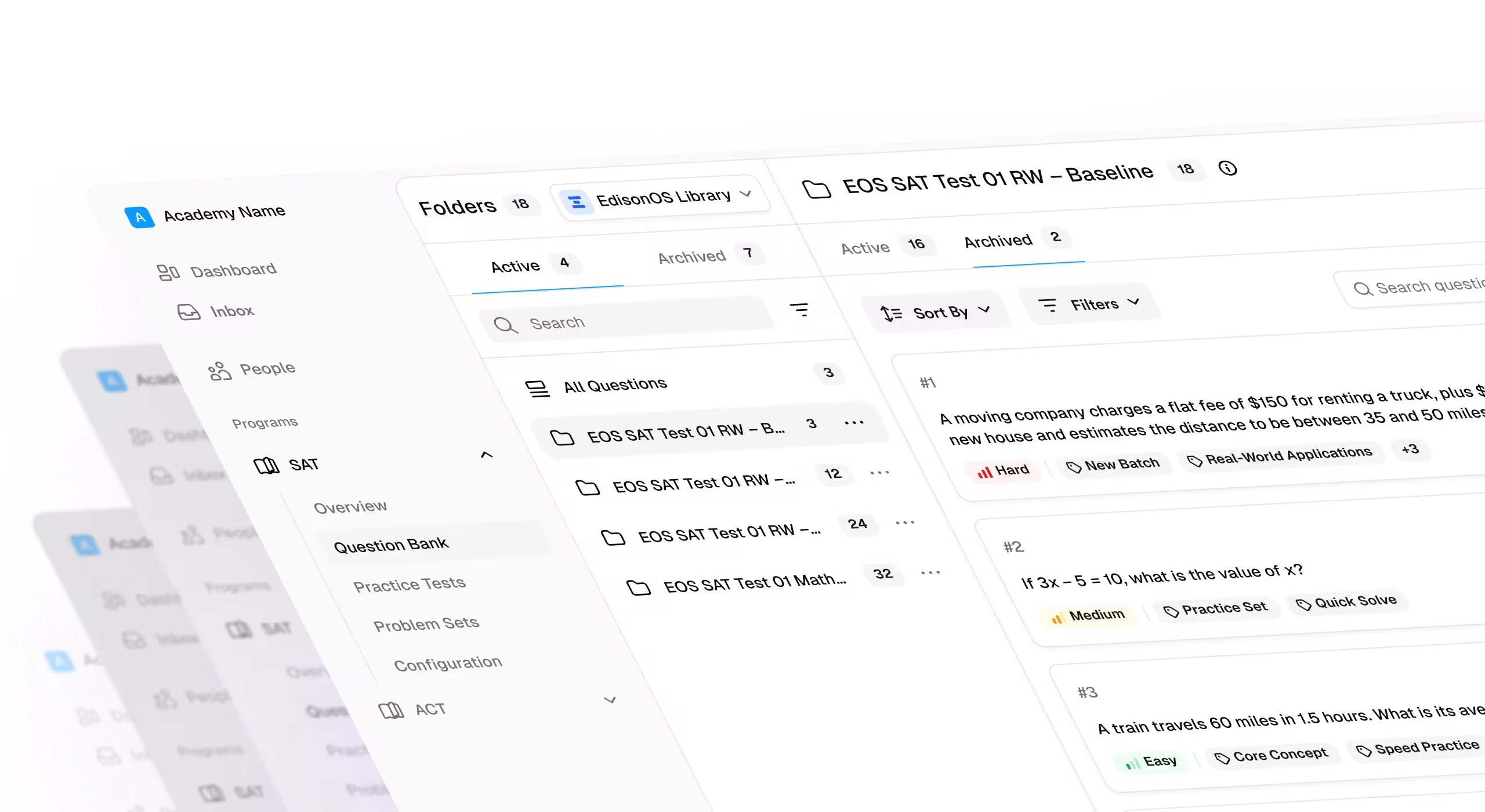
Albert.io is highly regarded for rigorous AP, SAT, and ACT practice questions, but tutors and institutions comparing it against EdisonOS should weigh a few key differences.
- EdisonOS — Built for tutors and test prep businesses, with BYOT custom test creation, white-labeling, deep analytics, and reported 200+ point SAT/ACT score improvements, areas where Albert.io offers less flexibility for institutions.
- Albert.io's rigorous practice questions — Math and science modules, like AP Calculus and Statistics, often mimic the pacing and difficulty of actual exams.
- Albert.io's detailed explanations — Step-by-step rationales after each question make it easier for students to learn from mistakes.
- Albert.io's topic-level tracking — A granular performance dashboard categorizes progress by specific concepts, enabling targeted studying.
- Albert.io's downsides — Some students find the questions overly difficult, non-STEM subject coverage is thinner than STEM, and individual subscription pricing can feel steep for single-subject use.
- Best used as a "Phase 2" tool — Students recommend Albert.io after learning core concepts elsewhere, since its rigorous questions suit concept testing better than initial learning.
Albert.io is a well-known practice and assessment platform used across grades 3–12, covering AP, SAT, ACT, and state exams. Many students, teachers, and districts evaluate it before committing to a subscription.
Reviews are mixed. Feedback varies significantly based on who pays, which subjects are used, and how intensively the platform is adopted.
This review covers:
- What users consistently praise about Albert.io
- Where users struggle or raise recurring complaints
- When teams start considering alternatives like EdisonOS
Disclosure: This review is written from EdisonOS's perspective, drawing on public user feedback and market analysis.
What is Albert.io and who typically uses it?
Albert.io is an online practice and assessment platform built for grades 3–12. It provides adaptive skills practice and large question banks across core subjects and high-stakes exams like AP, SAT, and ACT.
Typical users include AP teachers, school districts, and homeschool families. Schools that fund access tend to use it at scale, while individual students purchase subject-specific plans for focused test prep.
Day to day, teachers assign Albert questions as homework and formative practice, use dashboards to identify student gaps, and monitor performance. Students practice independently using exam-style questions and detailed explanations.
How we analyzed Albert.io reviews
Insights in this article are based on public user feedback, recurring themes from teacher communities, school case studies, and observed usage patterns across institutional and individual contexts.
Sources consulted include:
- Teacher blogs, school newspaper articles, and Albert's own curated testimonials documenting classroom-level implementation and outcomes
- Student and community discussions reflecting recurring concerns about pricing, assignment volume, and technical reliability
- EdisonOS's synthesized review and alternatives analysis, cross-referenced with independent teacher and school sources
What users like about Albert.io?
Most positive reviews focus on question rigor and explanation quality, particularly in AP subjects where consistent, exam-aligned practice drives meaningful score improvements.
- Rigorous, exam-level questions: Teachers and students frequently report that Albert's AP questions are as hard as or harder than the actual exam, with one physics teacher noting students found the real AP test comparatively easy after using Albert consistently
- Detailed, diagnostic explanations: Albert's explanations address not only the correct answer but also why incorrect options are wrong, helping students identify and correct misconceptions rather than simply memorizing answers
- Formative assessment and dashboards: Multiple teachers report that Albert's real-time dashboards help them identify class-wide trends, monitor individual progress, and target instruction, reducing time spent diagnosing gaps manually
- Documented AP score improvements: A cited AP teacher case reports a 25-percentage-point increase in AP exam class mean after adopting Albert, with 70 percent of students scoring in the top two quartiles above the global mean
- Self-paced, independent practice: Students value the ability to review by difficulty level, work in short focused sessions, and track progress independently, which Amazingtalker's article describes as productive for self-study learners
Common complaints and limitations in Albert.io reviews
Most negative reviews surface when schools assign Albert heavily late in the year, or when individual students and institutes attempt to scale usage across multiple subjects and many learners.
1. High pricing for individual payers
Students self-funding multiple AP courses at approximately 79 USD per subject describe Albert as expensive, with Reddit AP student discussions characterizing it as "horribly expensive" without institutional funding
2. Attempt caps limiting year-round review
EdisonOS's 2026 review notes that Albert introduced a model capping how many times students can attempt questions, which teachers report limits ongoing review in AP courses that rely on repeated practice
3. Uneven subject quality across disciplines
Quality and depth of questions and explanations vary significantly by subject; some disciplines are praised for depth while others are seen as having thinner or weaker content coverage
4. Technical reliability under heavy load
A school newspaper article documents repeated 502 server errors when many students accessed Albert simultaneously near exam dates, causing assignment submission failures and student frustration
5. Accuracy-graded assignments creating pressure
A student op-ed argues that grading Albert assignments for accuracy encourages collaboration to avoid wrong answers and penalizes genuine effort on difficult questions in high-stakes grading contexts
Albert.io reviews by use case
1. Albert.io for individual tutors
Albert's tutor license is priced at 750 USD or more per year, providing comprehensive access to adaptive practice and premium question banks for multiple students. Teacher testimonials indicate Albert functions effectively as a coaching tool, allowing tutors to assign targeted practice sets and review explanations between sessions.
Public documentation on tutor-specific features is limited. Information on student limits and subject scope within the tutor license is not clearly detailed on Albert's main site, requiring direct inquiry with their sales team.
2. Albert.io for tutoring institutes
Institutes with 50 or more students can access school-level licensing at 18 USD per student per year, with optional Pro and Onboarding add-ons for analytics and rostering. School implementation examples, such as a full AP program license covering 961 students and 2,062 exams, illustrate how institute-scale deployments can function.
EdisonOS's review notes that as institutes scale across multiple AP subjects, attempt-limit friction and per-student pricing pressure become more prominent. Albert does not separately document tutoring institute workflows distinct from standard school contracts.
3. Albert.io for schools and colleges
Hagerty High School's documented schoolwide AP license, funded across multiple school bodies, demonstrates how schools deploy Albert to support entire AP programs. Administrators describe it as having strong potential when used year-round across subjects.
The same school's student newspaper documents significant backlash when Albert was introduced late in the year with large, accuracy-graded assignments and infrastructure errors. Administrators concluded that year-round, thoughtful implementation, not last-minute exam prep, produces the best outcomes.
Real user review highlights
Paraphrased from public user feedback:
Paraphrased user feedback: A teacher reported using Albert consistently throughout the AP year, not just for final review, and attributed improved student understanding and above-average AP pass rates to that approach.
Paraphrased user feedback: A student described Albert's AP-level questions as slightly harder than the actual exam across multiple subjects, finding the challenge useful but noting that the difficulty felt more like exam simulation than concept reinforcement.
Paraphrased user feedback: A self-studying student said they found Albert's free question browsing helpful for gauging exam style but did not feel the fee for full answer access was worth it without school funding.
When Albert.io is a good choice (based on reviews)
Albert delivers the strongest results in school-funded AP programs where teachers integrate it year-round for homework, formative assessments, and targeted review rather than as a late-stage cramming tool.
1. School or district-funded AP programs
EdisonOS's review concludes Albert works best when schools cover per-student costs, giving teachers and students full access to rigorous question banks without individual pricing pressure
2. Homeschool families and small teams
Small implementations where per-subject costs are manageable and focus is limited to a few exams report strong value from Albert's explanation quality and question depth
3. Subjects with deep content coverage
Teacher testimonials indicate Albert is especially effective in subjects with robust question banks such as AP Chemistry, AP Biology, and selected AP humanities courses where question rigor is consistently high
When Albert.io starts falling short
Negative feedback clusters when users engage Albert more deeply than its pricing and attempt model support, particularly as the number of subjects, students, or testing cycles increases.
1. Per-subject costs compound for multi-exam students
Individual students preparing for several AP exams simultaneously face per-subject costs of 39 to 79 USD each, which accumulate quickly without institutional funding covering access
2. Attempt caps constrain long-term review strategies
Teachers who rely on repeated question practice throughout the AP year report that attempt limits directly conflict with the year-round review model Albert's own materials promote
3. Subject quality gaps surface at scale
When districts or institutes deploy Albert across many courses, uneven content depth outside flagship subjects becomes more visible, making the per-student fee harder to justify uniformly across all classes
These friction points lead growing institutes and districts to evaluate platforms built specifically for structured, large-scale test administration.
How EdisonOS compares to Albert.io (based on common review gaps)
EdisonOS is built as digital testing infrastructure for test-prep institutes, schools, and edtech companies. It addresses the operational gaps that surface most often in Albert.io reviews.
- No attempt caps on mock tests: EdisonOS structures controlled full-length mock administrations rather than per-question attempt limits, supporting year-round test cycle management without access restrictions
- Standardized content across all exams: EdisonOS delivers curated mock banks and Bluebook-mirroring Practice Tests for SAT with consistent fidelity, addressing subject quality variance concerns
- Institute-level cohort reporting: EdisonOS provides multi-branch governance, cohort analytics, and outcome reporting tied to structured test cycles, not individual practice dashboards
Teams evaluating Albert often shortlist EdisonOS when they need infrastructure for scheduling, administering, and analyzing mock exams at scale across multiple branches, rather than question-bank practice access tied to per-student licensing.
Albert.io vs EdisonOS: Which is the better fit?
Both platforms serve test prep needs, but they are built for fundamentally different operational contexts. The decision depends on whether the primary need is curriculum-aligned question practice or structured mock test administration infrastructure.
Final verdict on Albert.io reviews
Albert.io delivers documented value in school-funded AP programs. Rigorous questions, strong explanations, and formative dashboards produce measurable improvements when teachers deploy it consistently across the academic year.
Limitations are also consistent: per-subject pricing pressure, attempt caps, and uneven content depth create friction as usage scales across many subjects and students.
For institutes that need standardized mock test delivery, Bluebook-accurate Digital SAT Platform infrastructure, and cohort-level reporting across branches, EdisonOS provides the operational layer that Albert's practice-oriented model is not designed to offer.
Frequently asked questions about Albert.io reviews
Is Albert.io worth it based on reviews?
Albert.io is worth it when schools or districts fund access. Teachers in funded AP programs report strong ROI from rigorous question banks and detailed explanations tied to measurable score improvements.
Individual students paying 39 to 79 USD per subject often question whether the paywall for explanations is justified, particularly when preparing for multiple exams simultaneously without institutional support covering the cost of each subject.
What do users dislike most about Albert.io?
Top complaints include high per-subject pricing for individual payers, attempt caps that limit year-round practice, uneven content quality across subjects, and technical errors under heavy load.
School newspaper documentation and student community posts also highlight concerns about accuracy-based grading on large Albert assignments, which some argue creates high-pressure conditions and incentivizes collaboration to avoid point deductions rather than genuine independent effort.
Is Albert.io suitable for scaling teams?
Albert offers district-level features including rostering, standards reporting, and volume-discounted per-student pricing structurally designed for large deployments across many students and subjects.
EdisonOS's analysis notes that scaling introduces compounding friction: per-student costs accumulate, attempt limits conflict with long-term review strategies, and subject quality differences become more visible when institutes expect uniform content depth across every course in a broad curriculum.
Why do teams switch from Albert.io to EdisonOS?
Teams typically consider moving when they need structured mock test administration, standardized scoring, and branch-level reporting that extend beyond Albert's practice-oriented question-bank model.
EdisonOS's review identifies cost pressure from per-student and per-subject pricing, attempt limit constraints, and the absence of institute-wide operational metrics as the pattern of pain points that align with what Free Digital SAT Practice Tests and full mock infrastructure within EdisonOS are built to address.
Are EdisonOS reviews more positive than Albert.io?
Albert.io education reviews are dispersed across teacher blogs, school newspapers, curated testimonials, and third-party breakdowns. Many are positive, but some include strong criticism of pricing, attempt limits, and implementation stress.
EdisonOS has positive testimonials and B2B case references from named test prep companies, but fewer independent consumer-style reviews. Because the platforms are reviewed in different ecosystems, a direct quantitative comparison of overall review positivity is not currently possible.