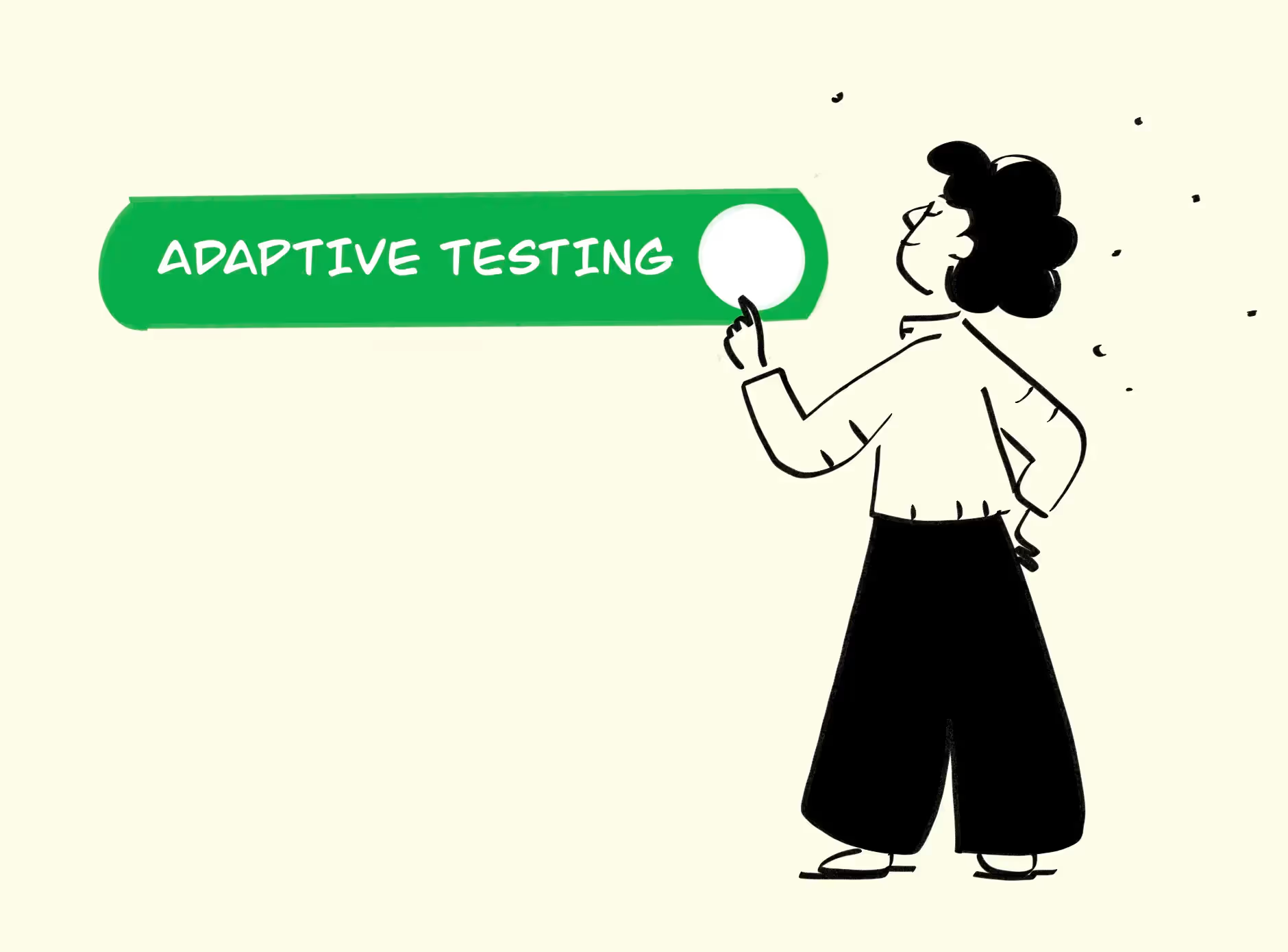
The digital SAT is adaptive, using multi-stage adaptive testing where difficulty shifts based on performance between modules rather than after every question.
- Two modules per subject — Both Reading & Writing and Math split into Module 1 (a balanced mix of easy, medium, and hard questions) and Module 2 (difficulty determined by Module 1 performance).
- Adaptation happens between modules only — Strong Module 1 performance routes to a harder Module 2; struggling routes to an easier one.
- Score impact — The easier Module 2 caps the potential section score around 600 points, while the harder Module 2 unlocks the full 800 points per section.
- Full control within a module — Students can skip around, bookmark, and change answers freely before the module timer ends, but no adaptation happens mid-module once it starts.
- Equal time and question count — Both modules have the same number of questions and time limits regardless of difficulty level.
- Module 1 matters most — Since it determines access to the full score range, every question in the first module deserves full effort.
The College Board's decision to make the digital SAT adaptive makes a significant difference to test-takers and tutors. As of the class of 2025, the SAT has officially entered its "majority-digital" era, with 97% of the over 2 million students who took the exam opting for the digital format.
So here’s the answer to a common question: Is the SAT adaptive? Yes, the SAT is adaptive - and to be specific, the SAT is section-adaptive.
A digital adaptive test is different from a conventional test because it adjusts itself according to the test-taker's performance—a shift that has helped streamline the experience, with 2026 score reports now consistently released within 12–14 days of the test date.
In this article, we discuss the digital adaptive SAT and how it differs from a paper and pencil test. Importantly, we explain how it changes your testing experience and impacts your SAT strategy. Finally, we show you where to find free digital SAT practice tests, answer a few questions, and dispel some myths regarding the new format of the SAT.
How Digital SAT Adaptive Testing Works
The digital SAT has two sections: the Reading and Writing section and the Math section. Each section is worth 800 points, which means the maximum score is 1,600 points.
Each section is divided into two equal parts called modules. The first module is called the Base Module, while the second is called the Adaptive Module. The Base Module which contains mostly moderate-level questions. The second is the Adaptive Module, where difficulty changes based on your performance.
If you perform well in the Base Module, you are routed to a more difficult second module with higher scoring potential. If not, you receive a relatively easier module, which can limit your maximum score.Either way, the structure of the test as well as the section remains the same.
Why adaptive testing matters for your score
Your SAT score depends not just on how many questions you answer correctly, but also on how difficult those questions are.
This means two students with the same number of correct answers can end up with different scores, based on the module difficulty they were assigned.
If you’ve ever wondered ‘Is the SAT adaptive by question or by section?’, you’re not alone. So here’s what you need to know: the SAT is adaptive by section, and not by question.
What Happens in Each Scenario: Hard vs. Easy Module 2
Scenario 1:
If a student answers more than a certain number of questions correctly in the Base Module, the test algorithm concludes that the student is skilled enough to answer difficult questions. Hence, the Adaptive Module for that student will comprise more difficult questions (only a few are moderately difficult).
Scenario 2:
But what if the student can correctly answer only a few of the questions in the Base Module? In this case, the algorithm will deliver an Adaptive Module with questions that are mostly easier than those in the Base Module.
What this means for your strategy
The first module is critical because it sets your scoring ceiling. Strong performance early on gives you access to higher-difficulty questions and better score potential.
Focus on accuracy first, avoid careless mistakes, and maintain steady pacing instead of rushing. Remember, the early questions in the first module count as much as the later questions on the same module - neither more nor less. So you want to focus on doing well across the entire section, instead of just treating some questions as more important.
Why adaptive testing reflects your ability better
The SAT is a multi stage adaptive test. It SAT adapts after the first module, adjusting to your performance. This makes the test more efficient and personalized.
Instead of giving every student the same questions, it matches the difficulty to your level, resulting in a more accurate measure of your ability.
Pros and Cons of Adaptive Testing
Like any other test format, an adaptive test has its strengths and limitations. Here are the three key pros and cons of adaptive testing, specifically in contest of the SAT:
Pros of the digital adaptive SAT:
- Adaptive testing provides accurate scores of the test-taker’s abilities.
- It reduces the chances of cheating.
- Adaptive tests typically require less time.
- The adaptive, new digital SAT causes less stress because it matches the questions with the test-taker’s abilities.
Cons of the digital adaptive SAT:
- Adaptive tests are suitable only for a large group of test-takers.
- If the difficulty level isn’t set appropriately, it can defeat the purpose of adaptive testing.
- When a student receives an easier Adaptive Module, their sectional score cannot cross a certain level, no matter how well they do in the Adaptive Module.

How the Adaptive Format Affects Your SAT Score
Here we discuss:
- Difficulty level of questions versus your scores
- Base and ceiling scores
- Number of questions you can miss
You’ll remember that just a few paragraphs earlier, we had mentioned your SAT scores will be impacted by whether you receive the harder module or the easier module.
If you receive an easier Adaptive Module, your scores will not rise above a certain point, even if you get all the questions right in the Adaptive Module.
In contrast, if your Adaptive Module is difficult, you will be assured of a certain minimum score in that particular section, no matter how poorly you do in the Adaptive Module.
To sum it up:
- Your maximum score will be capped if you receive an easier Adaptive Module.
- If you receive a difficult Adaptive Module, your minimum score will not fall below a floor level.
So here’s the secret all high-achieving students know:
The maximum sectional score you can receive with an easy Adaptive Module will always be lower than the minimum sectional score you can receive with a difficult Adaptive Module.
EdisonOS's scoring engine is based on the SAT’s adaptive scaling mechanism. That means tutors get the precise understanding of how this might work for the student in the actual test and get fully reliable score projections. As a direct result, they can map out better strategies for score improvements.
Hence, among other things, the key SAT strategy to remember is to do your best in the Base Module. That way, your sectional score will not fall below a minimum value. And if you’ve been wondering if early questions in module 1 count more, the answer is no, you must perform well across the entire section.
How many questions can you miss in module 1?
If you’re simply targeting a perfect 800 in a section, you can’t miss too many questions: estimates suggest you cannot afford missing more than 2 questions.
Because getting a difficult module 2 can lead to higher scores, some students want to know what’s the maximum number of questions they can miss in module 1 and still get a difficult module 2.
To simply ensure that you get the difficult version of module 2, you need to get roughly 70% questions correct in each module. Working backwards, it means you can miss under 6 - 8 questions in Math and under 7 - 9 questions in Reading and Writing, and still get a difficult module 2.
Does adaptive testing make the SAT harder or easier?
The adaptive nature of the SAT makes it more efficient and makes the assessment more accurate. For the student, it is neither more difficult or less.
Because the SAT is adaptive, it adjusts to the proficiency of the test-taker. To students who cannot answer many difficult questions in the first module, it will pose easier questions in the next module. Those doing well in the first module will be served difficult second module.
Students who get a difficult second module will be awarded with a better chance to score more. That gives those students an opportunity to showcase their exact capabilities and be evaluated accordingly.
How to Prepare for the Adaptive Digital SAT
Here we discuss the role of the below items during your test-prep journey:
- Moving within the module
- The best-fit tests and preparatory material
- Identifying weaknesses
- Preparing for the actual SAT
First, the good news. The College Board continues to assess the same skills it did in the pencil-and-paper-based SAT. Not everything is wasted if you have started your preparations using some older resources.
However, you will need more than those older resources to score more. You’ll need the right guidance, updated study material, and a set of practice SATs that are as close to the real SAT as can be.
Here are the four ways the digital SAT adaptive testing impacts test-takers:
1. Restrictions on how far back you may go
You may go back and forth to any question within the same module, but you cannot jump to any other module. That's because once you submit the Base Module, the test algorithm will freeze your performance for that module. Then, you will receive the Adaptive Module accordingly.
2. Choosing the right-fit test-prep material
It’s not about the types of questions; it’s about remaining faithful to the difficulty level of the actual SAT. Your practice tests won’t reflect your performance accurately without the right match of difficulty level.
Not surprisingly, few test-prep companies can do that. At Edison, we decided to overcome this challenge most uniquely. We prepared our practice tests by accurately mimicking the Bluebook app to create the most accurate adaptive SAT practice tests.
You can take the free digital SAT here.
3. Unveiling out your fundamental weaknesses
Though the College Board continues to evaluate the same skills as before, they have made small but important changes in both sections. So, it’s more important to uncover and address your weaknesses.
For instance, one reason you don’t score well in the Math section could be because you fail to understand the fine print of language (“The population of a town has grown by three times in the past decade.” Does it mean the population has become 3X the original or 4X?).
4. Preparing for the test day
This one may sound cliched, but the SAT is more than just a few math topics or writing questions. The more you work with practice tests that closely mimic the real SAT, the better equipped you get. So after every practice test, review the answer explanations of every question and not just the hard module.
The adaptive nature of the test splits each section into two modules of equal length but weighted differently. So, you’ll need a different strategy for each module. Build a strategy as you advance in your test prep and stick to it on the test day. Remember, the new digital adaptive SAT isn't the old paper test conducted on a digital device; it's different and deserves different preparation.
Are Bluebook practice tests adaptive?
Yes, the Bluebook practice tests are adaptive and closely mimic the actual SAT. They follow the multi-stage algorithm of the real test.
As a result, students taking the Bluebook tests will fully experience the replica of the actual SAT. Once students fully understand how to leverage the Bluebook tests, those practice tests will help them considerably in their test-prep.
Your test-prep platform should have the same adaptive test-style algorithm, and that’s exactly what EdisonOS has. An authentic test interface, high-quality questions, and the adaptive nature of the test form the core of the practice digital SATs that EdisonOS offers.
EdisonOS replicates the Bluebook interface screen-by-screen, including the two-module adaptive routing. That way, students get to practice the actual format they'll face on test day, not a simplified or altered version of it.
Additionally, EdisonOS comes with 22 full-length adaptive practice tests. Students get to work across a range of difficulty levels, not just isolated question drilling. This helps students develop module-by-module pacing instincts and easily master section-specific strategies.
How EdisonOS Replicates the Adaptive SAT Experience
EdisonOS, as a digital test prep platform for the DSAT, offers robust features specifically for tutors to help students prepare effectively for the adaptive nature of the Digital SAT.
- Real test simulation: The lack of familiarity with what the real test environment looks like creates anxiety in students on how to approach it. So, EdisonOS has meticulously created a real test simulation environment that mirrors the official Bluebook interface down to the last detail. You can find the layout, navigation tools, timer, built-in calculator, and every such element carefully replicated to provide students with an authentic DSAT exam-day experience. By attempting mock tests on our platform, students can approach the actual one more confidently and clearly.
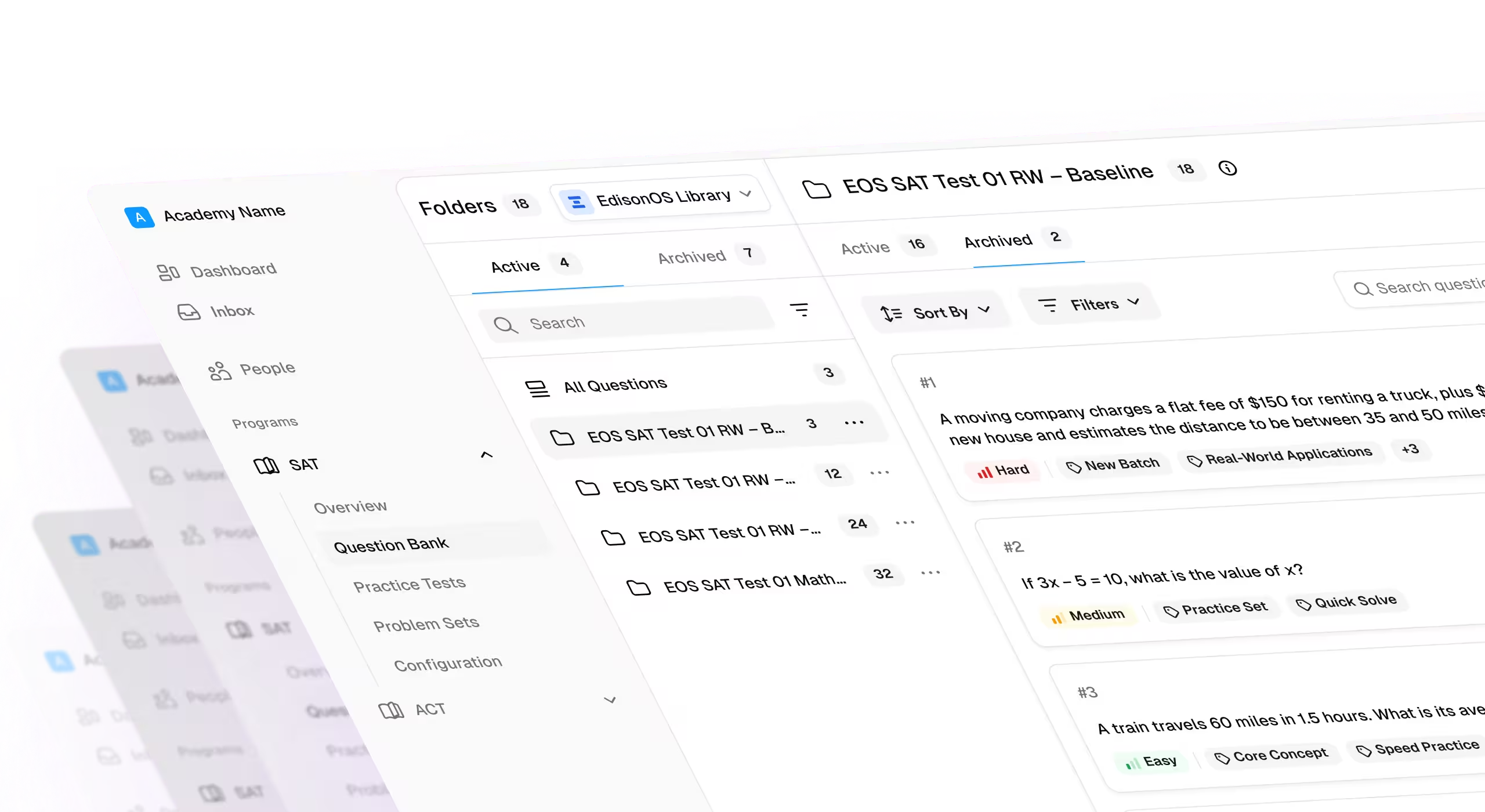
- Expert curation question bank: At EdisonOS, we are equipped with a question bank with 5000+ questions prepared by top industry experts with 2 decades of experience. Unlike platforms that rely on AI-generated content, we have a human-led approach that guarantees that students are exposed to questions that meet the content standards of the adaptive Digital SAT. Plus, EdisonOS also lets tutors create their own mock tests or practice tests with their questions in less than an hour.
- Molecular-level performance analytics and reporting: This platform offers molecular-level reporting that breaks down student performance by section, skill area, question type and time spent per question. This report gives detailed insights for tutors on how their students are performing. They can identify patterns and spot the learning gaps in a particular section, and based on this, they can provide targeted tests for the skills that need improvement.
- Customizable scale score system: We have designed a scaled score that mimics how the real test results are calculated. This helps students get familiar with the DSAT scoring system they will face. Plus, tutors can add their own scores on the customizable dashboard.
How EdisonOS Empowers Tutors for Digital SAT Success
EdisonOS is a purpose-built Digital SAT platform designed for tutors to craft high-quality practice tests, simulate the official exam environment, and access powerful student performance analytics. Since the Digital SAT's complex scoring system considers both question difficulty and correctness, tutors need sophisticated tools to prepare students effectively and demonstrate measurable results.
Why Tutors Choose EdisonOS:
- Expert-Vetted Content at Scale: Access 5000+ SAT experts-vetted questions and 22 expert-designed adaptive tests, helping tutors boost student scores by 200+ points
- Rapid Test Customization: Build your own practice tests that mimic the real test-taking experience in under 60 minutes, allowing you to target each student's specific weak areas
- Authentic Test Environment: Mimics the Bluebook interface to reduce test anxiety and familiarize students with the real test format, ensuring students are comfortable before test day
- Data-Driven Insights: Detailed breakdown of student performance where every second spent is analyzed, with tutor-centric tools to manage multiple students, track progress, and create personalized study plans with ease
Ready to transform your Digital SAT tutoring? Join thousands of tutors using EdisonOS to deliver measurable results and help students achieve their target scores.
Frequently Asked Questions
.svg)


.png)