- An SAT tutoring service sells tutoring directly to students and families, while an SAT tutoring platform gives tutors the infrastructure to run their own program.
- EdisonOS and MentoMind are built around Digital SAT content, assessments, student tracking, and tutor-facing tools.
- Wyzant is primarily a tutor marketplace, while PrepScholar, Kaplan, and Varsity Tutors primarily sell tutoring and test-prep services directly to students.
- Tutorbase focuses on tutoring-business operations, including scheduling, billing, CRM, and payroll, rather than specialized SAT content.
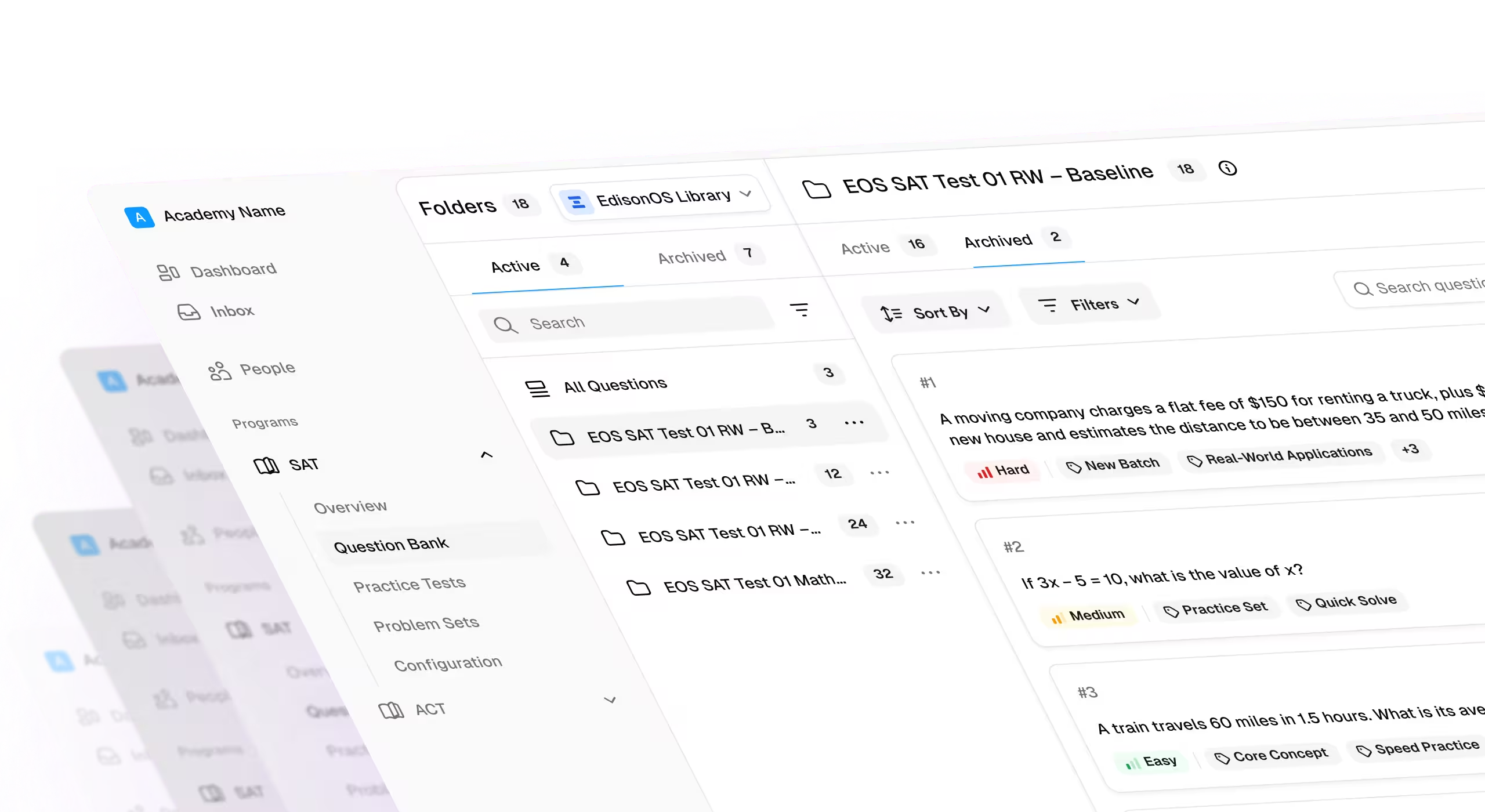
- EdisonOS offers white-labeling, SAT content, assessments, student management, analytics, and a branded tutoring environment, with published Academy Plan pricing starting at $49/month or $299/year.
- The right choice depends on whether you need SAT infrastructure, business operations, student acquisition, or a combination of these.
If you're an independent SAT tutor or run a small tutoring business, choosing a platform is different from choosing an SAT tutoring service for your child. A tutoring service delivers the finished experience to a family; a tutoring platform is infrastructure that a tutor can build a business around.
This guide compares the major options on Digital SAT content, assessments, branding, student management, business operations, and pricing transparency, including where each option leaves gaps as a tutoring business grows.
How Choosing an SAT Tutoring Platform Actually Works
Two questions help separate the platforms from the services:
- Who does the platform serve? A tutoring service such as PrepScholar or Kaplan sells a completed tutoring experience to a family. A platform such as EdisonOS or MentoMind gives a tutor tools to deliver their own program under their own business.
- What does the platform actually do for the business? Some platforms focus on SAT content and assessments, while others handle scheduling, billing, CRM, or payroll. A few combine content and tutoring-business infrastructure, but they do not all cover the same functions.
Best SAT Tutoring Platforms at a Glance
The platforms below solve different problems. Some help a tutor deliver SAT preparation, some help them find students, and others help them operate a tutoring business.
Best SAT Tutoring Platforms for Independent Tutors
1. EdisonOS
Who it's for: EdisonOS is best for independent SAT tutors and tutoring businesses that want to build and run their own branded Digital SAT program. It is particularly suited to tutors who need more than content alone and want one platform for assessments, student management, performance analytics, and test-prep delivery.
What it offers: EdisonOS provides:
- White-label Digital SAT platform: Deliver SAT preparation under your own brand, with a branded student environment.
- Digital SAT practice and assessments: Create and assign practice tests and full-length assessments designed around the Digital SAT experience.
- Question bank: Access 8,000+ expert-crafted questions across the platform for targeted practice and assessment creation.
- Diagnostics and analytics: Identify student strengths and weaknesses with performance data and tutor-facing analytics.
- Student management: Manage students, assignments, practice activities, and progress from one platform.
- Parent-ready reporting: Share clear performance information with parents to demonstrate progress and identify areas for improvement.
- Tutor and institute workflows: Support structured test-prep delivery across individual tutors, cohorts, and growing tutoring businesses.
Where it falls short: It is primarily test-prep infrastructure rather than a complete tutoring-business ERP covering functions such as payroll and full CRM operations.
Pricing: EdisonOS uses a tiered Academy Plan designed for different stages of tutoring businesses. The Basic plan costs $49/month or $299/year, while the Pro plan costs $149/month or $1,499/year. Larger organizations can use the Enterprise plan with custom pricing.
The Academy plans cover the core platform and its tutoring-business features, while student licenses and test credits are priced separately based on usage. This lets tutors choose a platform plan based on their operational needs and scale student testing separately, rather than paying the same testing cost regardless of usage.
2. MentoMind
Who it's for: Tutors and tutoring businesses that want white-labeled Digital SAT content, adaptive practice, diagnostics, and student or parent reporting.
What it offers: MentoMind provides 3,500+ SAT practice questions, adaptive full-length tests, diagnostics, skill tracking, targeted homework, white-label branding, parent reporting, and payment collection. Its institutional offering supports both one-to-one and group instruction.
Where it falls short: Its core focus is learning and test-prep delivery rather than the full operational stack of a tutoring business, such as comprehensive scheduling, payroll, and CRM.
For individual users, MentoMind publishes plans starting with a free tier and an Elite Performer plan at $24.99/month or $149.99/year. Tutor and institutional pricing is custom and depends on student volume and white-label requirements.
3. Wyzant
Who it's for: Independent tutors who primarily need a marketplace for finding prospective students.
What it offers: Tutors create profiles, set their own rates, and connect with students through Wyzant. Wyzant also handles lesson payments through its platform.
Where it falls short: Wyzant is not designed to give a tutor a proprietary SAT curriculum, white-label learning environment, or dedicated SAT assessment infrastructure. It is primarily a marketplace and transaction layer.
Wyzant currently states that tutors retain 75% of their posted hourly rate, with Wyzant retaining a 25% platform fee.
4. Varsity Tutors
Who it's for: Students and families looking for managed tutoring, classes, practice tests, and test-prep resources.
What it offers: Varsity Tutors provides SAT tutoring, live classes, diagnostics, practice questions, full-length tests, and a learning platform. Its SAT service includes tutor matching and personalized plans.
Where it falls short: It is primarily a tutoring service and learning ecosystem for students rather than infrastructure that an independent tutor can deploy as their own branded SAT business.
Its current SAT offering includes 1-on-1 tutoring packages, live classes, self-study resources, diagnostics, and practice tests.
5. PrepScholar
Who it's for: Students and families purchasing packaged SAT preparation directly.
What it offers: PrepScholar combines online SAT preparation with tutoring, diagnostics, practice tests, homework, and personalized instruction. Its current SAT tutoring packages range from $995 for 4 hours of tutoring to $4,795 for 32 hours, alongside its online prep content.
Where it falls short: The product is sold as a finished tutoring service rather than infrastructure for an independent tutor to put their own brand and curriculum delivery on top of.
6. Kaplan
Who it's for: Students and families looking for an established, family-facing SAT preparation provider.
What it offers: Kaplan combines live instruction, private tutoring, practice tests, score analysis, books, and online resources. Its current SAT tutoring and course offering includes private tutoring alongside an 18-hour live SAT course and four full-length adaptive practice tests.
Where it falls short: Like PrepScholar, Kaplan is primarily a direct-to-consumer tutoring and test-prep brand rather than a white-label platform for independent tutors to operate under their own identity.
7. Tutorbase
Who it's for: Tutoring businesses that need operational infrastructure as they grow.
What it offers: Tutorbase focuses on scheduling, billing, CRM, payroll, student management, family accounts, teacher availability, and other tutoring-business workflows. Its current pricing is 1% of invoiced revenue, with no setup fee.
Where it falls short: Tutorbase does not specialize in Digital SAT content, adaptive SAT assessments, or test-prep analytics. A tutor using it for an SAT business would still need a separate SAT content and assessment system.
SAT Content Platforms vs. Tutoring Business Tools
The distinction matters because content and operations are different problems. A tutor can have excellent scheduling software and still spend hours building SAT assessments. Conversely, a strong SAT question bank does not automatically solve billing, payroll, or lead management.
How EdisonOS Approaches Independent SAT Tutoring Businesses
EdisonOS is positioned around the part of the workflow that dedicated SAT tutors need most: delivering and managing test preparation under their own brand.
- Transparent pricing: EdisonOS publishes Academy Plan pricing instead of requiring every tutor to request a quote. Basic starts at $49/month or $299/year, while Pro starts at $149/month or $1,499/year.
- White-label platform: Tutors can configure their logo, name, and domain so students interact with a branded environment rather than a generic third-party test-prep site.
- Built-in LMS and SAT content: Tutors can assign full-length tests, targeted problem sets, and other SAT preparation content from the platform's library. EdisonOS currently lists 8,000+ questions and 15 SAT full-length mocks.
- Student and instructor management: Tutors and tutoring businesses can manage students, assignments, practice activities, and performance from the platform rather than maintaining separate tracking systems.
- Live classes plus assessments and analytics: Tutors can combine live instruction with digital practice, then use performance data and skill-level reporting to identify gaps and guide subsequent sessions.
Tutors typically start looking for this kind of platform when their SAT practice materials, mock tests, student data, and reporting have become too fragmented to manage efficiently across separate tools.
Using Separate Tools vs. a Dedicated SAT Platform: Which Is the Better Fit?
There is no requirement to consolidate everything. The question is whether the time saved by integration is worth changing a workflow that already works.
When Separate Tools Make Sense (And When an All-in-One Platform Is a Better Choice)
Separate tools can make sense when:
- You already have a scheduling or billing system that your business relies on and don't want to replace it.
- You're a solo tutor with a small roster and can manage student data and assignments without significant administrative overhead.
- You prefer best-of-breed tools, such as one specialist SAT question bank and a separate CRM or accounting system.
An all-in-one platform is a better choice when:
- You're managing multiple
instructorsand need consistent content, assessments, and student tracking across the team. - Juggling multiple logins is costing time, particularly when moving assignments, scores, and student data between systems.
- You want one brand across the student experience, from SAT practice and assessments to progress reporting.
Conclusion
Choosing an SAT tutoring platform is ultimately a question of what you need the platform to do for your business.
A marketplace such as Wyzant can help with student acquisition. A business-management platform such as Tutorbase can handle scheduling, billing, CRM, and payroll. SAT-focused platforms such as EdisonOS and MentoMind add the content, assessments, diagnostics, and student-performance infrastructure needed to actually deliver Digital SAT preparation.
For a solo tutor with a small roster, separate tools may be perfectly workable. As your business grows, however, managing multiple systems for content, assessments, student data, branding, and reporting can become increasingly difficult.
Before choosing a platform, look beyond the size of its question bank or the number of features on its website. Ask whether it supports the current Digital SAT, gives you useful student-level data, fits your teaching workflow, and lets you deliver the experience under your own tutoring brand.
If you're looking for a platform that combines Digital SAT content, assessments, analytics, student management, and white-label capabilities, you can explore EdisonOS's Digital SAT platform.
Frequently Asked Questions