- You don’t need a teaching degree or certification to become an SAT tutor.
- Master SAT content, digital testing, Bluebook, and student-level problem-solving techniques.
- Build credibility through score history, testimonials, teaching experience, and documented student results.
- Set competitive rates and choose a tutoring model that fits your expertise.
- Build a reliable pipeline through marketplaces, referrals, networks, content, and local opportunities.
- Use systems to manage scheduling, practice, progress tracking, billing, and parent communication.
- Scale sustainably by standardizing your tutoring process and reducing repetitive administrative work.
There is a clear distinction between how to tutor and how to become a SAT tutor that people will pay for, and this blog is about the latter.
To many people, becoming a SAT tutor may appear to be incredibly complex and challenging - To a handful of others, if you ask for tips on how to become a SAT tutor, they’ll say, ‘It’s simple - just start and you’ll learn on your way’.
Neither is accurate, as you’ll soon discover.
The basic questions to answer and the basic preparations remain the same, no matter whether you’re considering SAT tutoring as a career or side business. Here’s what this guide covers:
- What's actually required to start (and what isn't)
- How to build credibility without a formal certification
- What separates tutors who build a sustainable practice from those who stall out
- What makes someone hireable, not just someone who is available for tutoring
- Where EdisonOS fits for tutors ready to formalize their business
SAT Tutor Requirements at a Glance
Here’s a quick summary of the requirements to be a SAT tutor:
How Becoming an SAT Tutor Actually Works
If you request a seasoned tutor to share their inputs on how to become a SAT tutor, they will most likely tell you that the ground reality can be different. You may be working with teenagers and high school students, but their financiers - the parents - impact what it actually means to be a SAT tutor.
Two things stand out in particular:
- Credibility signals: The fewer credibility signals you have, the harder your chances of being hired. If you, for instance, don’t have a long history of improving scores or you can’t boast of many testimonials, parents will grow increasingly reluctant to hire you.
- Client expectations: Some would-be tutors believe that teaching and conducting tests is all they need to do. That belief isn’t true; in fact, that describes only half the activities. The other half requires you to meet client expectations, including parents receiving progress updates, students getting adequate practice material, and your schedule being flexible. It is not surprising to find new tutors being overwhelmed by this.
If you’re planning to become a SAT tutor, one of the first things you need to realize is tutoring is a client-service business; tutors need to deliver more than just good tutoring.
How to Become a SAT Tutor: 9 Steps to Get Started
The answer to the question ‘how to become a SAT tutor’ is not something you can encapsulate inside a formula. A number of competencies and activities need to combine for the tutor to get tutoring right.
Here are the 9 steps to follow when you’re gearing up to be a successful SAT tutor:
1. Master the SAT and digital format
It sounds like a no-brainer, right? Like, who’d want to become a SAT tutor and not master the SAT test content?
Mastering the SAT isn’t only about solving all the questions. There are two subtle but non-negotiable aspects:
- Solving it efficiently: That means solving the question within the time limit and using the best sequence of steps. If a method is easy but very lengthy, or if the method is short but extremely complex to learn, your students are unlikely to benefit from that.
- Solving it at the student level: You should be able to solve the question using what’s given right there, using what high school students are expected to know. Any formula that’s beyond high-school (say, a theorem you learned at your graduate school), even if relevant, is not acceptable. You should be able to understand what the students experience.
Equally important is knowing the digital format of the SAT very well. You should know how the adaptive nature of the SAT works. You should be fully conversant with the on-screen tools and how to best use them. When you recall every single detail, your students begin to respect your proficiency. Helping students manage SAT test anxiety is another thing you should be good at.
2. Decide whether you need a degree or teaching background
There’s a considerable truth in the saying that a degree is often required before you enter the classroom, not after. It means hiring managers or parents sometimes first screen you on the basis of your degree. But once you begin tutoring, your tutoring skills matter more than the degree you earned.
When your students consistently score 1500+ on the SAT, your college degree matters less than ever before.
A teaching background or experience is important but for a slightly different reason. Let’s say you’ve taught psychology (something unrelated to the SAT) in the past. However, if you’ve been able to tutor well, it means you have the system of making sure your students understand what you want to explain. You should be able to communicate ideas fluently and lucidly, and that matters as much as your domain mastery.
3. Build proof that you can deliver results
Vincent has never tutored SAT aspirants earlier, but he’s interested in doing so. So he comes up to you and says, “Bro, can you guide me on how to become a SAT tutor?”. And you say just two words, “Build proof.”
This two-word tip might be one of the most important suggestions. That’s because it will change how Vincent looks at tutoring - his approach shifts from being just another tutor to someone who understands the service business. He will know how important customer testimonials, track record, and documentation are.
Here are the different ways Vincent could build proof:
- Other tests: If he has tutored for other standardized tests, he can reach out to past students to request testimonials.
- Informal teaching: Perhaps Vincent has tutored his friends during high school or college. Maybe it was an informal arrangement.
- Teaching assistantship: During his university days, Vincent had taken up the role of a TA under his professor. His record there can be a solid way to establish his tutoring or related abilities.
- Working with the underprivileged: Did Vincent work with a not-for-profit that helped underprivileged kids to get an education? His teaching contributions with that not-for-profit are another way to establish proof.
- Own score: Maybe he has taken the SAT in the recent past and achieved a 1500+ score. That is strong evidence that Vincent knows his stuff.
4. Consider optional certifications
Depending upon how the hiring organization looks at certifications, this can cut down the time one’d need to become a SAT tutor.
While there’s no federal agency or an official body that is authorized to rate and certify potential SAT tutors, there are three alternatives available (the fourth is currently inactive):
- Schoolhouse: You can volunteer to tutor and simultaneously help others in their journey too. Along the way, you’ll receive support and guidance from experienced tutors too. More details are available on the Schoolhouse page for tutors.
- National Tutoring Association (NTA): The NTA has multiple tutoring certifications available, from Basic Level to Master level. As you scale higher levels, requirements will tighten, but you’ll also receive greater recognition. There are some specialized tutoring certifications too - for instance, Math Tutoring Certification. Visit the NTA website for additional information.
- American Tutoring Association (ATA): The ATA model offers different types of certifications. In addition to the regular programs, there are programs that will guide you on how to run a tutoring business. There are tiny modules (US$10 onwards) that count towards the total certification credits. Check out the details on the official ATA website.
- Harvard’s Center for Public Service and Engaged Scholarship: They used to have a SAT tutor certificate program, but it’s discontinued. If you are really keen to follow up, you can keep checking Harvard’s official page.
5. Set your rates and tutoring model
So, how much should you charge? There’s no single correct answer.
As a new tutor, it can be tempting to charge very little simply because you don’t have a long track record. But being the cheapest tutor in town isn’t necessarily the best way to build a tutoring business. Your rate should reflect your current level of expertise while leaving room to increase it as you build evidence of results.
You also need to decide how you want to tutor. Will you offer one-on-one sessions, small groups, or both? Will students pay by the hour, buy a package, or enroll in a longer program? Start with a model you can deliver consistently. You can always adjust your rates as your experience grows, or when you offer different packages.
In case you want to know the range, new SAT tutors are typically paid between US$25 and US$50 per hour. It goes without saying that you can arrive at a realistic figure after accounting for cost of living, skills, track record, and more.
6. Choose where/how you'll find students
Finding someone willing to pay you to teach is the trick question inside the larger query of how to become a SAT tutor.
When you're starting out, you have several ways to find students. You could:
- Join a tutoring marketplace,
- Build your own website,
- Use your personal and professional network,
- Consider offering free sessions on, say, YouTube
- Ask existing contacts for referrals, or
- Work with local schools and educational organizations where appropriate
Each route has its trade-offs. A marketplace may bring you students faster and take care of many things, but you'll have less control over the customer relationship. Building your own brand takes longer, but gives you greater control.
Once you get the early students, look for ways to leverage that. Keep testimonials, ask for referrals, document results, and build a pipeline so that finding your next student doesn't become a monthly emergency.
7. Build a system for delivering tutoring
Imagine having 15 students and trying to remember every student's homework, test scores, weak areas, upcoming sessions, and parent conversations. Even if you could manage it for a while, it’s not the right approach to scale. So better learn it when you’re still trying to figure out how to teach the SAT.
This is why a tutoring system matters. From the beginning, create a simple process for scheduling sessions, assigning practice, recording student performance, tracking progress, and communicating updates to parents.
Your system doesn't have to be complicated. A spreadsheet, calendar, shared folder, and a consistent lesson structure may be enough when you have only a few students.
And yes, remember, the good old consistency is key. Every student should know what they are expected to do between sessions, and you should be able to see whether they're actually improving. As your student base grows, you can move from separate tools to a tutoring platform that brings these activities together.
8. Turn initial students into a sustainable practice
Remember, your first few students are less of customers and more of ambassadors. They are a kind foundation of your tutoring business.
So observe closely. Which explanations work? Where do students struggle? How much practice do they actually complete? What kind of progress can you demonstrate after several weeks? What keeps them motivated? How do you use the SAT test generator amidst all this?
Document these learnings and use them to improve your tutoring process. At the end of a successful engagement, ask students or parents for feedback. Don’t shy away from asking for a testimonial. And, where appropriate, request a referral too.
Remember that over time, you want to move from “I tutor SAT students” to “I have a SAT tutoring system.” That means having a defined teaching approach, useful materials, progress tracking, a reliable way to attract new students, and even a sketchy blueprint for future expansion.
9. Aim to scale without burning out
Getting more students doesn't necessarily mean you’re building a better tutoring business, if you’re doing all the legwork yourself.
If you are personally teaching every session, answering every parent message, creating every practice test, managing every payment, and coordinating every schedule, adding more students simply adds more work. Your income may grow, but so does the number of hours you spend working. And you can only do so much.
This is where you need to decide what you actually want your tutoring business to become. You could remain a solo tutor and deliberately limit your roster. Or you could introduce group classes, standardized lesson materials, additional tutors, or technology that handles some of the administrative work.
The goal isn't necessarily to teach hundreds of students. It's to build a model where your time, income, and workload remain sustainable as your roster grows.
Additional resources / Reference articles
The hiring website Indeed has a good article on becoming a SAT tutor. Although not highly detailed, it highlights most of the important steps.
You can volunteer to be a SAT tutor at the Schoolhouse - check the webpage we mentioned earlier.
Manual Tutoring Management vs. Platform-Managed Tutoring
The reason some tutors choose manual tutoring management over platform-managed tutoring is the initial costing. Manual tutoring management can cost next to nothing initially; platform-managed solutions require a specific investment.
In a short time, however, tutors outgrow manual tutoring management. As the SAT tutoring business expands, its complexities increase too. There’s so much to be done and without strong systems, you’ll soon end up feeling you’re doing everything except growing your business.
How EdisonOS Approaches Independent SAT Tutoring
A strong platform works as the backbone that brings quality content, improves operations, and facilitates growth. EdisonOS works silently in the background to make sure you can achieve better results and drive growth for your tutoring business.
Here are five key areas which make EdisonOS the top platform for SAT tutoring:
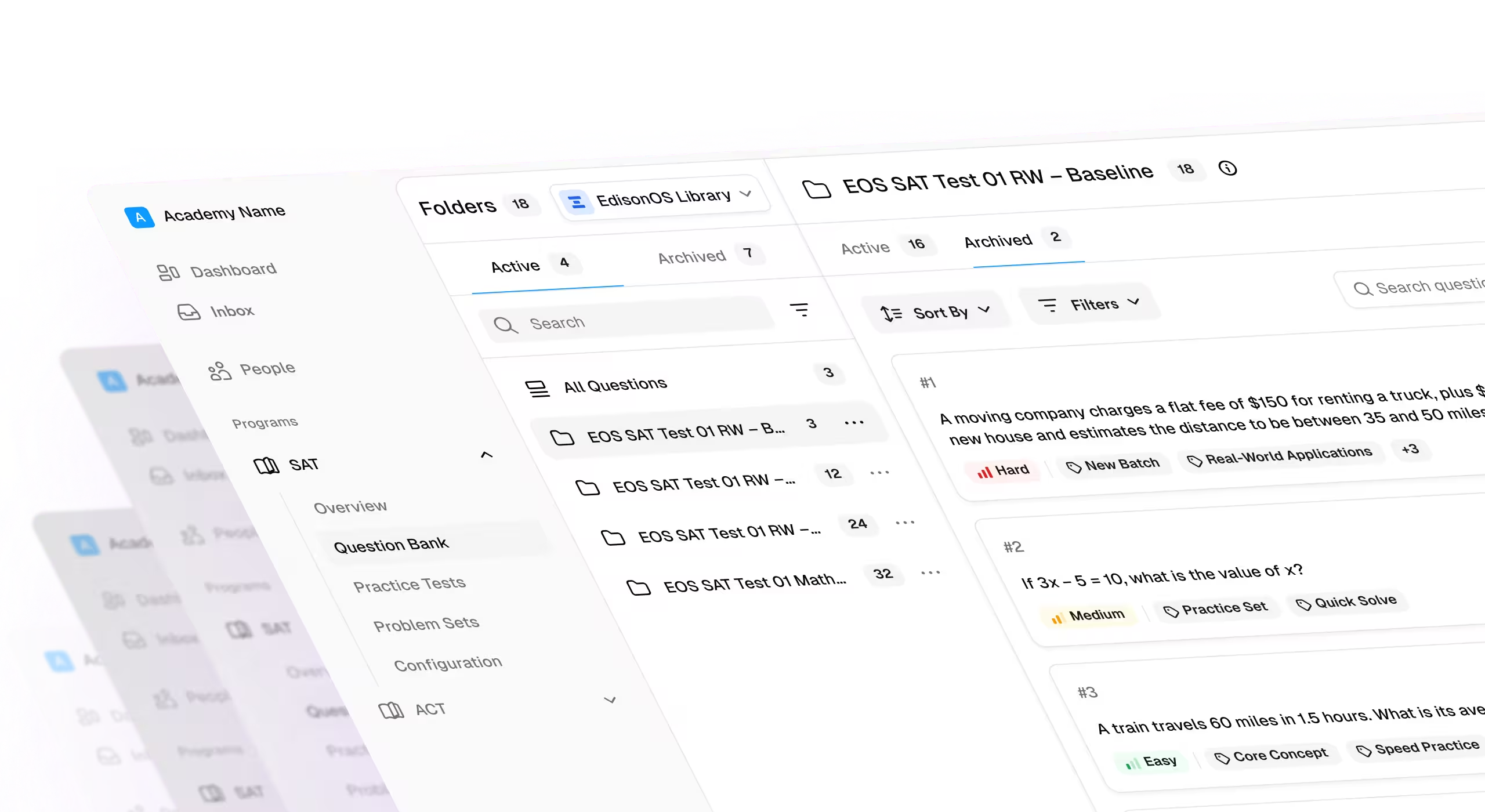
- Built-in LMS for SAT content and lessons: A rich collection of 4,000 expert-generated (not AI-generated) questions build a powerful prep foundation. Tutors don’t need to spend time developing content or lessons. The LMS provides the infrastructure to keep everything organized and efficient.
- Student and tutor/instructor management: EdisonOS gives you complete control over effortlessly managing your students as well as the tutors on your team. You easily schedule classes, assign tutors, oversee assignment of homework, and make sure your resources are being used optimally.
- White-label platform: Only your brand is visible to the outside world; EdisonOS runs silently behind the scenes. Everyone sees your branding, your name on your website, tests, reports, and communications.
- Classes, assessments, and analytics: Building custom SAT practice tests with the Educator Question Bank is easy. The EdisonOS content domain lets you create practice tests the way you want it. Receive clear actionable analytics that tells you which way to guide your students. Become an SAT tutor who not only teaches but drives score improvement.
- Transparent pricing: Complex pricing models or hidden costs only hurt the bottomline. EdisonOS offers clear, transparent pricing - you know what exactly you’ll be charged for. And it’s kept simple, so you don’t feel like you’re cracking a difficult Math SAT section.
Manual Tutoring vs. EdisonOS: Which Is the Better Fit?
Here’s a head-to-head comparison on manual tutoring vs EdisonOS-powered tutoring.
Conclusion
Becoming a successful SAT tutor takes more than mastering the test. You need to build credibility, attract students, and deliver consistent results. Equally important, you’ll need to use systems that make your tutoring practice manageable as it grows.
You can start with simple tools when you tutor a small number of students. However, manual processes can quickly become difficult to manage. A dedicated tutoring platform can bring content, assessments, scheduling, progress tracking, and student management into one place, helping you focus more on teaching and less on administration.
If you’re ready to build a more structured and scalable SAT tutoring practice, EdisonOS gives you the tools to manage your students, deliver SAT content, create assessments, track progress, and grow under your own brand. Explore further to learn why EdisonOS is SAT tutors’ #1 choice or sign up for a free trial and see how EdisonOS can support your SAT tutoring business.
Frequently Asked Questions