- A diagnostic test isn't just a starting score. It's the baseline that tells a tutor which test fits a student better and where their real gaps are.
- Not all wrong answers mean the same thing. Seeley diagnoses errors across three layers: knowledge, recognition, and application, and each one needs a different fix.
- Research backs this up. A seminal review of formative assessment found effect sizes between 0.4 and 0.7 on student achievement, and a 2019 study on diagnostic feedback systems found measurable gains in both achievement and student self-efficacy.
- One-on-one tutoring can act on a diagnostic faster than group instruction. Group programs shift more of that responsibility onto the student.
- Personalization isn't only about content. Seeley's own business changed its intake process to diagnose a student's motivation and preferred coaching style, not just their academic gaps.
- The highest-ROI fixes are often the simplest ones, like grammar rules or memorized geometry formulas, not the hardest questions on the test.
Ask Amy Seeley what her core philosophy is when a new student walks in, and she doesn't start with a study plan. She starts with a question: what's the goal, and what's the most efficient way to get there?
Seeley has worked with over 10,000 students across the ACT, SAT, PSAT, HSPT, ISEE, and GRE in a 30-plus year career, and on a recent episode of the EdisonOS Podcast, she walked through something tutors talk about constantly but rarely explain in detail: how a diagnostic test actually becomes a personalized plan, and why skipping that step is where most generic test prep falls apart.
"It's not even just about improving a test score," Seeley said. "It's sometimes making sure we understand what the goal is and how we can try to be efficient and effective in accomplishing what the student or the family is looking for."
Diagnostic Tests Identifies a Student’s Strengths, Weaknesses, and Test Fit
Most people think of a diagnostic test as a number: a practice score that tells you roughly where a student stands. Seeley uses it for something more specific.
When a student takes a practice SAT or ACT, the raw score is only the first layer. The second layer is comparing scores across tests to help decide which one actually fits the student, since, as Seeley put it, "the numbers might tell you something very easily if one is much higher than the other." But even when scores are close, the diagnostic surfaces something a single number can't: whether a student's struggles come from weak verbal skills, timing pressure, or gaps in specific content areas.
That distinction matters because it changes what the tutor does next. A student who's strong in reading but runs out of time needs pacing work. A student who's strong under time pressure but weak on vocabulary needs something else entirely. The diagnostic doesn't just measure a student. It routes them.
How Knowledge, Recognition, and Application Gaps Affect Test Performance
This is where Seeley's process gets genuinely specific, and it's the part that separates real personalization from a generic study plan.
When a student misses a question, she doesn't just mark it wrong and move to a review sheet. She asks why it was missed, and she's found the answer usually falls into one of three categories:
- Knowledge gap: the student doesn't know the underlying rule at all. Her example is a semicolon: if a student doesn't know it needs an independent clause before and after, that's a missing piece of knowledge that has to be taught from scratch.
- Recognition gap: the student knows the rule, but can't reliably identify when it applies. They understand a semicolon needs an independent clause on both sides, but they can't tell whether a given clause qualifies as independent.
- Application gap: the student knows the rule and can recognize it, but still doesn't apply it correctly under test conditions.
Three students can miss the exact same question for three completely different reasons, and reteaching the rule only fixes one of those students. The other two need something else: practice spotting the pattern, or practice applying it under pressure. Diagnosing which layer a student is stuck on is what makes the difference between generic review and what Seeley calls "very targeted instruction."
What Research Says About Diagnostic and Formative Assessment
Paul Black and Dylan Wiliam's widely cited 1998 review of formative assessment research found effect sizes on student achievement ranging from 0.4 to 0.7 across age groups, from young children through university students, a large enough gain to meaningfully shift where a student lands relative to their peers. The core mechanism is the same one Seeley describes: assessment only helps when it's specific enough to tell a teacher or tutor exactly what to do next, not just how a student is trending.
More recent research backs the same pattern in a more test-prep-relevant context. A 2019 study on a cognitive diagnosis feedback system found that students receiving detailed, attribute-level diagnostic feedback showed measurable gains in both self-efficacy and achievement, and it cut the classroom time spent on unit testing by a third to a half, freeing teachers to spend that time on individualized instruction instead. That's essentially the tutoring version of what Seeley described: less time guessing what to review, more time acting on exactly what a student needs.
How Diagnostic Personalization Differs Between One-on-One and Group Test Prep
Seeley is candid that this level of diagnosis is far easier in one-on-one tutoring than in group programs, and the difference comes down to accountability, not curriculum.
In a one-on-one setting, she can catch a knowledge gap in real time, in the middle of a conversation about why a student picked a particular answer. In group programs, students take diagnostic tests at the start and end of the program, but the responsibility to actually read those reports and ask specific questions falls on the student. "There's more accountability on the part of the student to have a voice and to ask their questions," she said.
It's a filter for who group prep works for. A highly motivated student who reviews their own results and advocates for themselves can thrive in a group setting. A student who needs someone else to notice the gap and name it usually needs one-on-one attention instead.
Tutors Can Use Diagnostic Results to Prioritize High-ROI Score Improvements
Once a gap is identified, Seeley's next move isn't to assign more practice broadly. It's to find the specific fix with the best return on a student's limited prep time.
Her examples are notably unglamorous. English grammar rules are often the fastest score movement available for verbal sections, because the content is finite and teachable. In ACT math, students frequently miss questions simply because they never memorized a geometry formula that the test doesn't provide. "So memorization, rote memorization in geometry for ACT can go a long way for many students initially," she said.
The pattern holds even for high-achieving students, who Seeley says often miss the simplest things, not the hardest questions, because overconfidence makes them read carelessly. The fix there isn't harder content. It's slowing down on the easy stuff. Diagnosing that distinction, hardest-question weakness versus careless-reading weakness, only happens if someone is looking at the pattern behind the errors, not just the score.
Student Motivation and Coaching Style Shape Personalized Test Prep
One detail from Seeley's own business is worth pulling out, because it shows personalization applies to more than content gaps. After a parent complaint that a tutor was being "too tough" on a student who wasn't doing homework, Seeley's team rebuilt their intake process to ask about a student's motivation level, their homework capacity, and what kind of coaching style they respond to, before assigning a tutor.
Knowing whether a student needs a demanding coach or a patient one is its own kind of personalization, and it's just as important to get right as identifying a knowledge gap.
How EdisonOS Turns Diagnostic Results Into Targeted Test Prep Plans
A diagnostic is only as useful as what you do with the results.
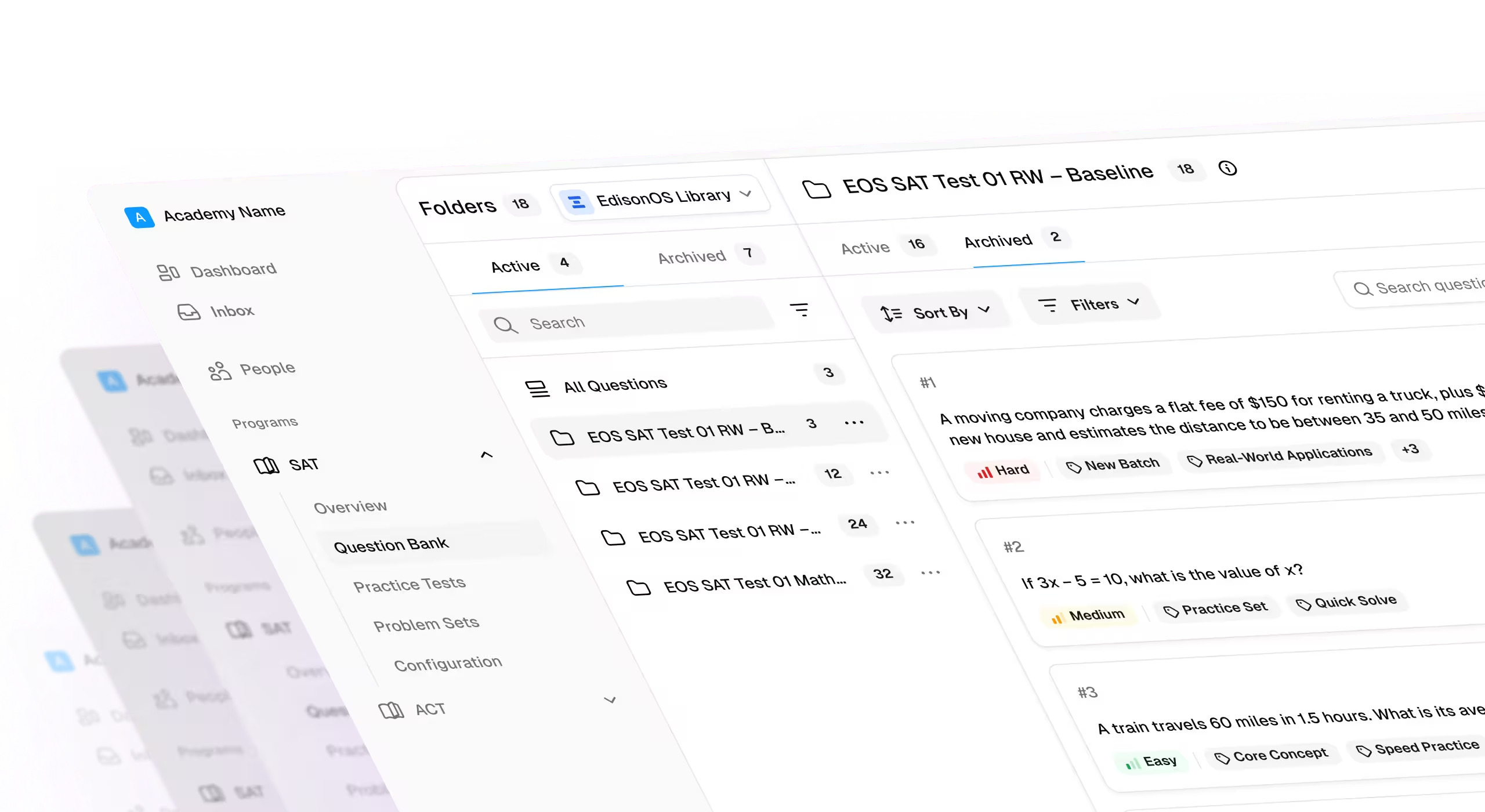
With the EdisonOS Diagnostic Test, tutors can assess where a student stands before building a study plan. Instead of relying on a single score, tutors can use detailed diagnostic insights to understand student performance, identify areas that need attention, and decide what to work on next.
From there, tutors can turn those insights into targeted practice and instruction, giving each student a clearer path forward without spending hours manually piecing together their results.
Ready to make every diagnostic more actionable?
Start your free EdisonOS Diagnostic Test today and see what your students' results can tell you.
Frequently Asked Questions
.svg)


.png)

.avif)