- Digital SAT diagnostics must mirror adaptive routing and difficulty-weighted scoring.
- Inaccurate diagnostics distort expectations, study plans, and parent confidence.
- Error analysis turns diagnostic data into targeted, strategic improvement.
A Digital SAT diagnostic test is often treated as a simple starting point. Give the student a test, get a score, build a plan.
In reality, diagnostics do far more; they shape expectations, influence confidence, and determine how parents evaluate progress over the next several months. When the diagnostic is off, everything built on top of it wobbles.
The problem is that most SAT diagnostics available online, free or paid, are not designed around how the Digital SAT actually works. They test SAT-style content but ignore adaptive routing, difficulty-weighted scoring, and how early performance limits or expands scoring potential.
For tutors, this gap matters.
To understand what a reliable Digital SAT diagnostic should look like, in this guide, we break down:
- How SAT diagnostic tests should work today
- What goes wrong with most online options
- How tutors can use diagnostics to build stronger study plans and parent confidence
Let’s get right into it:
The Problem With Most SAT Diagnostic Tests Found Online
A free DSAT diagnostic test is simple to find and even easier to take. For parents and students, they may appear to offer quick clarity before committing to test prep, but for you, tutors, they often introduce risk rather than insight.
→ The First Issue Is Intent.
Most of the time, a free practice test is a marketing tool. Some are deliberately difficult to create urgency and push enrollments, while others are overly simple, inflating scores to build false confidence.
In both cases, the result is the same: They set incorrect expectations, and you must manage the fallout weeks later.
→ The Second Issue Is That Most Digital SAT Diagnostic Tests Fail At A Structural Level.
They still rely on linear testing models that present the same questions to every student. The Digital SAT does not work this way. It uses a multistage adaptive format, where performance in the first module determines the difficulty and scoring ceiling of the second.
Linear diagnostics cannot capture this routing logic, leading them to overestimate a student’s true baseline routinely.
→ The Third Issue Is That They Lead To Flawed Study Plans.
You set goals for your students based on inaccurate data, progress appears slower than expected, and parents begin to question the strategy. In many cases, tutors must re-diagnose mid-program. It’s not because of the failure of instruction, but because the original diagnostic never reflected the realities of the Digital SAT.
→ Lastly, There Is The Issue Of Scoring Credibility.
Many free tools produce results that appear precise but are generated without proper difficulty weighting or adaptive scoring models. When these scores don’t align with official practice tests, your credibility takes a hit.
How does the Digital SAT Diagnostic test work?
The Digital SAT diagnostic uses a smart, adaptive testing model that adjusts difficulty based on how a student performs.
It works in four steps.
Step 1: The Routing Module
Every section begins the same way. Students enter a first module that includes a deliberate mix of easy, medium, and hard questions.
This is a sorting mechanism. The test is basically questioning how challenging the rest of this exam should be for you.
Performance in this first module decides what happens next.
Step 2: How the Test Adjusts Difficulty
Your early performance shapes the rest of the test. If a student performs well in the first module, the test adapts by presenting a more challenging second module. This keeps the door open to higher score ranges.
If a student struggles early, the test adjusts downward and delivers an easier second module. Even if the student answers most of those questions correctly, the overall score range becomes limited.
This is why early accuracy matters far more in the Digital SAT than it did on the paper test.
Step 3: Why Raw Scores Don’t Tell the Full Story
The Digital SAT uses difficulty-weighted scoring, where harder questions carry more value and some questions do more “scoring work” than others. That’s why two students can get the same number of questions right, but they still walk away with different scores.
It’s not about how many you got right. It’s about which ones you got right, and when.
Step 4: The Unscored Questions
Every module also includes a small number of unscored questions. Students can’t identify them, so every question feels high-stakes. That uncertainty is intentional.
It adds cognitive load, affects pacing, and tests focus over time.
What This Means for Diagnostics
A true Digital SAT diagnostic test must replicate this entire experience, not just the content. Adaptive routing, timing pressure, scoring behavior, and the digital interface all matter.
If a diagnostic doesn’t reflect how the test decides difficulty and score, it’s not measuring readiness. It’s measuring familiarity with SAT-style questions, and those are not the same thing.
What are the key Strategies to Build a Solid Diagnostic Material?
A strong SAT diagnostic isn’t defined by how many questions it includes but by how accurately it reflects the real exam. To do that well, do this:
1. Prioritize Test Fidelity Over Speed
A diagnostic should closely mirror the Digital SAT experience. That includes section structure, timing, and access to the same digital tools students will use on test day. When the environment feels unfamiliar, pacing and performance data quickly become unreliable.
2. Match the SAT’s Actual Content Distribution
Not all topics appear equally on the Digital SAT. A solid diagnostic reflects this balance, ensuring that weaknesses identified are meaningful and aligned with how the test is actually scored.
3. Avoid Writing Questions From Scratch
The SAT follows a very specific logic in question framing and difficulty calibration. Recreating this consistently is difficult and time-consuming. Using verified materials and converting them into digital diagnostics is both more accurate and far more scalable.
4. Build Diagnostics That Can Be Reused
Diagnostics shouldn’t be one-off assets. When working with larger student groups, multiple test versions:
- Help prevent memorization,
- Allow for repeated benchmarking
- Support progress tracking over longer programs
5. Capture More Than Just Right And Wrong Answers
Accuracy alone doesn’t tell the full story. Time spent per question, performance by difficulty level, and module-level behavior reveal whether a student’s challenges are conceptual, strategic, or related to pacing.
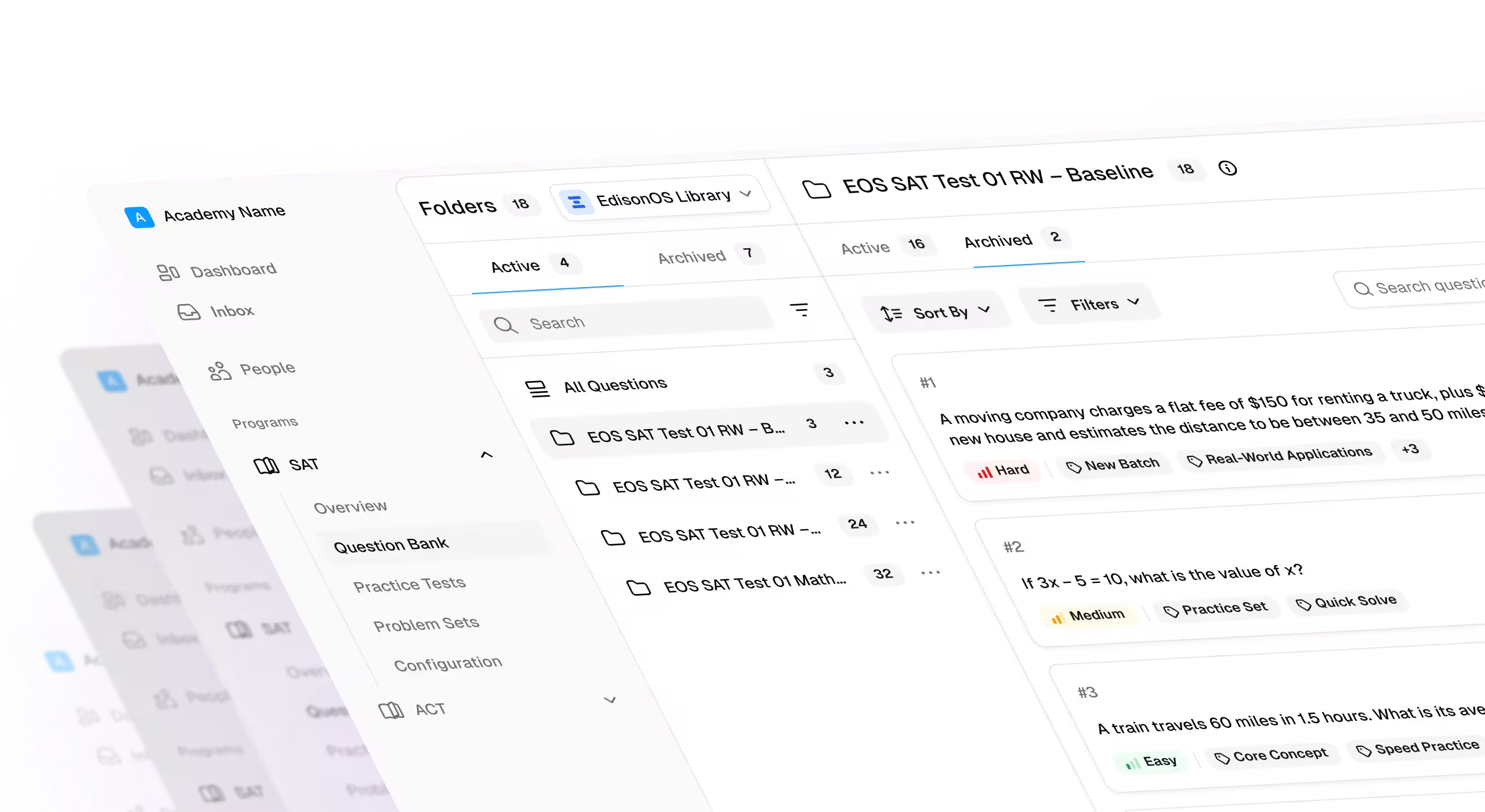
With EdisonOS, SAT diagnostics don’t have to live across spreadsheets, score charts, and separate tools. The platform brings diagnostic testing, scaled scoring, and performance analysis into one place so you can focus on interpretation, not manual work.
EdisonOS helps tutors:
- Run full Digital SAT diagnostic tests in an official-like testing environment
- Generate clear reports with section scores, skill breakdowns, and time analysis
- Maintain consistent scoring and reporting across diagnostics and practice tests
EdisonOS makes it easy to create high-quality SAT diagnostics and deliver a professional, data-backed testing experience from day one.
Try the free digital SAT practice test to see how EdisonOS simulates the digital SAT
testing conditions with built-in timing tools.
How Should You Analyze Your Student’s SAT Diagnostic Results?
An SAT diagnostic score is only the starting point. Here are a few questions to analyze the results.
How Far Are You From Your Goal Score?
Start by comparing the SAT diagnostic test score with the student’s target. This gap shapes the study timeline, intensity, and expectations.
A Digital SAT diagnostic test shows how much work lies ahead. Smaller score increases often come from focused practice and strategy tweaks, while larger jumps require sustained effort across content, timing, and test-taking habits.
This is where expectation management matters most. When you clearly explain what a 100-point versus a 200-point improvement involves, parents understand the roadmap, and students stay motivated from the start.
Which Sections Did You Struggle the Most With?
After identifying the goal gap, break the diagnostic down by section. Overall scores can be misleading.
Many students show uneven performance, strong in Math but weaker in Reading & Writing, or vice versa. Reviewing sections separately helps you spot where score gains are most achievable.
This breakdown also makes it easier to plan instruction and answer parents’ questions, especially when improvements in one section outpace those in the other.
Which Question Types Did You Struggle the Most With?
Section scores show where points are lost, and question-type analysis shows how they’re lost.
On the Digital SAT, students often perform differently across formats. Some handle multiple-choice questions well but struggle with Student-Produced Response items or data-heavy questions. These patterns usually signal format or reasoning issues, not gaps in knowledge.
By analyzing performance by question type, you can target instruction more precisely, focusing on specific skills and strategies instead of reteaching entire topics.
Did You Run Out of Time on the Exam?
Say your student finishes a diagnostic and you explain the correct answers. They nod to signal that they understand, and yet repeat the same mistakes later.
Now, that’s because effective review isn’t about revealing the right answer. It’s about uncovering why the wrong one felt right in the moment.
- Was it a timing decision?
- A misread question?
- A rushed strategy under pressure?
On the Digital SAT, these moments matter.
Early mistakes affect routing, difficulty, and scoring potential. Reviewing errors, then, isn’t just correction; it’s prevention.
The most productive reviews slow the student down, reconstruct their thinking, and force active re-solving. When students explain the solution back and test it themselves, patterns emerge. And guess what? Patterns can be fixed.
That’s when reviewing mistakes stops being repetitive and starts driving real improvement.
What Is the Best Way to Go Over Questions You Got Wrong?
After you review the diagnostic score with clear patterns, the real work begins. You will go through what went wrong question by question with error analysis.
Many tutors often rush this part.
But for tutors like you, such a review is the single most important step in turning an SAT diagnostic test into real improvement. If your students don’t understand mistakes properly, they will keep repeating them (often confidently).
When reviewing incorrect answers, guide students to identify why each mistake happened. In most cases, errors fall into one of four categories:
1. Time-related Issues
Occur when students know the material but can’t finish within the official time limit. Here, the fix isn’t more content; it’s the pacing strategy. Help your students recognize when to move on, estimate time per question, and practice under realistic conditions.
2. Question Comprehension Issues
These occur when students misread, rush, or fall for wording traps. These students often know the concept but misunderstand what’s being asked. Slowing down, identifying key information, and paraphrasing questions can dramatically reduce these errors.
3. Procedural Or Content Gaps
A rather straightforward issue where the student doesn’t know how to solve the problem or lacks the required background. These mistakes signal where targeted instruction or focused practice is needed.
4. Careless Errors
The most frustrating ones are also the most fixable. They usually stem from time pressure, missed details, or common SAT traps. Teaching students to build simple checking habits and leave time for review can significantly reduce them.
When you frame review this way, mistakes stop being random. They become actionable. And that’s where progress accelerates.
How do SAT tutors use EdisonOS to conduct SAT Diagnostic tests
For most tutors, the hardest part of prepping students for the SAT isn’t teaching; it’s everything around it. Creating tests, managing formats, calculating scores, compiling reports, and explaining results to parents all take time that doesn’t scale.
This is where EdisonOS fits into the workflow. You can use the platform to run accurate, professional-grade Digital SAT diagnostics without any manual effort. With EdisonOS, you can:
- Offer Free SAT Diagnostic Test: Administer full SAT diagnostic tests that provide scaled scores, helping establish a clear baseline from day one and build immediate parent trust.
- Run diagnostics in an official-like Digital SAT environment: Replicate the Digital SAT screen, screen by screen, using tools like the Desmos calculator and reference sheet. With EdisonOS, your students can practice in conditions that mirror the real exam.
- Create custom diagnostics in minutes: You can build SAT diagnostic tests quickly using EdisonOS’s SAT-aligned question library or upload your own curated question sets. This will save you hours every week.
- Generate instant, parent-ready reports: Each diagnostic produces detailed reports with section scores, skill-level insights, time management data, and scaled scores, making results easy to explain and defend.
- Customize difficulty and scoring: Adjust scoring logic to analyze performance across different difficulty levels, helping fine-tune study plans and track progress accurately.
- Scale diagnostics without added workload: By automating test creation, scoring, and reporting, you can serve more students while maintaining consistency and quality.
Ready to See How It Works? Run an accurate Digital SAT diagnostic test without manual overhead. Book a demo to see how EdisonOS supports SAT diagnostics for tutors.
Frequently Asked Questions
.svg)



.png)

.avif)