Tutors should teach error analysis by having students build a detailed error log, identify the root cause of every mistake, and use those patterns to guide future practice, preventing repeated errors.
- Build an error log — Track the student's answer, the correct answer, the mistake type, and the correct rule or formula for every missed question.
- Identify the root cause — Push past "what" to "why": content gap (didn't know the rule), misread (solved for the wrong target), execution (right setup, wrong calculation), or timing pressure (rushed with time running out).
- Design targeted practice — Base the next tutoring session directly on the errors actually made, whether it's drilling early algebra concepts or focusing on a weak reading skill like "Craft and Structure."
- Require re-testing — Have the student explain the correct reasoning back in their own words, then give a similar problem days later to confirm they can solve it independently.
A student misses a question on the SAT.
They read the explanation.
They think, “Oh, that’s what I should’ve done.”
And then they miss it again.
This loop is surprisingly common. It’s also why so many students feel stuck even after taking multiple practice tests.
The issue here is that students don’t slow down after a test and figure out what actually went wrong when they picked that answer. Most SAT wrong answer review stops at the explanation, instead of digging into the decision behind it.
A good SAT error analysis makes a difference here. When students learn how to analyze SAT mistakes properly, patterns show up fast: what they rush, what they misread, what they assume without realizing it.
This article breaks down how SAT tutors can teach error analysis in a clear, repeatable way, so wrong answers never become mere guesses.
Why Error Analysis Is Critical for SAT Success?
When students only take mock tests without proper SAT mistake analysis, they quietly rehearse the same mistakes.
Students who pause to analyze their errors improve faster because they’re doing something different after each test. Instead of asking, “What’s the right answer?” they start asking better questions:
- What did I think the question was asking?
- Why did that wrong answer feel safe?
- Was this a content/ timing / or a decision issue?
This is what we call SAT metacognition.
It’s basically thinking about how you think. Students who develop this skill learn to recognize patterns in their behavior, like rushing certain question types, overtrusting instincts, and misreading under pressure.
Students who engage in error-focused review retain more and transfer skills better than students who simply re-read explanations.
In SAT terms, that means this:
Two students can take the same number of practice tests. The one who systematically reviews mistakes: logging errors, spotting patterns, and adjusting strategy, will almost always see bigger score gains.
Error analysis turns practice from something students do into something they learn from. And once that shift happens, improvement starts compounding.
That’s why teaching error analysis is a SAT step that makes all the other work matter.
Take EdisonOS’s free digital SAT practice test and get detailed insights that help you understand where answers go wrong.
What are the 4 Types of SAT Errors Students Make?
A clean SAT mistake analysis starts by putting each wrong answer into the right bucket. Once you know what kind of mistake it is, the next step becomes much clearer.
Here are the four error types that are common on the SAT.
1. Content Gaps (Missing Foundational Knowledge)
These show up when a student doesn’t fully know the material yet. The question feels unfamiliar, or they’re unsure how to start.
This might look like:
- Not remembering a formula
- Being unsure of a grammar rule
- Getting stuck on a concept.
When the issue is a content gap, the fix is easy: learn the missing piece and practice it directly. Taking more full tests won’t help until the student fills this gap.
2. Careless Errors (Arithmetic Mistakes, Misreading, and Bubbling Errors)
These happen even when the student knows what they’re doing. The mistake shows up in execution, not understanding.
You’ll often see:
- Small calculation slips
- Skipping a word in the question
- Marking the wrong answer choice.
Here, the solution isn’t more content. It’s changing how the student works through questions: where they slow down, when they check, and how they manage pace.
3. Strategy Errors (Inefficient Approaches, Poor Time Management)
Strategy errors come from choosing an approach that costs too much time or creates unnecessary risk.
Common signs include:
- Solving everything the long way
- Spending too much time on one question
- Not knowing when to skip and come back.
Fixing these mistakes is about decision-making. Students need help picking smarter approaches and using their time more intentionally.
4. Conceptual Misunderstanding (Knowing the Material but Misapplying It)
These are the tricky ones. The student recognizes the topic and feels confident, but applies the idea in the wrong way.
This often shows up as:
- Using a rule in the wrong situation
- Misreading what the question is really asking
- Mixing up similar concepts.
These mistakes need deeper discussion. Students have to sort out how the concept works, not just what the right answer is.
How to Build an Effective SAT Error Log?
Instead of fixing a question once and forgetting about it, the SAT error log keeps track of what went wrong and what to do next. Over time, it becomes helpful, especially when the same kinds of mistakes start popping up again and again.
What goes into an SAT error log?
Each wrong question gets a short entry.
- Question #: So you can find it again
- Topic/ skill: What the question was testing
- Error type: Content gap, careless, strategy, or conceptual
- Root cause: What caused the mistake in the moment
- Action plan: What to try differently next time.
That’s all you need.
Sample SAT error log:
Teaching Students to Identify Error Patterns
Most SAT errors may feel random, but they’re usually repeats.
Same question type.
Same section.
Same moment in the test.
Teaching students to spot those repeats is one of the most important things to focus on.
What “error patterns” actually look like
Error patterns are specific and very trackable once students know what to look for.
Common patterns include:
- Missing inference questions in reading
- Making careless math errors late in the section
- Struggling with word problems but doing fine on equations
- Slowing down the first half, panicking in the second.
When students only review questions one by one, these patterns become unnoticed. When they zoom out, they become evident.
How to help students start noticing patterns
The change happens when students concentrate on “Where does this keep happening?”
A few simple prompts help:
- Do these mistakes show up in the same topic area?
- Do they happen when I’m short on time?
- Do they show up early, late, or throughout the test?
- Have I seen this mistake before?
This is where error logs and categorized reviews really start doing their job.
Pattern recognition = metacognition
At its core, pattern recognition is SAT metacognition; students become aware of how they think and behave during the test.
They start noticing things like:
“I rush when questions feel easy.”
“I overthink when I’m unsure.”
“I lose accuracy once I check the clock.”
That awareness changes how students approach the next test. They don’t just practice more; they practice differently.
Why does this matter so much?
Fixing individual questions helps in the moment. Fixing patterns changes scores. Period.
When students recognize their own tendencies, they start catching mistakes before they happen. They reduce pace at the right time. They stop repeating the same errors out of habit.
That’s why teaching students to identify SAT error patterns is such a strategic tutoring strategy. It builds test-taking awareness, and once that clicks, improvement eventually happens.
Section-Specific Error Analysis Strategies
Error analysis works best when it’s section-specific.
A ‘reading mistake’ and a ‘math mistake’ might both cost one point, but they usually come from very different places. Teaching students to review errors through the lens of each SAT section makes patterns easier to spot and fixes easier to apply.
Here’s how to break it down:
Reading and Writing: Where Interpretation Goes Off Track
Most reading and writing mistakes aren’t about vocabulary or grammar rules. They’re about interpretation: how students read, infer, and judge tone.
Common error patterns you’ll see:
- Misreading what the question is actually asking
- Misusing punctuation
- Errors in modifier positioning
- Applying a grammar rule in the wrong context.
What to focus on during review:
- Have the student explain why they chose the wrong answer before looking at the explanation
- Ask them to point to the exact line that supports the correct answer.
- For grammar questions, identify what triggered the rule (not just which rule applies).
A helpful reframe for students here is simple:
Every correct reading and writing answer has proof on the page. If they can’t find it, the choice isn’t safe.
Math: Where Execution and Strategy Matter Most
Math errors tend to fall into clearer buckets, which makes them easier and faster to diagnose.
Common error patterns you’ll see:
- Algebraic slips in multi-step problems
- Not remembering formulas
- Confusion when data is presented in tables or graphs
- Not using the right calculator.
What to focus on during review:
- Identify whether the issue happened during calculation or interpretation.
- Check whether the student chose the fastest reasonable method.
- Look for recurring issues within a topic, not just one-off mistakes.
In SAT Math, error analysis is less about getting every question right and more about building consistency. The goal is to help students identify where they need to be more deliberate and where they can work quickly without compromising accuracy.
The Error Analysis Session: A Step-by-Step Framework
Turning wrong answers into a clear plan is the outcome of an effective SAT mistake analysis. The following are the reliable steps in SAT test review strategies tutors can use after every practice test.
Step 1 - Score the test and flag incorrect answers: Score the test, then mark every incorrect question, including guessed answers. This creates the working set for SAT wrong answer review. At this point, the goal is simply to bring in all the data that you will analyze next.
Step 2 - Have the student retry missed questions without time pressure: Ask the student to attempt each missed question again, slowly. This step helps differentiate between misunderstanding, execution issues, and time pressure. For tutors, this step provides clearer insight into how the student is thinking during the test.
Step 3 - Categorize each error together: Now begin SAT mistake analysis. For each incorrect question, assign one error type:
- Content gap
- Careless error
- Strategy error
- Conceptual misunderstanding
Doing this collaboratively is a core part of teaching SAT error analysis. Over time, students begin to recognize SAT error patterns more clearly.
Step 4 - Identify the three highest-impact focus areas: Review the full test and identify three areas that matter most for improvement.
Analyze on points like:
- Which error type appears most often?
- Which mistakes affected timing or confidence?
- Which fixes would reduce future errors across multiple questions?
Narrowing down the focus areas helps with targeted adjustments and follow-through. This step also builds SAT metacognition by helping students evaluate impact rather than react to individual misses.
Step 5 - Create targeted practice assignments: Assign practice based on the identified focus areas.
Effective SAT tutoring strategies here include:
- Drills tied to a specific content gap
- Timed sets to address pacing issues
- Mixed questions to reinforce better strategy choices.
Each assignment should connect directly to an entry in the SAT error log, reinforcing the link between analysis and action.
Step 6 - Review progress in the next session: Begin the next session by reviewing progress in the targeted areas.
Key questions include:
- Did the same error type reappear?
- Was accuracy higher in the focus areas?
- Did the student recognize the issue earlier?
Regular progress review supports stronger learning outcomes. Over time, students internalize the process and develop the ability to analyze SAT mistakes independently.
Common Mistakes Tutors Make When Teaching Error Analysis
Teaching error analysis involves more judgment than most tutors expect. The following are the possible errors you should know while handling the process:
Focusing Only On Content Gaps
Many tutors default to reteaching concepts after every mistake. This overlooks strategy errors and careless patterns that often bring in score plateaus.
Doing The Analysis For The Student
Explaining every mistake may feel efficient, but it prevents students from developing SAT metacognition. During SAT wrong-answer review, students need to articulate why they chose an answer and where their reasoning broke down.
Failing To Follow Through With Targeted Remediation
Error analysis loses value when it isn’t tied to specific next steps. If insights from the SAT error log don’t inform practice assignments, the same SAT error patterns continue to repeat.
Overwhelming Students With Too Many Corrections At Once
Addressing every issue in a single session dilutes focus. Effective SAT tutoring strategies prioritize a small number of high-impact fixes so students can apply changes on the next test.
Tools and Resources for SAT Error Tracking
Tracking your SAT error analysis makes the process easier and more actionable. There is a mix of simple tools and platforms built specifically for test prep that help students and tutors log mistakes, identify trends, and adjust study plans as needed.
Below are the tools you can try:
- Google Sheets or Excel: This is a flexible way to build an SAT error log that automatically summarizes patterns and allows sorting by topic, error type, or date. You can share and update in real time with students.
- Printable error log templates: Tutors can customize weekly or session error logs and print them for students to review after tests.
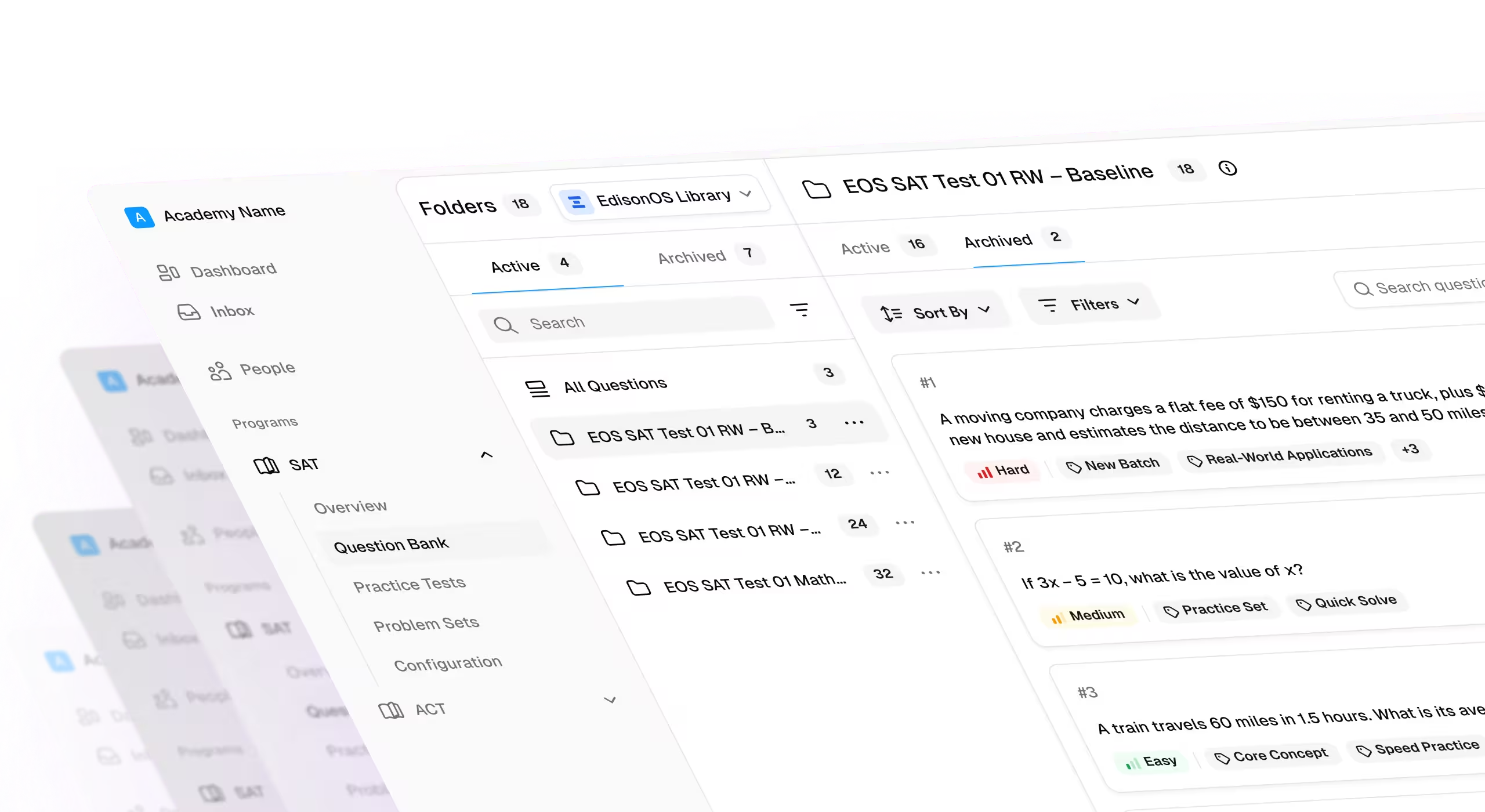
- Prep platforms: EdisonOS provides detailed student performance analytics by topic and test section, and tracks student progress over time. It centralizes performance data, making it easier to spot SAT error patterns and tailor instruction.
How EdisonOS Helps Tutors Teach Error Analysis
In SAT tutoring, error analysis usually breaks down for practical reasons.
Tests live in one place. Notes live somewhere else. Patterns live in your memory. That friction adds up.
EdisonOS fits into this gap by centralizing testing, review, and follow-up, ensuring consistent error analysis across students and sessions. With Edison OS, you get:
- 22 full-length digital SAT tests with real tools and timing. This makes SAT wrong answer review reflect actual test-day behavior.
- Offers different SAT question types, including multiple choice questions across Reading & Writing and Math, useful for spotting recurring SAT error patterns and assigning targeted follow-ups.
- Instant baseline scoring and diagnostics, so SAT mistake analysis starts with data, not assumptions.
- Section scores, skill breakdowns, and timing data that support focused review and build SAT metacognition.
- Customizable practice test (under 15 minutes), helpful for refining SAT tutoring strategies on pacing and decision-making.
Built for SAT tutors, EdisonOS combines realistic assessments, error tracking, and performance insights into one system. Explore how it supports consistent error analysis; book a demo with us.
Frequently Asked Questions
.svg)



.png)

.png)