- The digital PSAT/NMSQT runs 2 hours and 14 minutes instead of almost 3 hours, uses multistage adaptive testing, and includes a built-in calculator for the entire Math section.
- College Board’s 2026 proctor guide lists 28 digital AP Exams: 16 fully digital and 12 hybrid, where students read in Bluebook but handwrite free-response answers on paper.
- UWorld’s Philip Bates says the most overlooked prep skill is familiarity with the testing environment itself, including tools like the Desmos calculator.
- The PSAT works best as a diagnostic for SAT prep, AP placement and National Merit, not as a dress rehearsal.
- Short, consistent practice beats cramming, and AI should save educators time while a human stays in the loop.
For years, PSAT and AP prep meant a stack of paper practice tests and a stopwatch. That picture is gone. The PSAT/NMSQT has been digital since fall 2023, and most AP Exams now run through Bluebook, College Board’s testing app. The content hasn’t changed much. The experience of sitting the exam has, and prep has to change with it.
To understand what that means in practice, we sat down with Philip Bates, Director of College Readiness at UWorld and a former teacher and principal with 18 years in public education, for the EdisonOS podcast. Listen to the full episode for the complete conversation. Below, we pull out what matters most for tutors, schools and community organizations preparing students for the digital PSAT and AP assessment, and back it up with the latest data from College Board.
1. What Actually Changed With Digital PSAT and AP Exams
On the PSAT side, College Board’s own guidance says the digital PSAT/NMSQT is substantially shorter than its paper predecessor, with shorter reading passages and a built-in calculator available throughout Math. The exam is also multistage adaptive: how a student performs in the first module of each section shapes the questions in the second.
Bates sees the shift as a net positive for students. “The fact that these exams are digital excites me. The fact these are adaptive excites me,” he said, pointing to the shorter test, faster scores and better security. College Board makes a similar case on security: in the digital SAT Suite, each student gets a unique but highly comparable test form, which makes sharing answers far harder.
AP is a more mixed picture. Of the 28 digital AP Exams in 2026, 16 are fully digital and 12 are hybrid. In a hybrid exam, students answer multiple-choice questions and view the free-response questions in Bluebook, then write their responses in a paper booklet. The shift is still spreading: College Board has announced that AP Music Theory becomes a hybrid digital exam starting in May 2027.
Bates flagged exactly this as AP’s big open question: whether the hybrid sections eventually go fully digital, and what that does to the exam’s relevance. For prep, the takeaway is practical. Students need to be comfortable on screen and at a desk with a pen.
2. Practice in the Environment Students Will Actually Test In
The most actionable advice in the episode is about format. If a school or tutor prepares students for the PSAT or AP without mimicking the exam’s interface, Bates says, they are leaving points on the table.
“You want those interfaces to match... you want the format and everything to look the exact same because it’s such an easier transition when students are actually taking it live.”
Philip Bates, Director of College Readiness, UWorld (listen to the episode)
That means practicing with the same tools students will see on test day: crossing out answers, annotating passages, flagging questions and using the built-in calculator. Bates singled out Desmos. Because so few students use handheld calculators on these exams, he argued tutors should dedicate several full sessions to using Desmos well, applying it to real problems rather than only drilling concepts. He also noted a small quirk many students miss: anything entered into Desmos in the first part of the PSAT Math section resets when the second part starts. Familiarity with details like that removes surprises on exam day.
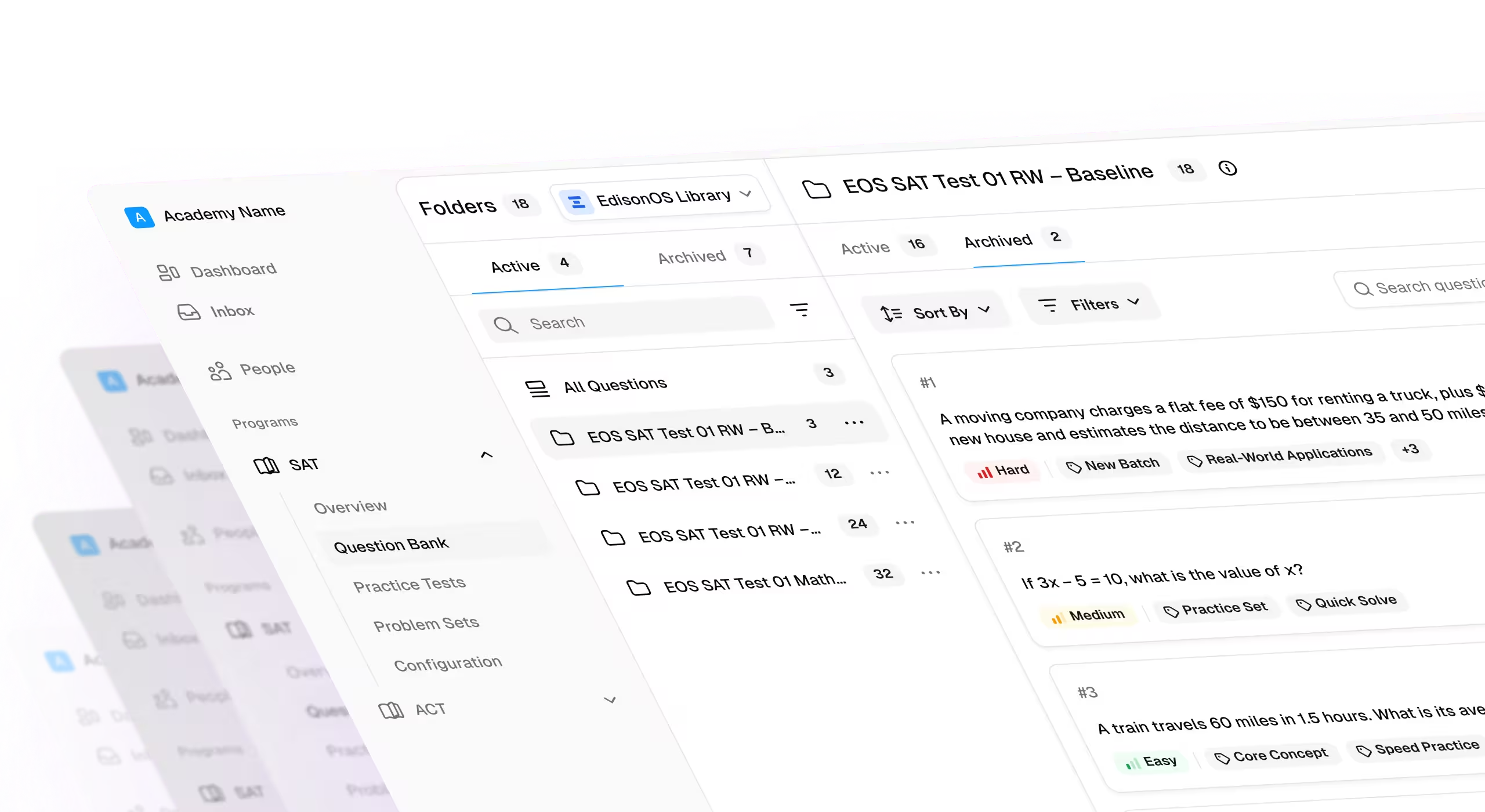
The same logic applies to the Digital SAT, which students often take alongside the PSAT. EdisonOS practice tests are built to mirror the Bluebook experience, so students rehearse in an interface they will recognize on test day.
Try it yourself: Take a free digital PSAT practice test on EdisonOS, or start a free trial to build and assign Bluebook-style tests to your own students.
3. Treat the PSAT as a Diagnostic, Not a Dry Run
A common misconception Bates hears is that the PSAT is just a dress rehearsal, so students shouldn’t prepare. He pushes back hard, and his reasoning is about confidence as much as score.
“Don’t use it as just a dry run or a rehearsal. Use it truly as a, hey, let’s prepare for this exam and get ready for it.”
Philip Bates, UWorld (listen to the episode)
His logic is simple. A student who walks in cold, with no exposure to the digital format, may do poorly, lose confidence and decide against taking the SAT. They also get a muddier picture of their real skill gaps. Schools that offer the PSAT to every student and prepare them for it get something more valuable: district-level data on skill gaps, and a way to spot students ready for AP Precalculus, Calculus or Statistics by looking at their PSAT Math scores. And because the PSAT/NMSQT also feeds National Merit eligibility, a weak result can mean a missed scholarship opportunity.
Bates’s advice for school leaders is to start at the top. If the principal understands why the exam matters and how its data will be used, buy-in follows from teachers, students and the community.
For tutoring companies and CBOs, the same idea applies: diagnostic PSAT practice gives you a starting point for every student, not just a score.
4. The AP Free-Response Gap That Digital Doesn’t Close
Digital delivery hasn’t changed where AP students struggle most. According to Bates, the majority of students who underperform on an AP Exam do so on the free-response section, because essays are harder to teach, slower to grade and impossible to bluff.
“You get into FRQs. You can’t fake it.”
Philip Bates, UWorld (listen to the episode)
He described a pattern in UWorld’s data: teachers who run hundreds of multiple-choice questions but barely touch free-response practice, while a colleague down the hall who works through FRQs, rubrics and pacing sees stronger results. His fix is daily and light. He recommends AP-style questions every single day, just one to three, with students trained to read the explanations properly. A second-year teacher who does this consistently, he says, can out-score a 20-year veteran who doesn’t.
With hybrid exams, there is a second layer. Students read prompts on a screen and write by hand, so practice should include both. Full-length digital AP practice in a Bluebook-style interface, paired with handwritten free-response work, covers both halves of the experience.
5. Smarter, Not Longer: How to Structure Prep
Bates is skeptical of the idea that more questions and more practice tests are automatically better. A better approach is to target what a student doesn’t know and focus there, since a lot of time is wasted on volume.
He used his own son as an example. His SAT prep ran about 180 days, but not in marathon sessions. It was roughly 20 minutes and eight questions at a time, with difficulty and duration building gradually. That is one family’s anecdote, not a controlled study, but it matches what Bates says UWorld’s usage data shows: students who prepare on a plan, and start early, do better than those who cram.
The same “efficiency” lens shapes his view of the exams themselves. Some AP multiple-choice sections run around 75 questions, followed by a long FRQ section. “Are we measuring students’ stamina or are we measuring their ability to show and prove to us that they understand the content?” he asked. He noted that adaptive testing is the easiest way to shorten a test without losing measurement quality, a direction College Board has already taken with the SAT Suite.
6. Where AI Fits, and Where It Doesn’t
Bates’s view on AI is measured. UWorld built an AI essay grader that is now in beta, and teachers split roughly into thirds: some won’t use it, some want AI to grade and then validate, and some want a mix of AI and their own judgment. His conclusion is that any good tool has to meet educators where they are.
He is also clear about limits. “AI is an incredible assistant, an incredible intern, an incredible save you time, but it doesn’t do the work,” he said, adding that human review matters for question quality. For districts that don’t want to fall behind, his first step isn’t buying anything. It’s setting clear standards for how teachers and students may and may not use AI.
7. What Tutors, Schools and CBOs Can Do This Year
- Match the testing environment. Run practice in a Bluebook-style interface so tools and navigation feel familiar. See how EdisonOS supports digital SAT practice, PSAT prep and AP prep.
- Teach the tools. Give Desmos and other built-in tools dedicated session time.
- Use the PSAT diagnostically. Offer it to every student, prepare them, then use the data for interventions and AP placement.
- Make free-response practice routine. Short, frequent FRQ work beats a last-minute push, and hybrid AP exams need handwriting practice too.
- Keep sessions short and targeted. Plan early, practice consistently and focus on gaps.
- Set AI guardrails first. Decide acceptable use before adopting new tools.
Final Thoughts
Digital PSAT and AP assessment hasn’t made the exams easier or harder. It has made the testing experience a skill of its own. The students who do best will be the ones who practiced in conditions that look like test day, treated the PSAT as the diagnostic it is, and built steady habits long before May. As Bates put it throughout the conversation, the goal isn’t to do more. It’s to do what works.
Ready to give your students that test-day familiarity? Start a free trial of EdisonOS or take a free Digital SAT practice test.