.png)
- GPA has lost most of its ability to differentiate students. UCLA's freshman survey data shows an A average has gone from something a small share of students earned to something most students now carry into college.
- What students actually know hasn't kept pace with their grades. The 2024 Nation's Report Card found only 35% of 12th graders proficient in reading and 22% in math, the lowest marks on record.
- AP exams are standardized in a way GPA isn't. Every student sits the same exam under the same conditions, regardless of which high school or teacher graded their coursework.
- The tool built specifically for this job is gone. SAT Subject Tests, once a precise, comparable score, were discontinued in 2021, leaving AP exams as one of the only standardized measures left.
- Reporting rules are tightening around AP scores specifically, not GPA. Stanford and Caltech now require applicants to self-report every AP score they've earned, and about 90% of top-20 schools use, recommend, or require them.
Not every AP score carries equal weight, but even a middling one adds more signal than a GPA line alone. A 5 tends to help, a 4 is largely neutral, and a 3 is often worth leaving off an application to a top-50 school.
Ask a college admissions officer to pick one number that tells them the most about a student, and you'd expect GPA to win by default. It's the number every high school reports, the one parents watch, the one that decides class rank. But talk to David Blobaum, a test prep expert who's spent years inside the admissions data, and a different answer emerges: when it comes to proving academic readiness, AP exam scores are increasingly doing a job GPA can no longer do on its own.
On a recent episode of the EdisonOS Podcast, Blobaum laid out the case for why. "That three, four, five still means massively more than an A in a class," he said. The reasoning is blunt. An A in AP US History could mean a student is one of the sharpest kids in the building, or it could mean their teacher grades generously. Colleges have no way to tell the difference just by looking at a transcript. What they can compare, across every high school in the country, is a 1-through-5 score on a standardized exam.
That's the real question behind AP exams vs GPA: not which one is "better" in the abstract, but which one still tells colleges something true.
What GPA Is Supposed to Measure, and Why It's Stopped Working
GPA is a rolling average of how a student performed across dozens of assignments, tests, and teachers over four years, which is exactly why it used to work reasonably well as a signal: it rewarded consistency.
The problem is what's happened to the grading underneath it. The UCLA Higher Education Research Institute has been tracking incoming college freshmen since 1966, and its longitudinal freshman survey data shows an A average has gone from something a small share of students earned to something the overwhelming majority now carry into college. When almost everyone has an A, an A stops being information.
Meanwhile, the 2024 Nation's Report Card tells a very different story about what students actually know:
- Only 35% of 12th graders scored at or above proficient in reading
- Just 22% reached proficiency in math
- Both are the lowest marks recorded since the 12th-grade assessments began
Put those two data points side by side and you get Blobaum's central worry: grades have never been higher, and proficiency has never been lower. GPA didn't get worse at its job. The thing it was measuring simply stopped meaning what it used to.
What AP Exams Measure Differently
An AP exam solves the one problem GPA structurally can't: it's the same test, scored the same way, taken by students at thousands of different high schools. A 5 in AP Chemistry from one school means roughly the same thing as a 5 from another. An A in chemistry does not.
There used to be an even more precise version of this idea. Until 2021, the College Board also ran SAT Subject Tests, single-subject exams scored out of 800 that gave admissions officers a far more granular read than AP's 1-to-5 scale. A 690 told a very different story than a 700. When the College Board discontinued Subject Tests in January 2021, that precision disappeared right as grade inflation was accelerating. AP exams weren't built to replace that tool, but with nothing else standardized left on the table, they became the next best option colleges had.
GPA vs. AP Scores: Where Each One Actually Wins
- Consistency over time: GPA wins here. It reflects four years of sustained effort, not one exam on one day.
- Comparability across schools: AP wins here. A score means the same thing regardless of which high school issued it.
- Resistance to inflation: AP wins here, though imperfectly. Blobaum's own theory is that some AP scores have gotten easier to earn too (more on that below), but the scale still can't be inflated by an individual teacher the way a grade can.
- Depth of subject-specific proficiency: AP wins here. A single grade in "AP English" can't tell you if a student is strong at rhetoric but weak at close reading. A score, especially back when Subject Tests existed, came closer.
- What colleges say they're actually using: increasingly, AP. Roughly 90% of top-20 schools and about 68% of top-50 schools use, recommend, or require AP scores in admissions.
Neither measure is complete on its own. But when they disagree, that is, when a student has a strong GPA and a middling AP score, admissions officers are increasingly trusting the exam.
Why Scores Went Up Without Students Getting Smarter
There's a wrinkle in the AP-exams-are-more-trustworthy argument, and Blobaum is upfront about it. AP English Language and Composition scores, for example, drifted down for years, hitting a low point where only around 8% of test-takers earned a 4 or 5. His theory, which he flags clearly as speculation, is that the College Board responded by making scoring easier on several exams, largely to stay competitive with dual enrollment courses, which offer college credit without any standardized exam attached at all.
If that's true, AP scores got a little easier to earn right as they became more important to admissions offices. Even so, Blobaum's take is that an inflated 4 or 5 still tells a college more than a transcript full of A's, because at least every student sat the same test under the same conditions. GPA doesn't have that baseline at all.
The Colleges Betting Hardest on AP Over GPA Alone
Stanford and Caltech now require applicants to self-report every AP score they've earned, including scores from exams taken outside their regular high school curriculum. Students can no longer choose to report only their strongest results.
According to Blobaum, here's how AP scores factor into admissions by tier:
- Top 20 schools: roughly 90% use, recommend, or require AP scores
- Top 50 schools: that drops to about 68%
- Below the top 50: AP scores thin out considerably as an admissions factor, and GPA and standardized tests like the SAT or ACT carry more of the weight
His advice for families is fairly specific:
- A 5 helps at competitive schools
- A 4 is largely neutral, neither helping nor hurting
- A 3 is often worth leaving off an application to a top-50 school, even though it may still be worth submitting later for college credit once a student has enrolled
What This Means If You're Choosing Between the Two
The honest answer is that students don't get to choose between AP exams and GPA. Colleges look at both. But the practical takeaway from Blobaum's argument is this: a strong GPA alone is no longer enough to prove readiness at competitive schools, because too many students now have one. An AP score is what turns "this student got good grades" into "this student can prove it."
For a student staring down a course catalog every spring, here's what that means in practice:
- Take as many AP classes as you can handle while still earning A's
- Don't stack AP classes at the expense of grades
- Don't assume a high GPA will speak for itself at competitive schools
- Remember the practical upside beyond admissions: an AP exam is a few weeks of focused prep, and a skipped college course because of it can mean real tuition saved and a real head start on a degree
The College Board Is Betting Big on AP's Future
The College Board isn't slowing down on building out this comparison further in its favor. Two new AP courses, AP Business Principles with Personal Finance and AP Cybersecurity, are launching for the 2026-2027 school year as part of its new Career Kickstart initiative, with AP Networking following in 2027-2028. It's a signal that the AP umbrella is widening into more subjects, which means more chances for students to have a standardized, comparable score sitting next to their GPA rather than relying on the transcript alone.
That's exactly why AP programs are worth strengthening rather than sidelining. Whatever the debate over AP exams vs GPA ultimately settles into, these exams are one of the few tools students have to prove what they actually know, and one of the few tools families have to trust what a transcript is telling them. Supporting students through that rigor, rather than around it, is how the AP program keeps doing the job GPA alone no longer can.
Where EdisonOS Comes In
As AP continues to expand, the challenge for tutors and academic programs isn't simply having more AP content. It's being able to manage the growing complexity of preparing different students for different exams.
That's exactly where EdisonOS is heading.
Today, five AP subjects are already live on EdisonOS:
- AP Calculus AB
- AP Calculus BC
- AP Precalculus
- AP Microeconomics
- AP Macroeconomics
And we're expanding with four more:
- AP Physics 1
- AP Chemistry
- AP Biology
- AP U.S. History
Different subjects come with different learning challenges. But the job for the tutor remains the same: understand where a student is, identify what needs attention, and know what to do next.
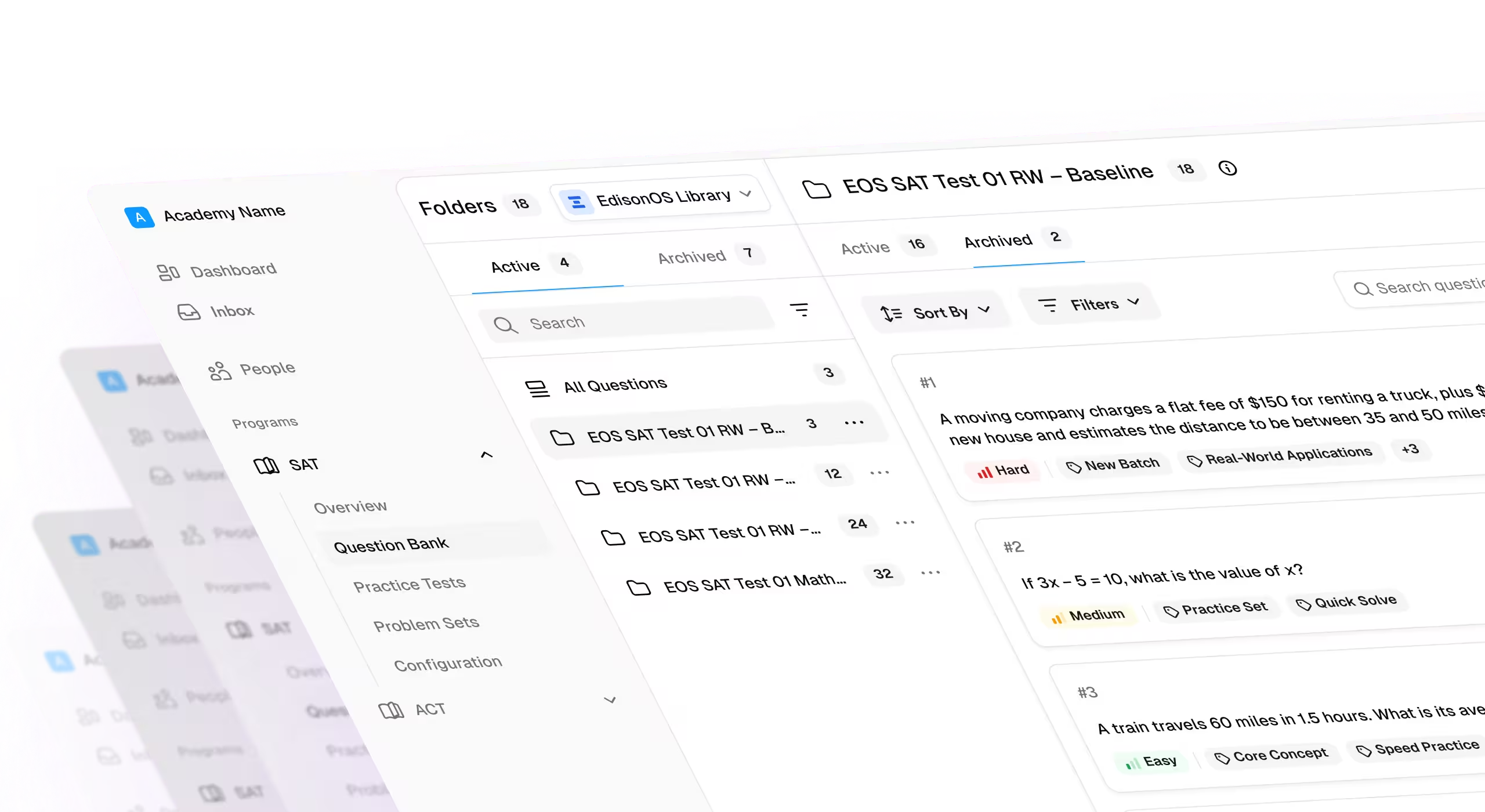
EdisonOS brings the assessment, practice, reporting, and student performance data together so tutors and academic teams can spend less time piecing together information and more time acting on it.
Because as AP grows, better preparation isn't about doing more. It's about knowing what matters next. And that's what we're building EdisonOS to help you do.
That's exactly why AP programs are worth strengthening rather than sidelining. Whatever the debate over AP exams vs GPA ultimately settles into, these exams are one of the few tools students have to prove what they actually know, and one of the few tools families have to trust what a transcript is telling them. Supporting students through that rigor, rather than around it, is how the AP program keeps doing the job GPA alone no longer can, and it's exactly what EdisonOS is built to help tutors do.
Start your free trial and see how a clearer path from AP prep to a score students can be proud of actually comes together.
Frequently Asked Questions
.svg)