- Early official SAT or ACT scores reveal real-condition performance that home practice consistently overestimates, giving tutors a reliable baseline for growth.
- Real test environments expose pressure, pacing, and focus issues that never surface in low-stakes home mocks, driving more targeted prep.
- Using an early official score, tutors can restructure the prep cycle around condition-specific weaknesses, compressing the improvement timeline.
- Timing the first official exam after at least one controlled mock, but before full readiness, maximizes diagnostic value and retake opportunities.
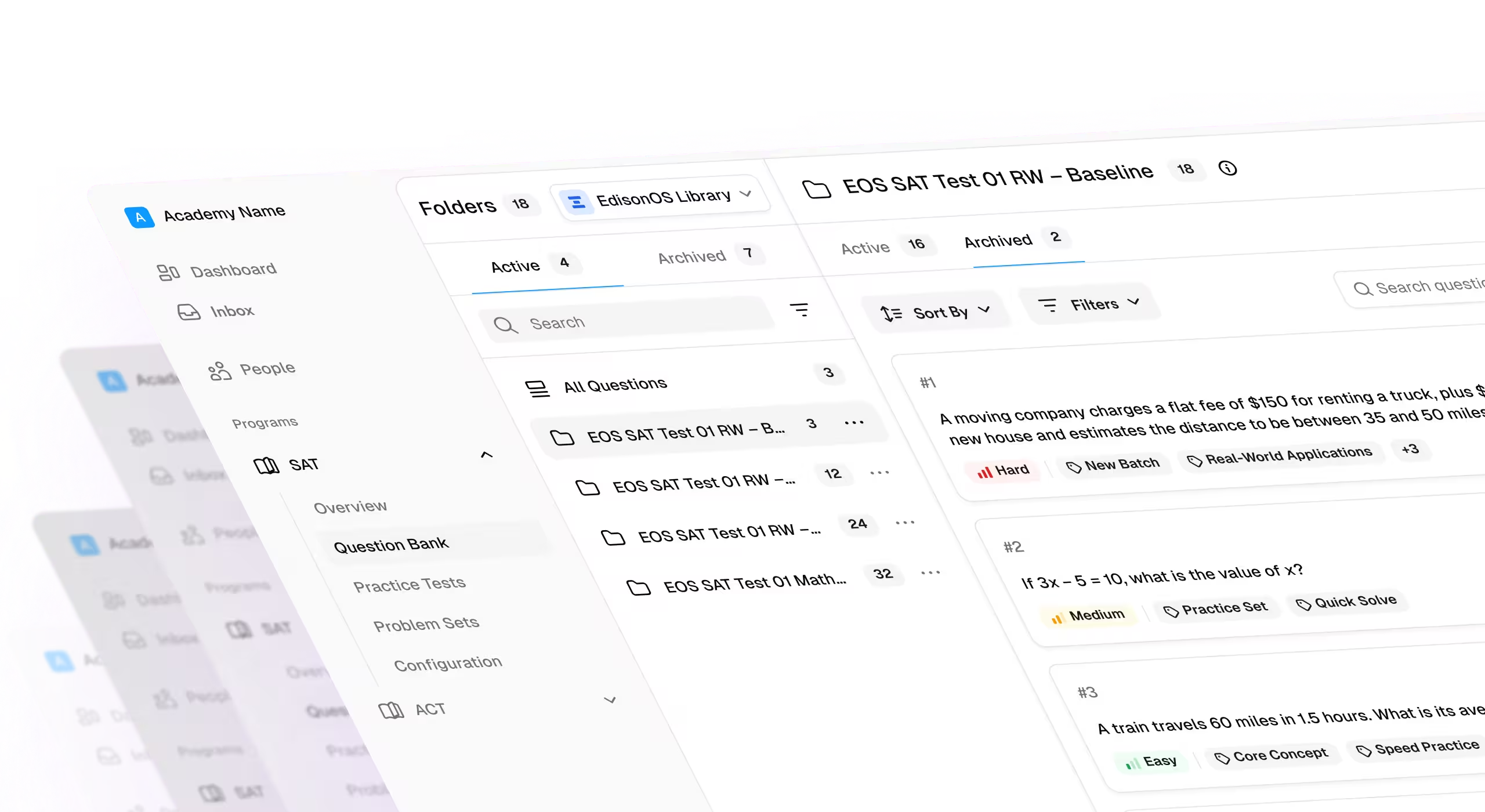
- EdisonOS lets tutors run official-style digital SAT and ACT mocks with detailed performance data, building test-day conditioning before the first official attempt.
Students who take an official SAT or ACT early in their prep cycle tend to improve faster than those who wait until they feel ready. Tutors report consistent patterns of students scoring 50–100 points lower on official tests than recent practice, revealing gaps that home prep never surfaces.
The common instinct is to delay official testing until students are fully prepared. That instinct often works against score growth. Without a real-condition baseline, tutors are building prep programs on data that overestimates where a student actually stands.
This article covers:
- Why early official test-taking accelerates score improvement compared to practice-only prep
- How real exam experience produces data and conditioning that practice tests cannot replicate
- How tutors can build an early test strategy into their prep structure for faster results
This guide is written for SAT and ACT tutors building structured prep programs for their students.
Why do students who test early improve faster?
An official exam produces real-condition data that changes how students prepare. Practice-only prep cycles lack that feedback loop entirely. The result is a prep program built on assumptions rather than evidence.
Early official scores reveal exactly where a student underperforms under real conditions. That is different from identifying where they struggle on practice sets taken at home with flexible pacing and no accountability.
Tutors who have an early official score can build the remaining prep cycle around what actually needs fixing. Without it, session focus is driven by practice patterns that do not always transfer to test day performance.
Signs a student is ready to test early:
- They have completed at least one full-length practice test under timed, controlled conditions
- Their practice scores are stable enough to produce a meaningful baseline official result
- They understand that the first official test is diagnostic, not definitive
What does an official SAT or ACT give students that practice tests don't?
Official tests and practice tests measure the same content. They do not produce the same experience. That difference is what drives faster improvement for students who test early.
1. Real stakes change performance patterns
Students behave differently when results are official. Time management, second-guessing, and pacing decisions all shift under real conditions. Tutors report students scoring 50–100 points lower on official SATs than on recent practice, driven by pressure and unfamiliar conditions.
2. Unfamiliar environment exposure
Test centers introduce variables — proctors, strangers, unfamiliar seating, early start times — that affect focus and performance. First exposure on test day, without prior experience, leaves students managing the environment and the exam simultaneously.
3. Adaptive scoring context
The real SAT's adaptive structure places students in a higher or lower difficulty Module 2 based on Module 1 performance. Under real pressure, this plays out differently than in practice. Students need live experience to understand how it affects their approach.
4. Official score benchmarks carry more weight
An official score gives tutors and students a credible baseline. Practice scores taken at home, with flexible pacing and no social pressure, routinely overestimate real readiness.
5. Mental conditioning from real experience
Having completed an official test removes the fear of the unknown. Students who have tested once approach subsequent prep sessions with greater operational clarity and less performance anxiety on the next attempt.
How does early test-taking change the prep cycle?
An early official score is not just a result. It is a structural input that reshapes the entire prep cycle. Tutors who use it correctly build more targeted programs.
1. It produces a real-condition baseline
Practice scores taken at home with flexible pacing overestimate readiness. An early official score establishes what a student actually produces under real conditions. That number becomes the true starting point for measuring growth, replacing an inflated home-practice figure that was never reliable.
2. It surfaces condition-specific weaknesses
Students often perform differently on specific sections under real conditions than they do in practice. An early official test reveals those gaps directly. Tutors can then adjust session focus to address condition-driven errors, not just content gaps identified from practice sets alone.
3. It compresses the improvement timeline
Students who test early and use the result to restructure their prep can target actual weaknesses from the start. Tutors who debrief official results against practice data identify the largest gaps and rebuild session priorities around real performance, not assumed performance.
When is the right time for a student to take their first official SAT or ACT?
Timing the first official test correctly matters. Too early produces noise. Too late wastes the diagnostic advantage. The right window depends on preparation stage, not calendar date.
- After at least one full-length controlled mock: The student should have completed at least one timed, proctored, full-length practice test before sitting an official exam. This ensures the official score is diagnostically useful rather than just a first-exposure result with no prep context.
- When practice scores are stable across sessions: A student whose practice scores vary significantly session to session is not ready to test officially. Score stability indicates the result will reflect a reliable baseline, not a single bad performance on an unprepared day.
- Early enough to allow two or three official attempts: Most students benefit from two to three total attempts, with the biggest gains typically occurring between the first and second sitting. Testing too late eliminates the retake cycle that early testing is designed to support.
- Before the student feels fully ready: Waiting for full readiness before testing officially delays the real-condition feedback loop. A slightly early official test produces more useful diagnostic data than a perfectly timed one with no prep cycle remaining to act on the result.
Should students take the SAT or ACT first — and does it matter for early testing?
The SAT vs ACT decision affects early test strategy. Both exams reward early testing, but they differ in structure, scoring, and how students respond to real conditions.
- SAT uses adaptive digital format: The SAT's Module 2 difficulty adjusts based on Module 1 performance. Students benefit from experiencing this structure under real conditions early, as it affects pacing and strategy in ways that practice at home cannot fully replicate.
- ACT is fixed format with consistent pacing demands: The ACT does not adapt. Its challenge is sustained speed across four sections. Early testing reveals whether a student's pacing holds under real time pressure, which home practice rarely replicates accurately.
- Score superscoring affects strategy: Both SAT and ACT are superscored by many colleges, though more colleges superscore the SAT than the ACT, and policies vary by institution. Early testing gives students more attempts to build a superscore, a structural advantage that disappears when testing is delayed.
- Tutor recommendation should be data-driven: Base the SAT vs ACT decision on diagnostic results, not student preference. An early diagnostic on both exams gives tutors the clearest picture of where each student has more scoring upside before committing to one exam.
How should tutors build early test-taking into their prep structure?
Early test-taking only produces faster improvement when it is built into the prep structure deliberately. An official test taken without a debrief plan produces a score, not a strategy.
Set expectations before the first official test
Students and parents often treat the first official test as a high-stakes performance event. Reframe it operationally before registration: the first official test is a diagnostic tool. Its value is the data it produces, not the score it reports. Setting this expectation early prevents the result from derailing motivation before the real prep work begins.
Debrief the official result against practice data
After the first official test, compare the result directly against the student's most recent controlled practice scores. Identify where the gap is largest. Section-level differences between practice and official performance reveal exactly which conditions the student has not yet trained for, giving the next prep phase a precise target.
Rebuild the remaining prep cycle around the official result
Use the official score as the new baseline. Adjust session focus, mock frequency, and content priority based on what the real exam revealed. Assign homework and full practices between sessions based on the weaknesses the official result surfaced, not on the prep plan built before testing.
Tutors who treat the first official test as infrastructure, not outcome, build prep programs that improve with each testing cycle.
How EdisonOS helps tutors prepare students for early official testing
Preparing students to perform on an official SAT or ACT requires consistent real-condition simulation before test day. EdisonOS provides the digital testing infrastructure tutors need to build that conditioning systematically across the prep cycle.
- Administer full-length digital SAT mocks with official-style score scaling and structured timing that mirrors real exam conditions from the first session onward
- Access question-level and section-level performance data per student after every mock to guide debrief decisions and adjust session planning before the next cycle
- Run Free Digital SAT Practice Tests and Practice Tests for SAT aligned to current Digital SAT format and Digital SAT Curve scoring before the first official attempt
Tutors using EdisonOS build condition familiarity before students sit their first official exam. Each mock produces structured data. That data shapes the next session. Students arrive at the official test having already performed under real conditions multiple times. Review SAT Trends to keep mock design current with the latest exam patterns.
Frequently Asked Questions
.svg)





.png)