.avif)
Transitioning from practice SATs to the real exam often produces a 50 to 100+ point score drop, driven by adaptive testing shock, pacing fatigue, and test-day adrenaline-induced brain fog.
- The "hard" module spike — Practice tests often undersell true test-day difficulty; acing the first section on the real SAT triggers a trickier, more cognitively demanding second module.
- The adrenaline dump — Stress hormones narrow working memory on test day, causing students to misread subtle nuances like negatives or adverbs and lose points on concepts they'd already mastered.
- Content rotation — Live tests feature recently rotated question types and rhetorical density that static practice materials don't fully capture.
- Environment and interface — Test centers introduce distractions, uncomfortable seating, and proctor pressure that at-home practice simply doesn't replicate.
- Replicate extreme conditions — Have students practice in a quiet room, no phone, using the official Bluebook App, to mirror real test-day constraints.
- Shift from content to strategy — Spend 70% of prep time on test logic and timing rather than memorization, like spotting "three undeniably wrong answers" in Reading or mastering Desmos regressions in Math.
- Account for the score gap — Advise students to subtract roughly 30 to 50 points from their best practice score to set a realistic real-test baseline.
- Build stamina with the question bank — Drill weak subscores in timed sets of 10 to 15 questions using the College Board Question Bank.
- Manage the pre-test routine — The day before should be for rest, not cramming: quality sleep, a high-protein breakfast, and arriving early to minimize stress-driven cognitive drop.
Students who score well on practice SATs often underperform on test day. Tutors report this pattern consistently, with score drops of 80–150 points common among mid-range performers. It is not random. It is structural.
The gap between practice SAT and real SAT performance is documented and predictable. It is rooted in specific environmental, psychological, and procedural differences that practice tests, by design, do not replicate.
This article covers:
- Why practice SAT scores don't always predict real SAT results
- The psychological and test-day factors that change performance under real conditions
- How tutors can close the gap through structured preparation
This guide is written for SAT tutors and independent instructors preparing students for exam day.
Why do students score differently on the real SAT than on practice tests?
Practice tests remove the variables that matter most on test day. Conditions, stakes, and environment all affect performance in ways that drills and at-home mocks cannot replicate.
The structural difference is straightforward. Practice tests are taken at home or in class, often with breaks, flexible pacing, and low accountability. The real SAT has none of those allowances.
If tutors measure progress only through practice scores, they are measuring the wrong thing. A score achieved under comfortable conditions does not confirm readiness for real exam conditions.
Signs the gap exists in your student:
- Practice scores are consistently higher than diagnostic benchmarks suggest they should be
- Student performance drops on timed sections but recovers when sections are retaken without time pressure
- Students report feeling confident in practice but describe freezing or rushing on test day
What actually changes between a practice SAT and the real exam?
The differences between practice and real SAT go beyond nerves. They are structural, environmental, and procedural. Each one affects performance in a measurable way.
1. Testing environment
Practice tests are taken in familiar settings. The real SAT places students in an unfamiliar room with strangers, a proctor, and strict procedural rules they may not have practiced following. Noisy hallways and uncomfortable seating are common variables students have never trained around.
2. Time pressure is felt differently
Students know they can pause or retake practice tests. On the real SAT, every second of lost focus is permanent. This changes how students manage pacing decisions under pressure.
3. Stake-driven cognitive load
When results feel consequential, working memory narrows. Students second-guess answers they would confirm quickly in practice, slowing down on sections where speed matters most.
4. No recovery option
A bad section in practice is ignored or retaken. On the real SAT, students must mentally reset after a difficult module and continue. That skill requires specific preparation, not just content knowledge.
5. Physical and logistical variables
Early start times, check-in procedures, and unfamiliar seating affect focus before the first question is read. These are conditions most practice sessions never simulate.
How do psychological factors affect real SAT performance?
Test anxiety and performance pressure are not personality traits. They are predictable responses to high-stakes conditions that tutors can directly address through structured preparation.
What is test anxiety and how does it show up on SAT day?
Test anxiety narrows focus, increases second-guessing, and slows processing speed under timed conditions. Research shows students with high trait anxiety produce more regressions and longer reading times in evaluative conditions.
Students who appear confident in practice can experience significant cognitive interference when the same material appears in a real exam context.
How does performance pressure change decision-making?
Under pressure, students default to slower, more cautious processing. This affects time management most directly.
Students who finish practice sections comfortably may run out of time on the real SAT because each decision carries more perceived weight, increasing hesitation on questions they would otherwise answer quickly.
What role does familiarity with test conditions play?
Students who have only taken practice tests in low-stakes environments have not trained the mental skills needed for real exam conditions.
Familiarity with format alone is not sufficient. Familiarity with pressure is what transfers to test day performance. Both must be trained deliberately.
What do practice tests measure accurately — and what do they miss?
Practice tests are reliable indicators of content knowledge and question-type familiarity. They are not reliable indicators of how a student will perform when conditions are unfamiliar and stakes are real.
- What practice tests measure well: Content mastery across Reading, Writing, and Math sections; question-type recognition; section-level timing when conditions are controlled and the student is working without social pressure or time consequence
- What practice tests underestimate: The cognitive cost of managing nerves, recovering from a hard question, and maintaining focus across a full-length exam in an unfamiliar physical environment with no recovery option
- Where scores tend to inflate: Students working at home with flexible pacing and no social pressure routinely score higher than they will under real exam conditions. Research notes that Bluebook practice tests run slightly easier, particularly in Math.
- Where scores tend to hold: Students who have trained specifically under timed, distraction-free, full-length conditions with no retakes produce practice scores that more accurately predict real SAT results
How can tutors close the gap between practice and real SAT performance?
Closing the gap requires tutors to change how practice tests are administered, not just how often they are given. Conditions matter as much as content.
1. Simulate real test conditions consistently
Administer accurate full-length practice tests under timed, proctored conditions with no pausing, no retakes, and no mid-test feedback.
Students should experience check-in procedures, strict section timing, and a distraction-free environment every time a mock is run. Consistency builds the mental conditioning test day requires.
2. Train mental reset between sections
Teach students a structured reset routine for use between sections. A difficult module should not carry into the next. Students who practice deliberately moving on, rather than ruminating on errors, perform more consistently across the full exam.
3. Debrief performance, not just answers
After every full-length mock, debrief how the student managed time, handled difficult questions, and recovered from errors, not just which answers were wrong. This builds metacognitive awareness that transfers directly to real exam conditions and cannot be developed through content review alone.
Tutors who treat mock administration as infrastructure, not just assessment, produce students prepared for conditions, not just content.
How often should students take full-length practice SATs before the real exam?
Frequency matters, but only when each practice test is administered and debriefed correctly. Volume without structure does not close the gap between practice SAT and real SAT performance.
1. Early in the program
Administer one full-length diagnostic under controlled conditions to establish a baseline. This gives tutors a score that reflects actual readiness. Research suggests students targeting 1100–1200 benefit from 4–6 full-length mocks across the prep period.
2. Mid-program
Run a full-length mock every two to three weeks. Students targeting 1300–1400 benefit from 6–8 mocks; those targeting 1450 and above from 8–10, spaced to allow proper review between sessions. Score movement between mocks is more informative than any single result.
3. Final two weeks before exam
Increase frequency. Students should enter test day having experienced real exam conditions multiple times. Space mocks carefully to avoid burnout while maintaining condition familiarity.
How EdisonOS helps tutors run real-condition SAT practice
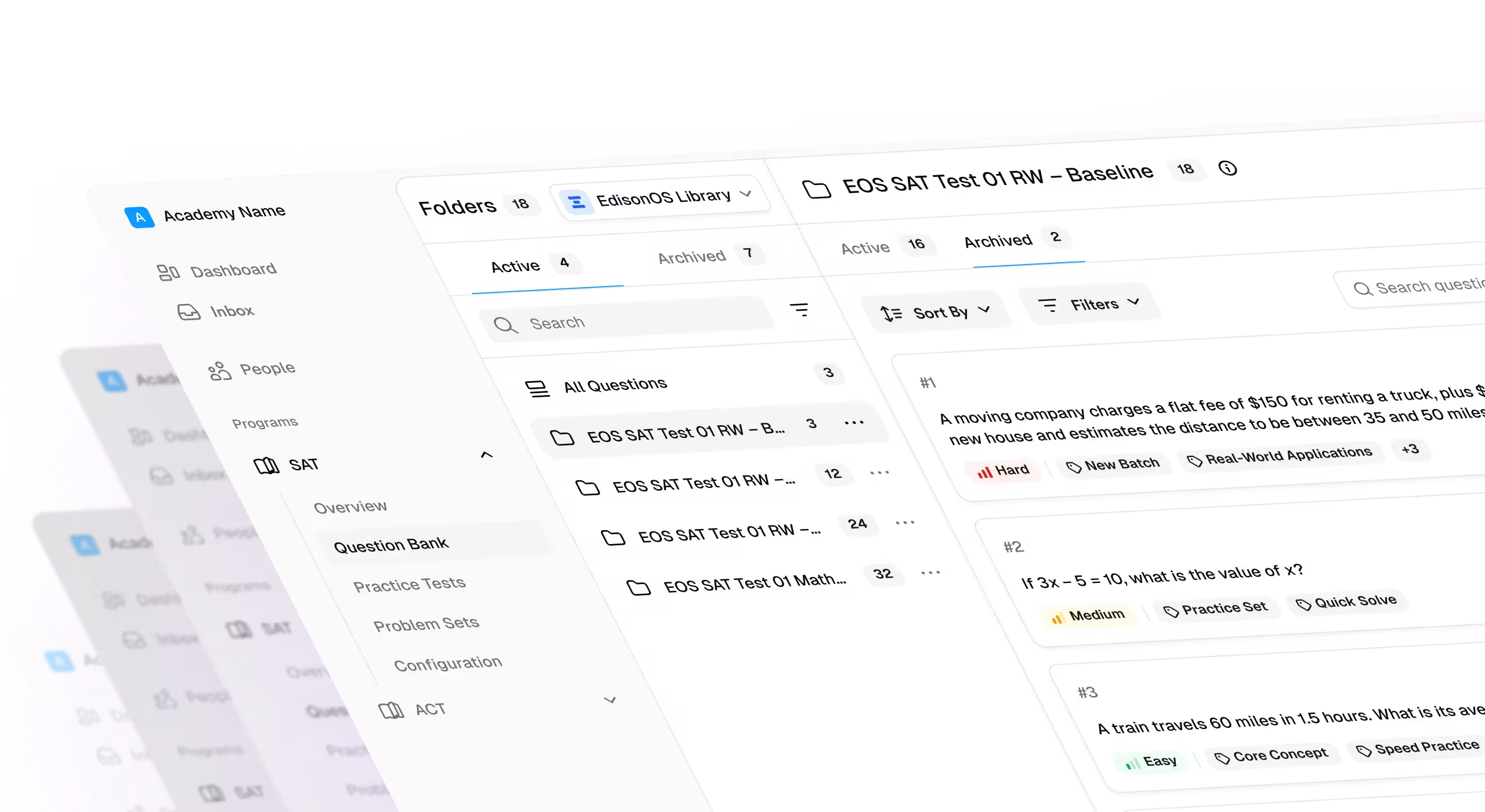
Replicating real SAT conditions requires more than a printed test and a timer. EdisonOS provides the digital testing infrastructure tutors need to administer standardized, full-length mocks that mirror actual exam conditions consistently.
- Administer full-length digital SAT mocks with official-style score scaling, structured timing, and section-level reporting that mirrors real exam conditions every session
- Access question-level performance data per student after every mock, so debrief decisions are based on data, not memory or general impressions
- Use Free Digital SAT Practice Tests, Practice Tests for SAT, and Digital SAT Curve scoring to give students accurate, exam-aligned simulation every time
Tutors using EdisonOS replace informal mock administration with structured test cycles. Each session produces data that informs the next. Students build familiarity with real conditions, not just real content. Explore SAT Trends to keep mock design aligned with current exam patterns.
Frequently Asked Questions
.svg)





.png)