.avif)
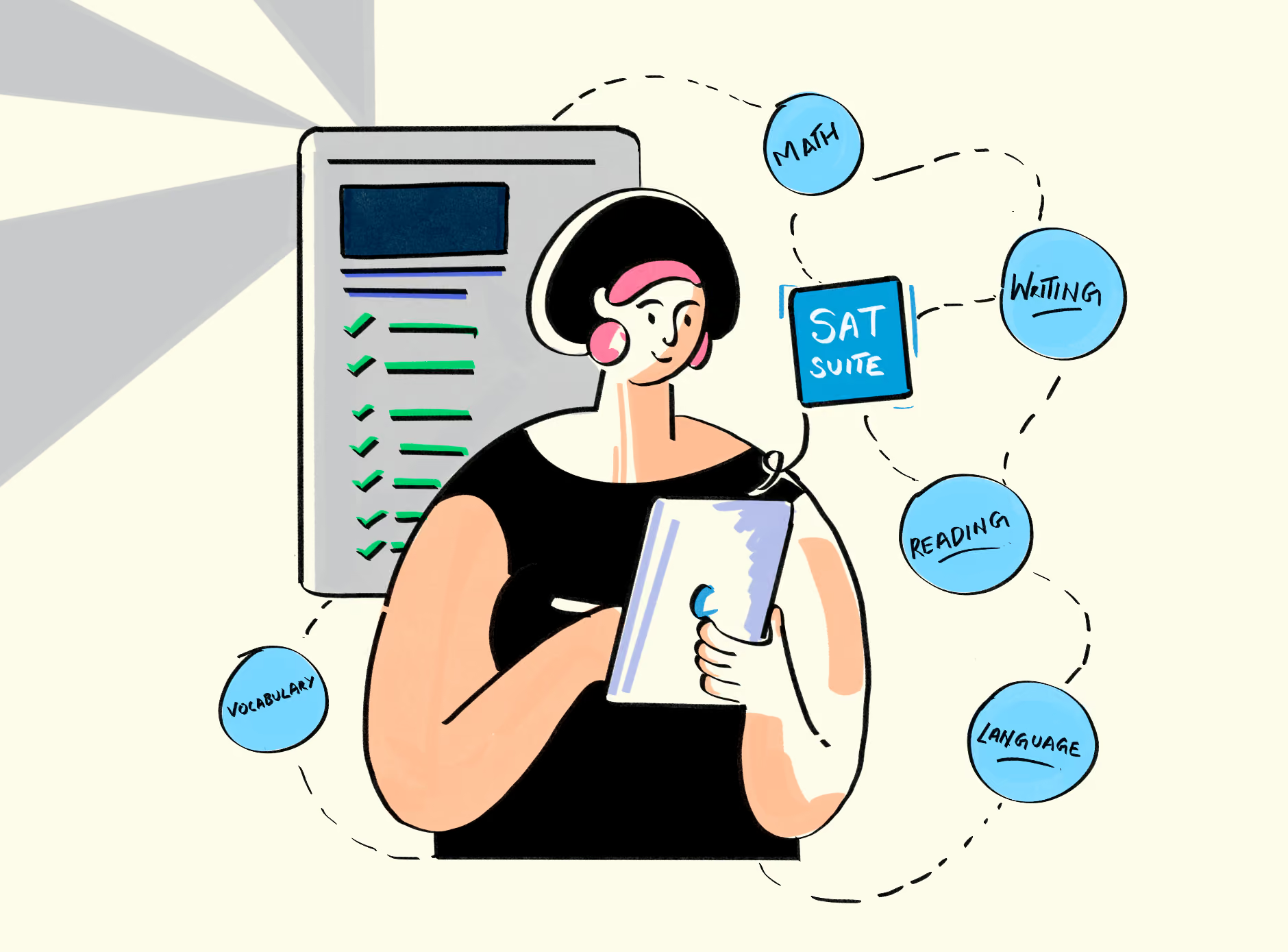
Mastering the digital SAT means shifting away from old paper-based strategies, since the exam is now fully computer-adaptive, runs 2 hours and 14 minutes, and covers Reading & Writing and Math across six critical areas.
- It's multi-stage adaptive — Module 1 performance strictly determines whether Module 2 is harder or easier, so missing a Module 1 question hurts the score ceiling more than a Module 2 mistake.
- Desmos is available on both math modules — The built-in calculator covers the entire Math section, though it's worth solving fraction-heavy or complex equations by hand and cross-verifying, since rounding errors can creep in.
- Reading & Writing merged into short passages — Instead of long passages, the test gives 54 short, one-question passages, emphasizing main idea, vocabulary-in-context, and structural transitions over obscure grammar traps.
- Tighter timing despite shorter passages — With 134 minutes for 98 questions, students average roughly 82 seconds per question, making pacing practice on official tests essential.
- No penalty for guessing — Wrong answers cost nothing, so educated guesses plus the digital flag tool for returning to tricky questions are the smart default.
- Register early and practice on Bluebook — Whether testing in India or the US, register well ahead of deadlines and use official Bluebook Practice Tests to simulate the real adaptive environment and scoring.
On Saturday, March 14, 2026, close to 200,000 American high schoolers, most of them juniors, sat down for the first Digital SAT of the year. The College Board confirmed the test was delivered globally through the Bluebook app, and unlike the technical stumbles that plagued the platform's debut in March 2024, this administration ran smoothly on the tech front.
But technical stability was never going to be the headline. The real story is the same one that has defined every Digital SAT since the format launched: the gap between what students practiced and what they actually encountered in the test room. This article is a full accounting of what happened, what students are saying, and what tutors and schools need to do before the May 2 sitting.
Key Context: This Was Anticipated
- Experts widely expected the March 2026 test to feel similar to the more demanding 2025 administrations.
- The College Board has spent two years refining its adaptive algorithm, and the difficulty curve, especially in Math Module 2, now behaves consistently with what Bluebook Test 11 had already signaled.
- For well-prepared students, much of this felt familiar.
Test Day Report
What Actually Happened on March 14
Post-exam conversations lit up across Reddit's r/SAT, Discord prep servers, Facebook study groups, and YouTube community posts. Three themes kept repeating: the adaptive Math Module 2 was genuinely difficult, scientific reasoning dominated the Reading and Writing (R&W) section, and the Desmos calculator alone was not enough to get students through the harder math path.
The Digital SAT's adaptive structure means experiences varied significantly, even within the same test center. Students who performed well on Module 1 were routed into a harder Module 2 with denser passages, more subtle vocabulary, and multi-step math problems. Students who struggled in Module 1 received an easier Module 2, but faced a ceiling on the highest score they could achieve.
Student Voices
What Students Said Across Forums
The post-test conversation tracked patterns seen in past administrations but with new specifics pointing directly to the March 2026 experience.
"Math Module 2 was brutal. I thought I was prepared, but some of those multi-step applied algebra problems felt completely different from anything in Bluebook Tests 1 through 6." — Reddit · r/SAT · March 14, 2026
"The Reading and Writing passages had so many science-style study design questions. I kept asking myself 'is this an ACT Science section?' It wasn't bad, just unexpected." — Reddit · r/SAT · March 14, 2026
"My practice scores were 1430–1460. Feeling like I might land around 1370–1390 based on how that second math module felt. Fingers crossed the curve is generous." — Facebook SAT Prep Group
"Transition words were way more nuanced than I've seen in practice. Not just 'however' vs 'therefore' — they were testing whether you understood the exact logical relationship between two ideas." — SAT Prep Discord · March 14
"I used Desmos on almost every problem in Math Module 1, but in Math Module 2 the questions were structured so you actually had to know the algebra. Desmos wasn't enough." — YouTube · PrepTube Comment Section
"I actually thought the vocabulary wasn't as hard as past tests. 'Ubiquitous,' 'quintessential' — solid academic words. The inference questions were the real trap." — Instagram · @SatPrepStudent
"March felt like my practice finally paid off — except Math Module 2 reminded me I still had gaps I didn't know about." — r/SAT Post-Test Megathread · March 14, 2026
Expert Analysis
What Tutors and Analysts Are Saying
The tutoring community, from independent educators posting to YouTube and TikTok to established prep networks, largely validated student reactions while offering important context.
"The SAT isn't dramatically reinventing itself, but it is refining what it rewards. The March 2026 exam reflects a thoughtful refinement — one that increasingly rewards students who think critically, reason scientifically, and communicate clearly." — Ivy Tutors Network · February/March 2026 Analysis
Experts from Applerouth Tutoring, Strategic Test Prep, Franklin Yard, and SupertutorTV consistently flagged two patterns. First, students who relied primarily on Bluebook Tests 1 through 6 as their main practice material were underprepared for the difficulty ceiling they encountered. Second, Bluebook Test 11 proved to be the most accurate predictor of the March 2026 experience, by a significant margin.
"Test 11 is the gold standard. It's the newest test and most closely reflects what the College Board is administering right now in 2026. The R&W modules are legitimately difficult." — Strategic Test Prep · March 2026 Bluebook Rankings
On the math side, the Desmos conversation has evolved meaningfully. Tutors noted that the College Board has tightened Math Module 2 questions so that pure Desmos dependency, once a viable shortcut for 30 to 40 percent of math problems, no longer carries students through the harder path.
"Never walk away from a practice problem saying 'I'll just Desmos it.' You have to know how to do it without Desmos, too - because in Math Module 2, they use variables instead of numbers specifically to block that strategy." — SupertutorTV · Post-Test Analysis
Practice vs. Reality
How Much Did Bluebook Test 11 Predict the Real Exam?
The short answer: significantly. Experts who analyzed Bluebook Test 11 before March 14 identified six specific signals, all of which appear to have materialized on the actual exam.
This pattern of Bluebook Test 11 preceding a major spring administration and aligning closely with the real exam mirrors what happened before the August 2025 SAT, when the College Board released a practice test that proved highly predictive of the actual exam's structure and difficulty.
Year-Over-Year Comparison
How March 2026 Compares to Recent Administrations
The Digital SAT has had a volatile history since its March 2024 launch. Understanding where March 2026 fits in that arc matters when setting expectations with students and parents.
The Volatility Arc: March 2024 to March 2026
- When the inaugural Digital SAT launched in March 2024, it shocked students with difficulty ratings as high as 4.5 out of 5. Students scoring 1540–1600 in practice reported expecting scores below 1400.
- Difficulty swung unpredictably across 2024 and 2025 administrations, ranging from 2.5 to 5 out of 5 in student perception.
- By late 2025, the October sitting was considered a record high for difficulty. March 2026 now sits in a calibrated mid-to-high range — genuinely challenging, but no longer chaotic.
- The College Board has clearly gotten better at tuning difficulty and adaptive behavior after two full years of live data.
The practice-to-real score gap that defined the March 2024 cohort has not fully closed, it has evolved. Early Bluebook tests (Tests 1 through 3 specifically) tend to produce slightly elevated practice scores compared to actual test-day conditions. The emerging consensus among prep professionals is clear: use Bluebook Test 11 as the primary late-stage diagnostic, build in a realistic 50 to 100 point buffer below your target score, and treat Math Module 2 performance as the true benchmark of readiness.
Score Interpretation — Remind Students and Parents: A hard Math Module 2 does not mean a devastated score. The College Board's equating process adjusts scaled scores to account for difficulty differences across test forms. A 680 in Math earned on a harder Module 2 pathway is equivalent to a 680 on any other pathway. What matters is how you perform relative to the other students on your adaptive path — not how the questions felt in the moment.
Score Release
What to Expect on Results Day
March 14, 2026 - Test Day
Students completed the Digital SAT. The test was delivered via the Bluebook app. Score data is instantly processed for most question types upon submission.
Around March 27-28, 2026 - Score Release (Estimated)
Scores go live. The College Board typically releases Digital SAT scores within 13 days of the test, on a Friday. Students should check their College Board account starting around 6 AM Eastern Time. Scores drop in two waves: a morning wave (6–8 AM ET) and an afternoon wave (6–8 PM ET). Not all students receive scores at the same time.
Within 10 Days of Student Release - Colleges Receive Scores
Students who designated colleges as score recipients during registration will have results sent electronically. Colleges typically process reports within 1 to 2 days of delivery.
May 2, 2026 - Next Test Opportunity
Students who want to improve their score have the May administration as their next opportunity, well before AP exams dominate the calendar in late May.
Key Lessons
What March 2026 Taught Us About the Digital SAT
Every administration adds to the field's collective understanding of what this exam rewards. March 2026 confirmed six important signals.
1. The Digital SAT Is a Stable, Mature Exam
Two years of College Board calibration have paid off. The adaptive algorithm now behaves predictably, Math Module 2 difficulty is intentional and consistent across administrations. For prep professionals, this means reliable planning benchmarks going forward.
2. Scientific Literacy Is Now a Core R&W Skill
The SAT is increasingly integrating scientific reasoning and study design interpretation into its Reading and Writing section, territory traditionally associated with the ACT. Students with strong analytical reading habits and exposure to research-style passages are clearly better equipped.
3. Inference-Based Reading Continues to Be Rewarded
The exam consistently favors students who can recognize meaning expressed in paraphrased form over those who rely on surface-level keyword matching. This is a nuanced but very teachable skill that many experienced tutors have already built into their programs.
4. Desmos Is Most Powerful When Paired With Conceptual Fluency
Students who combine strong algebraic understanding with smart calculators consistently outperform those relying on either alone. Math Module 2 is specifically designed to reward conceptual math reasoning alongside, not instead of, tool proficiency.
5. Bluebook Test 11 Is the Most Predictive Practice Resource Available
Across this spring's expert community, Bluebook Test 11 is the consensus recommendation as the highest-fidelity preparation resource for upcoming sittings. Programs that have incorporated it are well ahead of those still relying on earlier practice tests.
6. Setting Realistic Score Expectations Is Powerful Prep Strategy
Industry data consistently shows a 50 to 100 point gap between peak practice scores and real-test performance for many students. Tutors and schools that proactively frame this for families, before scores arrive, are providing significant added value and reducing post-score anxiety.
For Tutors & Schools
What the Community Is Focusing On Before May 2
Strategies Tutors Are Finding Most Effective
- Use Bluebook Test 11 as the primary late-stage diagnostic, its difficulty and question style now most closely mirror what students encounter on actual test day.
- Frame the practice-to-real score gap proactively with students and families. When a March score comes in 50 to 100 points below practice, that is a known and well-documented pattern, not a reflection of poor preparation quality.
- Incorporate study design and scientific passage work into R&W reading sessions. Students who can recognize experimental variables, control groups, and research conclusions are consistently better equipped for the current R&W section.
- Balance Desmos proficiency with underlying algebraic fluency, particularly for students targeting 700 or above in Math. The two skills reinforce each other effectively, and neither alone is enough in Math Module 2.
- Expand transition word practice to include nuanced logical relationships, not just simple contrast or agreement phrases, an area where many students gain quick points with targeted instruction.
- Set the expectations for conversation with parents before scores release, so results day becomes a planning moment rather than an anxious one.
Notes for School Counselors & Program Directors
- Students who sat for March 14 as a baseline have strong retake windows on May 2 and June 6, both well before senior-year application timelines heat up.
- The test-optional landscape is shifting. MIT, major state universities, and several Ivy League institutions have reinstated testing requirements. Scores carry real weight again in 2026.
- Superscoring policies create strong multi-test strategy opportunities. Helping students think in terms of banking their best section scores across multiple sittings, rather than chasing a single perfect day, is a high-value counseling framework.
- School Day SAT testing windows (March 2 through April 30) are available for in-school programs and have also transitioned to digital format this spring.
Looking Ahead
The Road from Here
The March 2026 administration is the opening act of a full testing year, and a strong foundation for students who plan to retest in May or June. The signals from March are clear enough to act on, and tutors and school teams who have navigated previous shifts in the Digital SAT are well-positioned to translate these insights into real results for students.
The broader story of 2026 is meaningful for every prep professional: as more colleges restore testing requirements and the Digital SAT matures into a reliable instrument, the value of expert-guided preparation continues to grow. Families understand this, and they are looking to the educators they trust most.
EdisonOS will publish a full score-release analysis when March 2026 results drop, expected in the window of March 27–28, 2026. That edition will include comparative percentile data, a section-level breakdown, and prep adjustment recommendations for the May sitting.