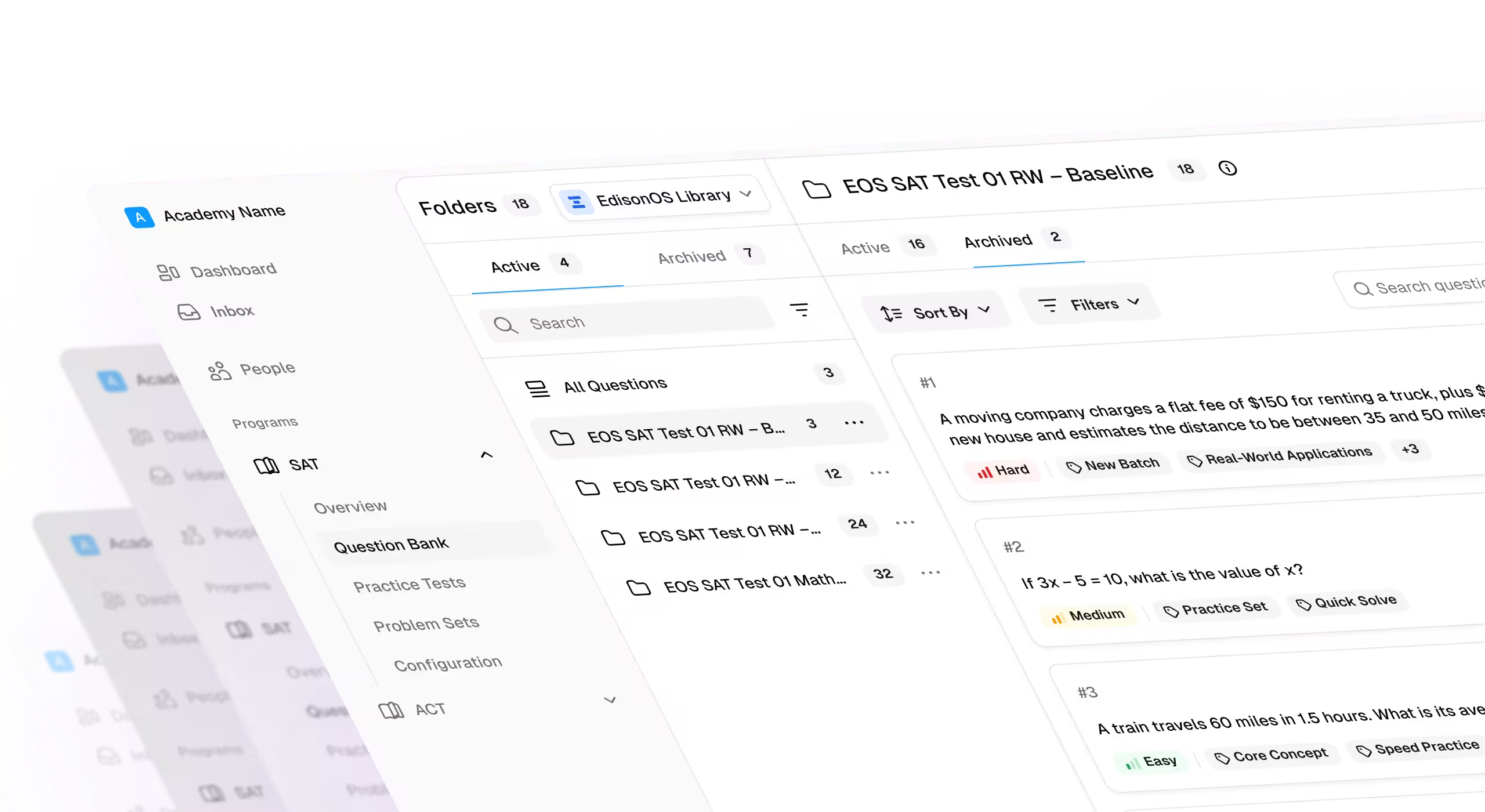
Training for the Digital SAT English section means turning practice tests into an active diagnostic tool through structured pacing and targeted review, across 9 unbeatable strategies.
- Review every mistake carefully — Analyze wrong answers for recurring traps and weak concepts rather than just checking the score.
- Read the question first — Scan the prompt before the passage to read with specific intent.
- Predict your answer — Form a mental answer before viewing choices to avoid falling for distractor traps.
- Limit vocabulary time — Cap vocabulary and context questions at 20 to 30 seconds, then make a confident guess and move on.
- Use the last-sentence shortcut — For standard detail or main-claim questions in short passages, the final sentence often carries the answer.
- Apply majority rules for grammar — Look for common patterns among punctuation or convention answer choices when stuck.
- Eliminate extreme distractors — Cross out choices that are too broad, overly extreme, or unsupported by the direct text.
- Skip and flag difficult items — Circle back to time-consuming questions only after finishing the rest of the module.
- Simulate strict test conditions — Practice exclusively on the official Bluebook App to build real interface and pacing familiarity.
Preparing for the SAT Reading and Writing section requires specific strategies, because language questions cannot be boiled down to inflexible formulas like Math.
The subtle differences in meaning, tone, and grammar can make selecting the right choice confusing. All this makes it super important to practice and further hone strategies and skills.
Studies like the one by the researchers from the University of Louisville School of Medicine, Kentucky, USA have clearly established the importance of test-taking strategies through practice.
Here, we discuss the 9 key strategies for SAT English that students can implement to perform better and score higher. We also provide a 6-point framework on how to get the most out of some of the best Digital SAT practice tests.
9 Strategies to master the SAT Reading and Writing Section
Success on the SAT Reading and Writing section depends not only on strong English skills but also on using the right test-taking strategies. The nine strategies below will help you manage time effectively, avoid common traps, and answer questions with greater accuracy.
1. Practice with full-length digital tests
Taking realistic practice tests is one of the most effective ways to prepare from, like this set of free digital SAT practice tests. Mock tests help you understand the exam format, improve pacing, and identify the question types that slow you down.
- Review each test carefully after you’ve finished the test. That’s the only way to derive the full benefit of a practice test.
- Pay attention to questions that you got wrong and improve that area.
- Go through the explanations to begin to learn the incorrect choice from the correct one.
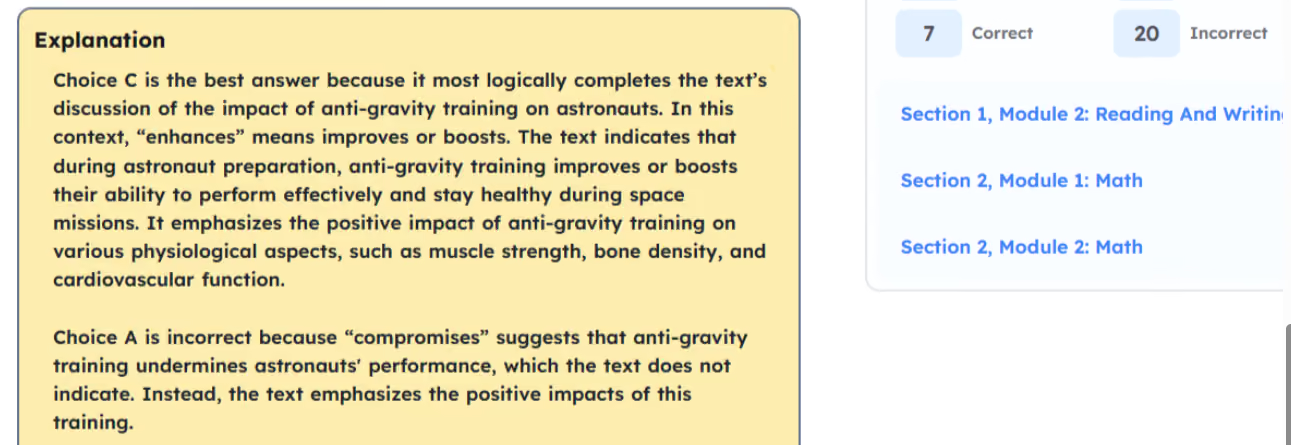
Answer explanations (see image attached) are key to developing the refined understanding of what the test-makers are looking for.
2. Work with the digital SAT format
SAT trends evolve gradually. The latest change has brought about a fundamental change in how students approach the SAT. Because the digital SAT is adaptive, your performance in the first module affects the difficulty of the second. Strong performance early can unlock a harder second module and help you score higher.
- Practice only on digital platforms.
- Aim to build familiarity with the adaptive structure, pacing, and digital test interface.
3. Manage your time
Pacing the SAT is critical. Here’s an effective strategy to manage your time well:
- First answer the questions that are quick and straightforward.
- If a question takes too long, flag it and move on.
- Return to the flagged questions once you have completed the easier ones.
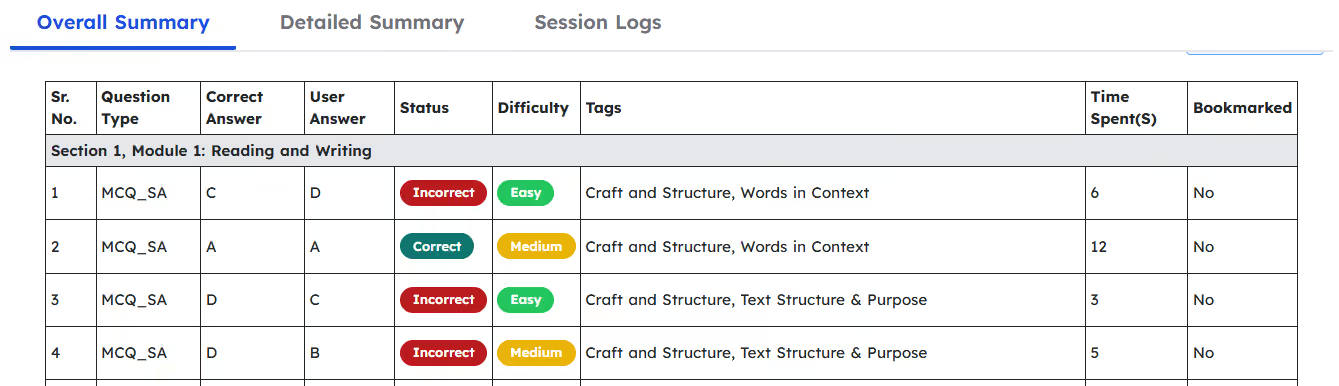
With detailed analytics (see adjacent image) on how much time you spent on what kind of question can quickly help you do course-correction.
4. Use short-passage to practice reading
Because passages are short,
- read actively
- identify the main claim quickly
- ignore minor details until the question asks about them
This strategy helps avoid overanalyzing.
5. ‘Predict’ the answer
Before you look at the answer choices, be sure to have some idea (even if it’s hazy) of what the correct answer should look like
- Predict the answer in simple terms and then check the choices
- With the answer you had in mind, first eliminate choices that actively mislead you
- Zero in on no more than two choices and then scan the passage again if required
Question-type specific strategies
The SAT comes up with certain types of questions repeatedly. The below strategies have been formulated keeping in mind some specific question types.
6. Don’t rush inference questions
Inference questions require you to draw conclusions that are implied, not direct.
- First start with what the text clearly says.
- After that, eliminate options that introduce new ideas or use extreme language.
- Do not confuse your previous knowledge with what is covered in the message.
7. Find the purpose of a sentence
Purpose questions ask the role of a sentence or detail in the passage. Ask: ‘What’s the function the sentence plays’?
Sentences most likely
- define something,
- support or refute a claim,
- help transition from one idea to another, or
- summarize a theory.
Just choose one that best matches the role.
8. Solve vocabulary-in-context questions
The best way to crack a vocabulary question is to treat the target word as a blank.
- Before looking at the answer choices, ask yourself: ‘Logically, what word would make most sense here?’
- Then eliminate options that do not match the meaning or tone of the sentence you have in mind.
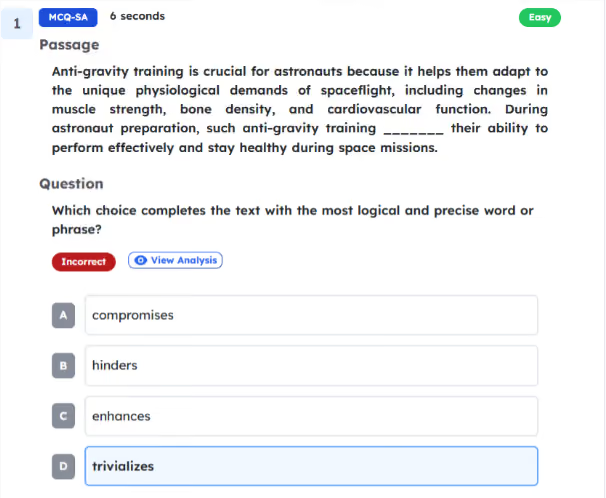
In the adjoining image, elimination can quickly lead to the correct choice. The passage itself starts by saying “Anti-gravity training is crucial…”, and becomes the central idea. That means choice (A), (B), and (D) are all wrong, because they make the training look harmful or less important. The only correct choice is ( C ).
9. Apply grammar rules
Grammar questions test rules such as
- subject–verb agreement,
- pronoun reference,
- parallelism,
- punctuation, and
- sentence boundaries.
Identify the rule being tested and apply it systematically. When the rule is clear, the correct answer usually becomes obvious.
How to get the best out of the EdisonOS SAT English practice tests
The closest you can come to writing an actual SAT without an admission ticket is taking Edison’s mock SAT. If you wish to understand the rationale behind this claim, our CEO’s post explaining how Edison created the most accurate mock SATs is a must-read.
Effective SAT prep is crucial for achieving a high score. English forms half of your scores (800 points out of the maximum 1,600). Hence, you want to devote a great deal of attention to the English section of the SAT.
Here are six specific, actionable steps you need to take to better prepare for SAT English through our mock SATs.
1. Know the composition of the test
You should know the basics of the section very well. Total time, total questions, kind of questions,… The Digital SAT won’t surprise you, so use the practice tests to understand everything about the SAT. Your first step isn’t studying the subjects in detail; it’s getting a comprehensive understanding of types of questions by using practice questions.
2. Treat it like the actual SAT
Here’s how you can take the practice test like the actual SAT
- Single sitting: Take it in one go, with only as much break as the SAT allows. Incorporate SAT practice questions to simulate the actual test experience.
- No distractions: Put your cellphone on Silent mode, disable notifications, and choose a comfortable position where you can sit all through the test.
- No cheating: This is non-negotiable.
- Adaptive test only: While the printed test might help somewhat, it can never substitute the adaptive Digital SAT. The Digital SAT isn’t just a new version of the original test; it’s significantly different.
3. Pay more attention to your mistakes
In most cases, you’ll see that your mistakes can be boiled down to one of three reasons: lack of knowledge, unnecessary haste, and applying the wrong concept. Identifying and addressing these mistakes is a crucial part of any SAT prep strategy.
- You didn’t know a certain phrase or were unaware of a particular rule of the language.
Remedy: You need to pay attention to learning.
- You knew the relevant stuff but misread the question or missed a particular word.
Remedy: You need to slow down a bit and make sure you don’t make any silly mistakes.
- You knew the relevant stuff but applied a completely different concept.
Remedy: You need to reinforce your understanding of which concept is applicable when.
4. Realize that English isn’t quite like Math
In Math, you can apply a formula to a certain question. There’s no ifs and buts.
English is different because it’s a language that’s constantly evolving. Its set of inviolable rules is rather limited. Words have multiple meanings; ‘fine’, for instance, can mean ‘nice’, ‘tiny’, or ‘penalty’. A slight change in the question’s wording can turn the question 180 degrees. So widen the kind of things you read. While you can’t read everything that might appear on the SAT, extra reading aims to understand a new topic faster and reduce your discomfort. Practicing with a variety of practice questions helps students understand the nuances of the English section.
5. Know the gap: How far are you?
When you prepare for a journey from A to B, you begin by finding out the distance from A to B. It’s hardly any different with SAT preparations. Find the gap between where you currently are and where you wish to be. If your target score for English is at least 670 and you’re presently scoring around 550, it means you need to cover at least 120 points - not something you can take lightly. Using SAT practice questions helps identify the gap between current and target scores, ensuring you focus on areas that need improvement. Preparing without a specific goal isn’t a good idea.
6. Decide if you need help
If your performance in the practice test is substantially below expectations, you likely need help. This help could be in the form of additional practice tests, coaching, or extra course material to work with. And once that is clear, take swift action, as additional resources and strategies are an important part of any SAT prep plan.
A higher score in Digital SAT English: Start here
Getting a perfect score in the SAT English section is not unheard of. Every year, you see many students getting impressively high scores. So, there’s no reason why you shouldn’t do well on the SAT. Once you determine to focus on good performance and have the right course material and practice tests, make sure to take advantage of the free practice tests available from the College Board to start your preparation.
In case you are unsure, we recommend you familiarize yourself with the SAT sections first. Our free mock SAT is available to all students, so why wait? Set aside the time for it, register for free, and start practicing.





.avif)