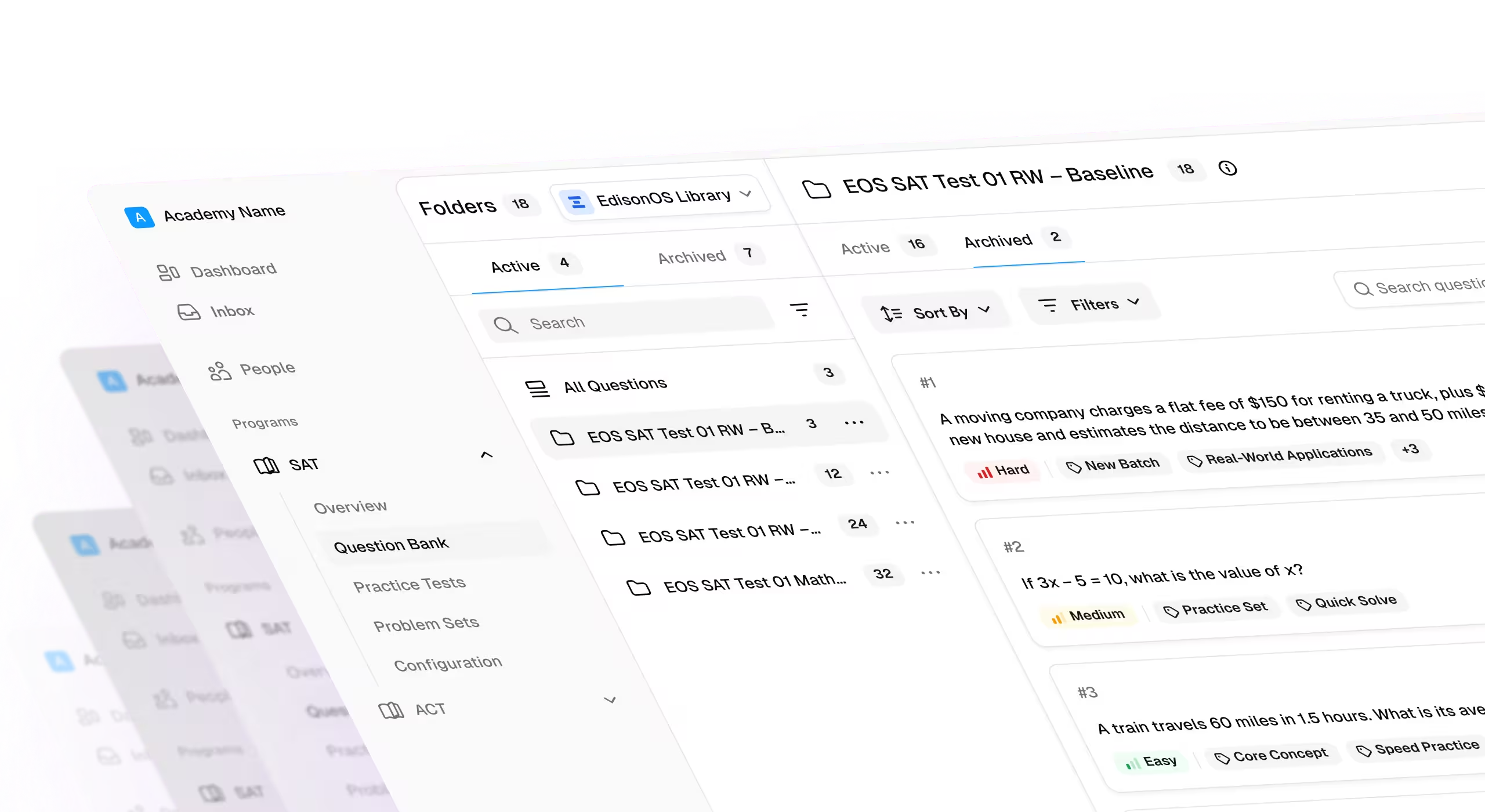
- A SAT study plan for 2 months works when it takes eventualities into account.
- The given SAT study plan is a tutor-facing framework, one that tutors can use right away for an individual student or a cohort of students with different proficiency-levels.
- This is a dynamic plan, not frozen; it is to be customized based on student data.
- This 8-week plan is divided into four phases, and requires 4 to 5 full-length Digital SAT practice tests.
Why a 2-Month SAT Study Plan Is Different When You're the Tutor
A SAT study plan meant for tutors isn’t the same as a study plan for students. Although both plans share the same broader goal - namely, achieving the dream score - they have several execution-level differences in approaches and even intermittent objectives.
To begin with, tutors help students achieve scores - they don’t sit for the SAT and achieve the score on behalf of the students. In that sense, a tutor is a bit like a basketball coach; they ensure your team wins the game but they aren’t part of the playing team.
Integral to this role, tutors teach, diagnose, and make adjustments. They guide students with pacing, assign focused homework, and ensure accountability.
And here’s a big difference: tutors manage multiple students simultaneously. Almost always, these students come with different test-taking skills and time schedules. This means adjusting sequences, and not just covering the topics relevant for the SAT.
Importantly, every decision is based on performance data, time available, and individuals goals and limitations, rather than on generalized plans or even gut-feeling. The tutor also needs to make decisions on how they’ll allocate time between actual tutoring, assigning practice, reviewing progress, and conducting mock SATs.
This article offers a flexible, customizable framework to tutors. The flexibility becomes more significant because of the adaptive nature of the SAT: getting more than a few questions wrong in the base module can automatically limit the student’s score, no matter how well they do in the subsequent adaptive module.
Before Week 1: The Diagnostic Session Every Tutor Needs to Run
While discussing the importance of a diagnostic SAT, here’s a great analogy: Think of the SAT study plan as a map. The student is at point A and wants to achieve a certain score, which we’ll call point B.
Can you suggest to a student the route to go from A to B? You can’t, until you know where the student is today - their point A. And the diagnostic SAT is the best way to determine where the student is today, to find what their point A is.
So the starting point of your 2-month study plan for SAT is to have the student take a full-length diagnostic test before you start teaching.
What diagnostic test should I offer?
Choose either an official Bluebook test or an equivalent adaptive SAT diagnostic test.
How should I analyse the results?
First look at what they’ve scored. Then look at the broad parts where the student has done very well and the parts where they’re mostly likely facing challenges.
What things should I look at?
Start by understanding what the student’s dream score (or the dream college) is. Understand what kind of time they’d be able to devote.
What’s the best way to offer feedback to the student?
Discuss the test scores with the student, but don’t over-analyse or it might sound too formidable. Review Reading & Writing and Math separately, so that they have the basic details. Show them their biggest scoring opportunities. Mention timing issues only if they are serious. Based on the score gap, finalize the initial priorities for Weeks 1 and 2.
How to Read a Score Report Like a Tutor
The first thing to do is to avoid looking only at the score. Instead, look for:
- Section-level strengths and weaknesses
- Accuracy by topic
- Performance across difficulty-levels
- Time taken per question
Based on this, you will be able to determine what kind of homework to assign and what approach the lesson plan should take. For instance, a student who makes too many unforced mistakes by guessing will need to be restrained. Against that, a student who’s playing too safe needs to be reminded that there are no penalties for guessing.
You will need to chart out their skills and accuracy so look for their performance in domains, rather than just questions.
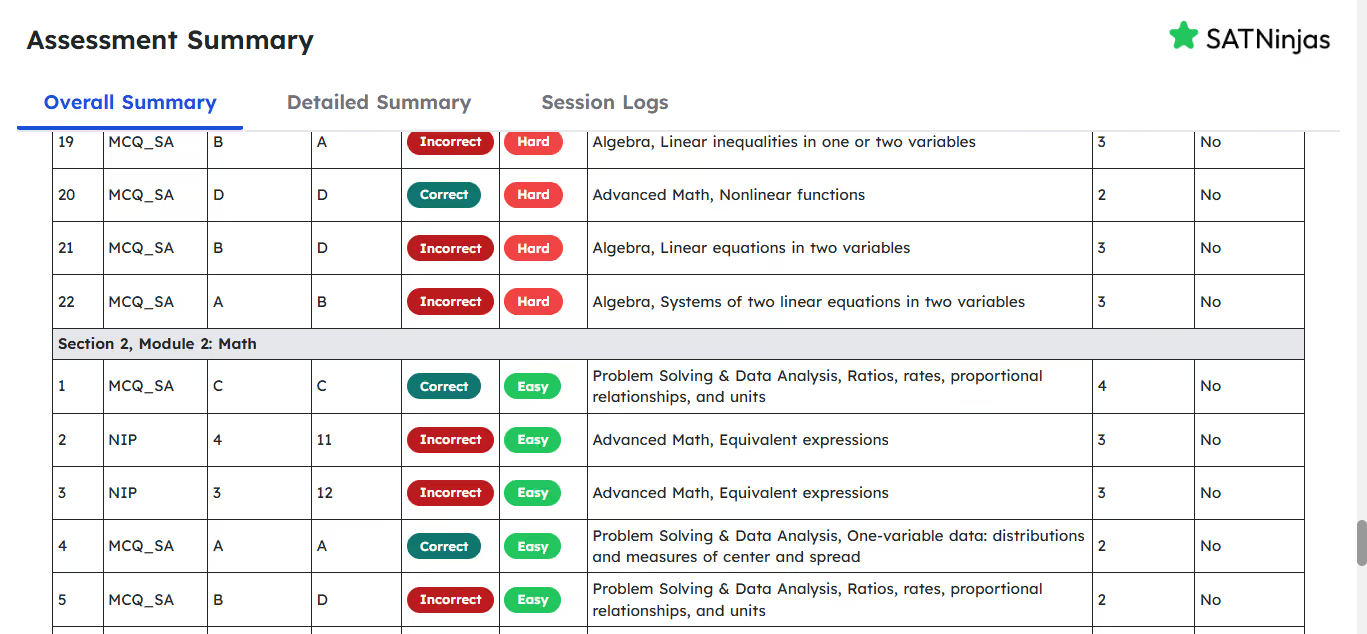
A mapping of their correct and incorrect answers versus the difficulty level and domain provides powerful insights into where the tutoring should head to.
The 4-Phase, 8-Week Framework
A 2-month plan for high SAT scores will work best only when you break it down into specific activities to be carried out over the weeks.
We’ve broken down our 8-week framework into a four-phase framework. Here are the four phases:
- Foundation
- Targeted Review
- Mixed Practice
- Simulation
The following table explains the phases and their goals:
Remember, this framework is adaptable, so adopt it after you’ve tweaked it for your students.
Phase 1 (Weeks 1-2): Foundation and Baseline
The first step is obvious by now: analyse diagnostic test results. The next step is important, because it decides how much immediate score improvement you can make.
If the student’s weakest area is, say, trigonometry, don’t worry. That’s because trigonometry has only a few questions on the SAT. Against that, if the student really struggles with algebra, you’re onto something, because algebra is important for the SAT.
Based on this, build a content priority list that starts with high-frequency, high-impact topics. Rank skills by improvement opportunity. Take up the lower-yield concepts later on.
Then, build the practice plan. After that, you can custom practice tests and assign focused homework. If the gap between the current score and desired score is substantial, you need to create an error log - basically a record of how often the student commits the same mistake.
Finally, remember to work on modules, and not on full-length tests. That’s because you want to take a modular approach: improve in small bits, and avoid huge topic coverage.
Phase 2 (Weeks 3-4): Targeted Content Review
This is the phase where you emphasize content mastery and place it over speed (you can build speed later on).
Keep alternating Math and Reading and Writing sections. That avoids monotony and maintains self-motivation for the student, because most are better at one section than the other. Alternating gives them the joy of working in their strong area and the practice to work on the weak area.
The tutor’s role is to clearly identify weak areas and design and assign homework that’s directly tied to the weaknesses of the student.
Next, you want to refine the practice sets. Now that you’ve some data from the previous phases, you will need to build custom tests that directly attack the weak areas and eventually minimize the weak spots.
This is also the stage to make the plan more dynamic. You can update priorities, remove the topics you think your student has already mastered, and increase practice where the student continues to be weak.
Finally, end Week 4 with the first full-length practice test. That gives your students (and you) the complete picture of where they stand and what course to take next.
Phase 3 (Weeks 5-6): Mixed Practice + Pacing Strategy
Ok, so you’re half-way in your 2-Month SAT study plan. You’re well on your way to helping your students get their dream scores, and now’s the time to be strategic instead of only tutoring.
First, you want to mix the questions types. This will give your students the taste of what the real SAT will throw to them. Questions of varying domains and difficulty levels exercises them and lets them see how quickly they can jump from one concept to another.
Next, administer weekly full-length tests, which means during this phase you’ll have your students take two full-length tests. Two full-length SATs not only make things a little hectic but also make them understand the importance of strategy. Which brings us to the next thing…
Now, introduce pacing strategies. Explain them, with concrete examples, where they need to slow down and where they need to be quick. Discuss how they can improve their decision making in order to do this.
Review their mistakes. This will give you the opportunity to double check the error patterns specifically to see if your students are learning from their previous mistakes.
Finally, patiently explain to them how adaptive modules work. In particular, explain that if they land an easier adaptive module, their maximum scores are capped while if they land the difficult adaptive module, their maximum scores face no such restrictions.
Phase 4 (Weeks 7-8): Full Simulation and Test-Day Readiness
Now you’re in the final leg of your students’ test-prep. In addition to test-taking skills like pacing or making the right choice on when to slow down and when to speed up, your students need something critical: confidence. Bolster their confidence by showing that they’ve been working for at least six weeks now, so there’s virtually nothing they need to be afraid of.
The time is also mature to conduct full-length simulation. Enforce official testing conditions, prevent unscheduled breaks, and ensure complete commitment to do the best. This gives you the final opportunity to fine tune timing, pacing, and decision-making strategies that your students are operating on.
Conduct the final checks on progress with the baseline and target scores. Identify the ways to bridge the gap where the student currently is and where they desire to be. Prioritize strategy refinement instead of content teaching. It is important that you do not cover any new concepts - that’d only stress the student due to the unfamiliarity. Let them, instead, trust what they’ve already mastered.
In summary, this phase is where you prepare them to be test-ready. Share tips on the importance of sleep, confidence, logistics, and a positive mindset.
Adapting the Plan by Student Profile
As clarified earlier, the biggest strength of the 2-month SAT study plan discussed above is its flexibility and dynamic nature. It is open to adjustments at any stage.
Here are two scenarios that you can use as reference:
Student below 1200
The mean of all the SAT scores of 2025 is 1029, as reported by the College Board Annual Report. In other words, as many students scored above 1029 as below.
So when you’re working with students whose scores are below 1200, their performance is closer to the average scores.
The good news is - and it’s supported by both the bell-curve and research papers like this one - that lower-scoring students tend to make larger improvements than higher-scoring students.
Here’s how you’d work with a student below 1200:
- Longer Foundation phase: Spend more time explaining the basics. Once that’s done, students are more confident and deal with questions with a much higher accuracy.
- More content review: Spend more time reviewing content and pinpointing what they should be working on.
- Fewer full-length tests: When they’re below 1200, full-length mock SATs will more likely overwhelm your students; they’d end the test believing they hardly know anything. Targeted tests and more practice questions work better.
- Slower pacing: Focus on accuracy and getting the basics right. When your students struggle with accuracy and basics, pushing them to speed up will only worsen things.
Student above 1250
These students bring with a bigger promise; they could actually end up in the 1500+ range, if you know precisely how to guide them all through their test-prep journey.
These students are past the foundation stage, so you need to directly move to the next stage. In order to be efficient, compress the content review. Walk them through key areas but there’s probably no need to spend a lot of time going through the basics: skim, warn them about any likely pitfalls, and keep moving.
Place a great emphasis on full-length tests. When someone is 1250 and more, it means they’ve taken care of all the big things everywhere, so now it makes sense to look for the finer aspects. One possible case, for instance, could be that they didn’t reach 1550 not because they didn’t know many answers; they stopped around 1250 because they were held back by weak packing strategies.
Feel free to take up harder questions and analyse them at length. Explain to them how some answers choices could directly be eliminated or what part of the question provides the key to the starting point. In Reading and Writing, for example, you can show how focusing on certain words can quickly eliminate choices that are designed to mislead your students.
You’ll notice that although the framework remains the same, the internal proportions change.
What to Do When the Plan Isn't Working
Here’s a situation that stops just short of being a nightmare for tutors: the plan started right but nearly halfway in the journey, it becomes apparent that the plan isn’t working. Typically, you want to check this at the start of Week 4.
But how exactly do you know the plan isn’t working? Some signs are easy to spot: score plateauing (or falling) or homework incomplete. Others need a closer look: the student is battling increased anxiety or mistakes are repeated.
That’s where you change gears and improve the intervention.
The first thing to do is to shift your focus. When things aren’t working out well, never push full-length tests. Instead, bring in module-only sessions. Work only on Math. Then work only Reading and Writing. That gives you a closer, more fuller picture of what exactly is going wrong, and why.
As a matter of fact, if you sense that students are battling anxiety or experiencing burnout, you can reduce the testing frequency. When there’s a burnout, full-length tests will only increase learning blockages and will likely hurt rather than improve scores.
Other activities to do include:
- Increasing targeted practice
- Reviewing error logs
- Checking trends of skill improvement
- Assessing if students are speeding up or slowing down at the right point
Tools That Make This Plan Easier to Execute
Tutoring using only a whiteboard may sound adequate, but that won’t make the cut. Digital SAT preparations, like any other modern test-prep, require efficient tools. Tools don’t just bring in more tests or more practice questions, they bring in an important element: planning and systems.
An intelligent, digital tool will quickly show you the areas where your student is struggling. Next, it will enable you to easily prepare custom tests on which your students can practice in order to eliminate weak areas. All this is virtually impossible without digital tools.
The first tool is Bluebook. While it will not let you prepare custom tests, Bluebook is invaluable because it is the official source for SAT. You get to practice with material provided by the testmaker themselves, and that too on the simulated test interface. These two factors make Bluebook your obvious first choice - and it’s indispensable too.
However accurate the Bluebook tests are, there are only 8 of them. That means they might not be sufficient. You can use the College Board question bank, but even that is not open to customization. So you need supplemental resources.
EdisonOS is designed to fill exactly that gap. The 22 full-length Digital SAT tests make available to your students more than what they’d need. It starts with diagnostic scoring and then you can use one test after another, and see how your students are doing. You can study the analytics to get a closeup of where your students shine and where they falter.
Perhaps more important is the BYOT feature of these Digital SAT tests.
The BYOT, short for Build Your Own Test, is a feature that offers outstanding personalization. When you notice your students need more practice in a particular area, you can use the BYOT to create a custom test in minutes. This test will attack the specific areas you asked for, thus making sure your students practically eliminate all their weak areas.
Start your free trial now to experience how choosing the right set of tests can completely transform your SAT test-prep.
Conclusion
A successful 2-month SAT study plan is built on data, not assumptions. By starting with a diagnostic test, prioritizing high-impact topics, tracking progress, and adapting instruction as students improve, tutors can steadily guide students toward their target scores. Don’t forget that data, and not mere assumptions, should guide your plan.
The four-phase framework provides a structured roadmap while remaining flexible enough to accommodate different skill levels, learning styles, and score goals. For complete success, you’ll need a platform that can make your efforts efficient and result-oriented.
EdisonOS combines diagnostic assessments, 22 full-length Digital SAT practice tests, detailed analytics, and the BYOT (Build Your Own Test) feature to help tutors create highly targeted, personalized practice. Why not speak to a SAT expert to learn more?.
Frequently Asked Questions
.svg)


.png)

.png)