- While Bluebook practice tests are the most accurate SAT practice tests available (they're created by the College Board), don’t assume your practice score will exactly match your real SAT score.
- It is common to score about 20-50 points lower on the real SAT than on the best Bluebook practice tests.
- The question is not about the quality or accuracy of tests - the challenge is that there are too few official tests available.
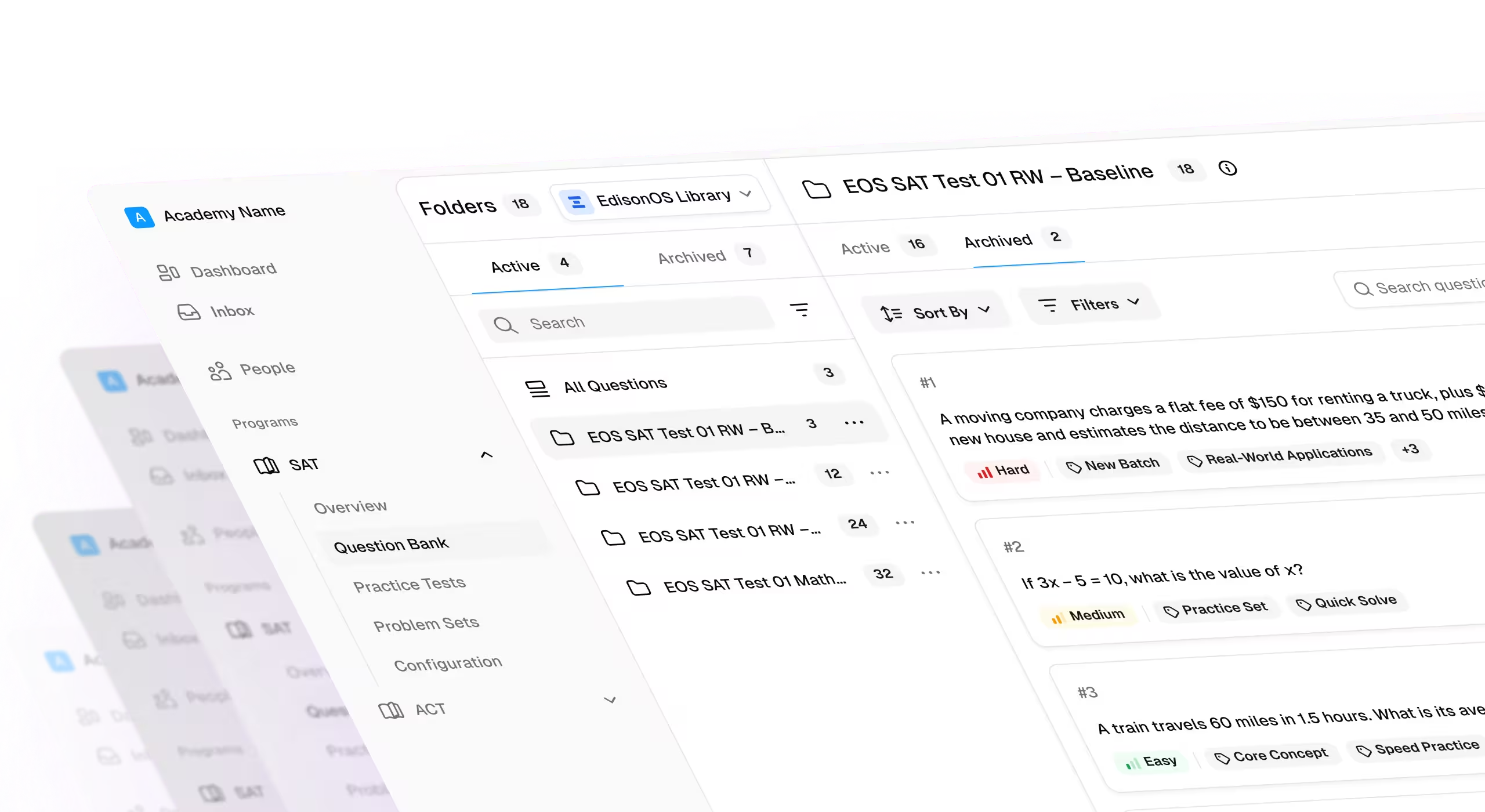
- Tutors find it best to add the 22 EdisonOS practice SATs, along with the 8 Bluebook tests, in order to ensure students achieve their dream scores.
Test-takers regularly ask how accurate are Bluebook practice tests, because of the different stories they read on Reddit or other online groups. The College Board designs the SAT as well as the Bluebook tests, so this question ideally should be of no value.
Yet, if the Bluebook tests come from the test-maker themself, why do students score lower on the actual SAT than they do on the Bluebook tests?
It would be easy - and convenient - to blame the stress a real-word test could cause compared to the stress-free environment in which a student writes their practice tests. However, that’s not the complete story.
This blog answers important questions like are Bluebook tests easier than the real SAT, whether Bluebook practice tests are accurate, how do I improve after Bluebook practice tests, and more.
What Does "Accurate" Actually Mean for an SAT Practice Test?
A SAT practice test can be called accurate if it replicates the difficulty level, question distribution, format, and the adaptive algorithm of a real test. If all this matches, your score in a SAT practice SAT and your score on an actual SAT you take should not vary.
In simpler words, accuracy of a test means question quality and score prediction.
However, the question of accuracy gets a little confusing because some students, in their early stage of test-prep, mistake identical interface of a practice test as fully mimicking the actual SAT. To them, if the test buttons look the same, the in-app tools are identical, the layout resembles that of the SAT, the practice test would be accurate.
These students forget that the adaptive algorithm of the SAT can make a practice test low-quality or extremely accurate, depending how well the practice test follows the original algorithm. In order to be faithful to the adaptive nature of the SAT, the practice test must also accurately classify questions as difficult or easy - something that only highly experienced test-setters can do.
Besides, there is what is called equating the scores. The College Board uses a complex statistical method which adjusts raw scores on the higher or the lower side, based on how difficult (or easy) your version of the SAT is. Finally, your SAT scorecard also shows a 40-point range - the score you’d likely get if you were to take the SAT again under similar conditions.
All this means it takes a good deal to fully understand what an accurate SAT test would mean.
It's Not Just Format - It's the Scoring Curve
The first point to remember is that if two students got the same number of questions correct on a test, there’s no guarantee their scaled scores will turn out to be the same. In other words, the same number of correct answers does not equal the same scaled scores.
The SAT first looks at the number answers you got correct. It assigns 1 point for every correct answer (no penalties for incorrect answers or questions you didn’t attempt). After that, it will look at whether you received the easier adaptive module or the difficult module. Then, using a proprietary (and confidential) conversion process, the system will arrive at your sectional scores.
So if someone simply copy-pastes some SAT practice questions from some random source to compile a test for you, you might have something to practice on. But the moment you try to estimate what could be your actual SAT score based on such a test, you’d go wrong by a wide margin. That’s because you have no idea how the College Board would have treated this test and what conversion table it might have used.
Each Bluebook test has a different conversion table, which is not surprising given that each test varies slightly for the rest of the tests.
A small note: it appears that the older Bluebook tests were more lenient. That means that you could get as many as 6 questions wrong and yet end up with a 760. In the latest Bluebook test, getting 6 questions wrong could restrict your scores to 720.
This is why EdisonOS takes great care in compiling questions, making their conversion table a great deal more accurate.
The Adaptive Module Problem
The Digital SAT is not just another test where students are ranked on the basis of the number of correct answers. In addition to the conversion of raw scores, its adaptive nature makes it unique.
To be more accurate the SAT is multi-stage adaptive, and here’s how it works. Everyone starts with the same first module. Based on how well you perform there, the second module becomes either more challenging or less challenging. Doing well on a harder second module gives you the opportunity to earn a higher score, while an easier second module generally limits the highest score you can achieve.
Essentially, your performance in module 1 decides the difficulty level of module 2.
This is also where tutors need adaptive simulation that’s truly reflective of the real SAT. They need to know things like:
- Which question would qualify as easy and which as difficult
- What proportion of easy, moderate, and difficult to maintain in the adaptive module
- How many questions can a student get correct in order to receive a difficult adaptive module
At EdisonOS, we’ve studied the existing Bluebook tests closely to accurately assess the information required above.
So, Are Bluebook Practice Tests Accurate? The Short Answer
Yes. Bluebook practice tests are the most accurate SAT practice tests available because they're created by the same organization that creates the real SAT. But that doesn’t mean you can treat every Bluebook test as equally predictive of the real SAT. Some are more predictive than the others, and yet most students still score about 20 to 50 points lower on the real exam than on their best practice test.
The simple fact that the Bluebook tests come from the test-maker itself makes them the gold standard. You can be sure that when compared with tests by, say, Kaplan or Princeton Review, Bluebook tests are more predictive and more accurate.
So what expectations can you keep from the Bluebook tests?
- Treat your Bluebook score as a strong forecast, not a promise. If you scored 1480 on a Bluebook test, it means you’re doing well, but there’s no guarantee you’ll score 1480 on the actual SAT.
- Be prepared for some natural variation. Adaptive testing, test-day conditions, the nature of the particular test you’re served, and other factors can swing your scores either way.
- Look for consistency and growth, rather than exact numbers. If your scores are gradually improving as you take one Bluebook test after another, it means you’re using them right. Wide variations in scores, on the other hand, means something is off.
Importantly, well-designed practice SATs from other sources reinforce your strengths and help you uncover your weaknesses. Check the adjoining screenshot.
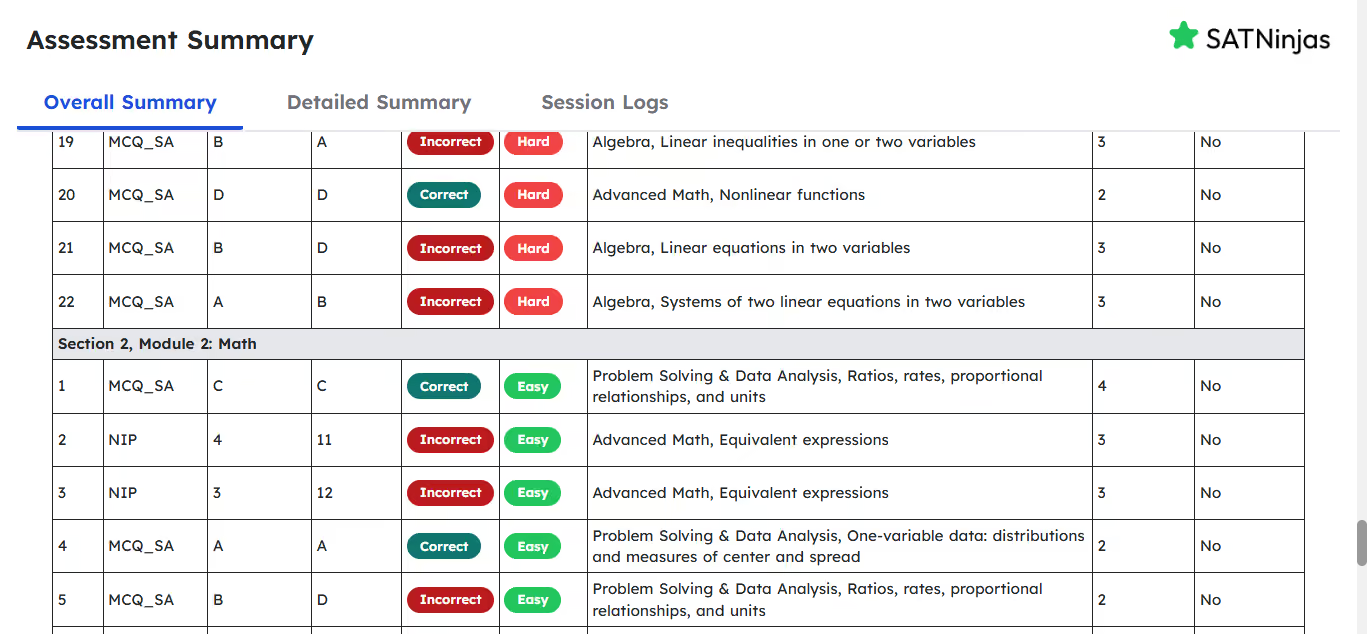
You can see the practice test shows which easy or hard questions, from which particular topic you got correct or incorrect. That tells you where you need to do the repair work.
All 8 Bluebook Practice Tests Ranked by Accuracy (2026)
Currently, the Bluebook offers 8 tests: test numbers 4 through 11. As we said earlier, different tests have different accuracy standing.
Below is how we rate
Tests 11 & 7: Most Predictive of Your Real SAT Score
As mentioned in the table above, Test 11 has been added most recently. Because students (and tutors) often complained that no Bluebook test does full justice to the actual SAT, the College Board may have given in. The test is not only the latest but also the most accurate Bluebook test so far. Recency is important because you’ll find the question quality and distribution almost identical to that of the actual SAT.
Make sure you’ve taken Test 7 before you take Test 11. For most students, Test 11 becomes an important benchmark before the actual SAT, but Test 7 is an excellent primer to that. Ideally, you should be taking these two tests about 2 to 3 weeks before the test.
Tests 5 & 6: Accurate, But They'll Push You Harder
There’s a school of thought in test-prep that says that it helps when you practice harder (but relevant) questions, because it not only widens your understanding but also improves your reflexes. When you have tackled more difficult questions, you can see through the actual questions faster.
Tests 5 and 6 do just that: they propel you to more concentrated efforts. And they will help, because they are accurate. Importantly, remember, they are slightly conservative predictors, so there’s cause to panic if your scores dip a little.
However, do not confuse difficulty level with accuracy; a difficult test pushes you to work harder but an accurate test is far more useful in predicting your scores.
Tests 8, 9, 10 & 4: Use These Early, Not Late
Test 4 has older content but it is also more generous in scoring. These two factors make Test 4 rank the lowest in the list of accurate Bluebook tests. Eventually it may be less representative of the actual SAT scores, but you can’t ignore it. So it’s a good idea to start with this test.
Next come tests 8, 9, and 10. They are of moderate accuracy and rated mutually equivalent, so it wouldn’t matter which of the three you start from.
One important thing, though. As you move from one of these three tests to another, your scores should show improvement. That’s again because the tests are of equal difficulty levels, so the learning you collected after the first test should definitely raise your scores in the next one.
Three scenarios
With the above context, we will build three hypothetical scenarios:
Scenario 1: You have time only for 2 tests
A no-brainer. First, take the Test 7. Review your mistakes very carefully. Then take Test 11. Your actual score will be pretty close to what you got in Test 11. This strategy is advisable only when you have built adequate skills.
Scenario 2: You have time for upto 5 tests
Take any one test from 8, 9, and 10. Review your mistakes and then move to Test 6. Review some more and take Test 5.The improvement in your scores should indicate if you’ve reviewed your mistakes the right way. You should be ready for Test 7.
Don’t be disheartened if your scores didn’t improve significantly after 5, because 7 is tough for many students. Review, and then trust yourself when you approach Test 11.
Scenario 3: You have time, but you need confidence:
Start with Test 4. It is generous so you’ll start with the much-needed confidence. Then work your way up the above table. You should see a clear improvement in scores. Of course, as you come closer to 1550, score improvement becomes slower and tougher.
This is also a reason EdisonOS provides 22 practice SATs. A bigger number of tests means you’ve covered everything, leaving virtually no room for surprises when you sit for the actual SAT.
Why Your Bluebook Score May Not Match Your Real SAT Score
Sometimes students religiously follow the Bluebook, interpret scores the right way, and work hard to make improvements - and yet they end up with an actual SAT score that’s measurably lower than what they saw in Bluebook tests. This causes them stress and self-doubt.
Some students complain that Bluebook scores inflate their egos. That is a valid complaint we hear often.
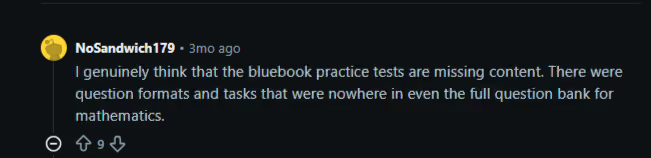
Their frustration is completely understandable.
Neither their approach is incorrect nor the Bluebook tests are inaccurate. Let’s take a closer look at the three major reasons behind the apparent mismatch.
Scoring Curve Differences by Test Version
The College Board offers multiple versions of the SAT. And for obvious reasons, they need to maintain a certain parity across all these versions.
And yet, different tests reward - or view - mistakes differently. In the older tests, students had a better margin for error. You could make more mistakes and yet come up with a good score. In fact, it was not unusual to miss 7 or 8 questions in a section and yet land a score of 1500.
The newer tests are less lenient. They allow you a narrower room for error; getting 7 or 8 questions wrong can push you well below 1500. Hence, comparison across tests in different versions can be misleading.
Test-Day Conditions Add Pressure Bluebook Can't Replicate
Even if your actual SAT were to be an almost exact replica of your Bluebook practice test (unlikely, but let’s assume for a moment), the two scores won’t match for a simple, obvious reason: test-day conditions.
Your test-day is going to be special - and different. Maybe a few things outside your control changed. Maybe you didn’t sleep well the night before and it overwhelmed you for a while. Maybe the pressure to perform led to some unforced errors. Maybe there was more noise at the test-center than you expected. Any or all of this can impact how you do in the test.
That’s why some teachers recommend that you should write at least one practice SAT where you are stressed. Add some external noise, take a test without adequate sleep, introduce some resistance…that can mentally toughen you up and prepare for a few surprises.
Question Content Drifts Over Time
The final reason is that SAT evolves. If a test remains the same for decades, it will lose its relevance. Colleges will no longer be able to rely on scores, because tests no longer reflect the changes colleges - and workplace - need.
That’s why the SAT regularly drops some topics and introduces some new ones. It changes test formats over time, or refines the emphasis placed on reading or hard core calculation skills.
All this is also a strong reminder that tests that are added more recently carry a bigger weight. That’s because they are closer to what the test-taker is looking for.
The Biggest Limitation of Bluebook: You Only Get 8 Tests
Yes, the biggest limitation of Bluebook tests is that you get only 8 tests. When the chances of your admission to your dream college so much depends on the SAT, 8 practice tests don’t sound like much.
But why is that a problem?
The first problem is that these scores turn into unreliable benchmarks. Students use these scores as the benchmark for what to study next. If the tutor doesn’t check details, they’ll also be led by these scores and recommend resources accordingly.
Two, there are limited tests, so nearly everyone finishes those tests and then takes retests. The issue here is that retaking the test would most likely inflate their scores - improved scores without any evidence of improvement in skills.
And three, when students retake the same test, they have built some awareness of the questions in their memory. They have a fair idea of what the question is about and how to best approach it. The result? Their answers start coming from memory and recognition rather than skills, reasoning, or real efforts.
These are the exact problems EdisonOS solves. EdisonOS lets tutors build their own tests (BYOT) so that tutors can create focused tests that directly address student weaknesses. The 22 practice SATs become a virtually inexhaustible pool of practice, so that you learn by reasoning and skills, and not by memory or familiarity born out of retests.
What Tutors Do When Bluebook Tests Run Out
Just because the Bluebook has only a few tests is no valid reason to abandon the Bluebook entirely. In fact, Bluebook is an indispensable aspect of SAT test-prep. You can’t ignore the Bluebook.
But then eight tests aren’t much. Sooner or later, tutors will find that their students will run out of Bluebook tests. They may use the tests for another review, but retests bring limited real benefits, if any.
So what do tutors do then?
Tutors use authentic mock SATs that mimic the actual SAT in every possible way: question difficulty, adaptive algorithm, test interface,... everything. They use these mock SATs to provide better, more focused practice to their students. The all-in-one platform for SAT tutors offers the perfect, exam-like environment and gives tutors access to student analytics with which to customize test-prep.
EdisonOS comes with 22 full-length SAT practice tests with 5,000+ SAT-aligned questions. It replicates screen-by-screen the actual Bluebook interface - remember this is the exact interface you’ll see on the actual SAT.
Here is how you use the combination of Bluebook and EdisonOS practice tests:
Step 1: Start with Bluebook tests.
Step 2: Spot and target your weak areas.
Step 3: Move to custom EdisonOS tests to address those weak areas.
Step 4: Practice till you hit the Bluebook benchmarks.
Here’s a quick comparison of Bluebook tests and the mock SATs provided by EdisonOS.
EdisonOS tutors reduce test creation time from 35 hours a week to 2–3 hours. Tutors can start a free trial and see how it works.
Conclusion
Bluebook tests are accurate, so don’t abandon them. At the same time, remember that the number of Bluebook tests are inadequate. Rushing through the Bluebook tests would empty the resource too soon.
That’s why tutors use scalable material to supplement Bluebook tests. The best place to start is to take a free diagnostic SAT.
EdisonOS’s set of 5,000+ carefully selected, SAT-aligned questions don’t just provide you practice. Each question comes with a detailed explanation of why a particular option is correct and the rest of the choices are wrong. This analysis helps you easily avoid incorrect choices in the real SAT.
Remember, EdisonOS extends your practice with Bluebook, it doesn’t replace the Bluebook SATs. That is the best strategy to combine official resources with third-party practice SATs in order to reach your dream score.
Frequently Asked Questions
.svg)


.png)

.png)