Successful last-minute SAT preparation comes down to staying calm, managing your time, and using digital testing tools wisely, with smart test-day packing, pacing, and strategic guessing as the priorities.
- Charged device — Make sure your testing laptop or tablet is fully charged and the Bluebook app is downloaded ahead of time.
- ID and admission ticket — Bring a valid government or school-issued photo ID plus your printed test ticket.
- Calculator and backup power — Pack an approved calculator (or know the built-in Desmos app well) along with extra backup power.
- Fuel for breaks — Bring water and a small, easy-to-eat snack.
- Flag and move on — If a question is taking too long, flag it, skip it, and return later rather than losing valuable time.
- Never leave blanks — There's no penalty for wrong answers on the digital SAT, so guess on every question.
- Use Desmos for everything — Rely on the built-in calculator even for simple arithmetic to avoid careless mental mistakes.
- Process of elimination — Cross out answers that are obviously wrong or rely on extreme, absolute wording before locking in a final choice.
The final days before the Digital SAT exam can feel different from the rest of the prep pattern. Instead of learning new concepts, most students are focused on timing, device readiness, and staying mentally steady during the exam.
Tutors often shift their focus too, from intensive teaching to reinforcing strategy, confidence, and test-day routines that help students perform consistently.
In this phase, small decisions can make a noticeable difference. To keep these priorities clear, we’ve organized the last-minute Digital SAT tips into three practical timelines:
- The week leading up to the exam
- The night before
- The test itself
Our goal is to help students and tutors focus on what truly matters in the final stretch: clarity, confidence, and steady execution on test day.
3 SAT Test Tips: A Week before Test
1. Review Core Concepts
Focus your last-minute SAT prep on revising high-impact concepts, not learning new material. Prioritize topics that appear consistently and areas where you tend to lose time or make mistakes.
By honing in on key areas and effective strategies, you boost your chances of improving your Digital SAT score, entering test day prepared and focused.
Key Math Formulas to Review:
- Algebra: Linear equations, quadratics, and slope-intercept form (y = mx + b)
- Geometry: Area and circumference of circles, triangle and rectangle formulas, and the Pythagorean theorem
- Trigonometry: Basic ratios (sin, cos, tan) and key unit circle values
- Statistics: Mean, median, mode, range, and basic standard deviation concepts
- Probability: Simple probability, combinations, and permutations
Important Grammar Rules to Prioritize:
- Sentence structure: Subject-verb agreement, pronoun agreement, and parallelism
- Punctuation: Correct use of commas, semicolons, and colons
- Modifiers: Ensure modifiers are placed clearly and correctly
- Verb tense: Maintain consistency within sentences and passages
- Conciseness: Remove unnecessary words and avoid redundancy
Effective Reading Comprehension Strategies:
- Skim with purpose: Identify the main idea, tone, and passage structure quickly
- Mark key details: Focus on names, transitions, and supporting points
- Answer strategically: Start with direct questions before moving to inference-based ones
- Eliminate aggressively: Remove options that are extreme, vague, or unsupported
2. Take a Timed Practice Test
Complete a full-length practice test under timed conditions using official practice tests for Digital SAT preparation, ideally using a College Board practice test that matches the digital test format.
Use official Digital SAT practice tests whenever possible. Platforms like the College Board’s Bluebook app provide the most accurate simulation of test-day format, question types, and timing.
To make the most of your practice:
- Use official digital tests: Stick to Bluebook or similar platforms that replicate the real exam experience closely
- Set strict timing: Follow section-wise timing without pauses to build real test stamina
- Manage time intentionally: Aim for about one minute per question, and save extra time for difficult questions
- Apply section-specific strategies: Skim passages for main ideas in reading, and use estimation or elimination in math to move faster
- Stay mentally steady: Take short pauses between sections to reset and avoid fatigue
After completing the test, focus on analysis, not just scores:
- Review every mistake: Understand why each answer was wrong instead of just noting the correct one
- Identify patterns: Look for repeated errors, such as specific grammar rules or math concepts
- Adjust your strategy: Use these patterns to decide where to slow down, revise concepts, or change your approach
Consistent, focused analysis after a timed test is what leads to real improvement, not just repeated practice.
Ready to experience a full-length Digital SAT under timed conditions? Try our free DSAT Mock Test for an authentic test-day simulation. You'll get detailed insights into your performance, helping you pinpoint areas for improvement before the big day.
3. Utilize Digital Practice Tools
Get comfortable with the digital test platform and its tools so you can navigate confidently on test day without wasting time figuring things out.
Use these tips to make the most of the digital format:
- Practice highlighting and flagging: Mark key information in passages and flag uncertain questions so you can return to them without losing track
- Learn the calculator properly: Spend time using the built-in calculator so you know where everything is and can solve questions quickly without hesitation
- Move through the interface smoothly: Get used to switching between questions, sections, and tools so you do not lose time navigating during the test
Familiarity with the platform reduces stress and helps you stay focused on solving questions rather than managing the interface.
3 Best Tips for SAT: A night before the test
1. Prepare Your Study Materials
If your test center allows it, carry a small set of study materials for a quick review before the test begins. Keep this review focused and light so it builds confidence instead of adding pressure.
Use these SAT do’s and don’ts for an effective last-minute review:
- Prioritize high-impact topics: Quickly revise essential math formulas (area, volume, slope-intercept, probability), key grammar rules (subject-verb agreement, punctuation, sentence structure), and core reading strategies like skimming and elimination
- Avoid cramming new material: Do not try to learn anything new at this stage, focus only on reinforcing what you already know
- Keep materials minimal: Use flashcards, a one-page cheat sheet, or a short list of reminders to stay focused without feeling overwhelmed
A short, intentional review like this helps you enter the test with clarity and confidence.
2. Pack Your Bag
Getting your bag ready the night before helps you start test day feeling calm and organized. It removes last-minute stress and ensures you do not forget anything important.
Here’s what to carry:
- Bring the essentials: Keep your admission ticket and a valid photo ID ready, such as a passport, school ID, or driver’s license
- Pack basic supplies: Carry at least two sharpened pencils, and if you plan to use one, bring a calculator with fresh batteries
Add a few comfort items to stay comfortable during the test:
- Watch: Wear a simple watch to track time, avoiding smartwatches or anything that makes noise
- Jacket: Dress in layers to adjust to room temperature
- Snack: Bring a light snack for the break to maintain energy
- Water: Carry a small bottle in case water is not easily available
Being prepared the night before helps you stay focused on the test, not logistics.
3. Prioritize Rest
Getting enough sleep the night before the SAT helps you stay alert, focused, and mentally sharp. Aim to go to bed at a reasonable time so you wake up feeling rested, since staying up late can leave you tired and unfocused during the test.
Sleep directly affects memory and concentration, making it one of the simplest ways to support your performance. Stick to your usual routine rather than trying to sleep much earlier than normal, as that can make it harder to fall asleep.
3 Best Time Management Tips for SAT
- Review flagged questions: Use extra time to revisit marked questions and catch missed details
- Take a second look calmly: A fresh pass can help you see errors more clearly
- Avoid unnecessary changes: Stick with your first answer unless you are sure it is wrong
Your first instinct is often correct; trust it unless you have clear evidence otherwise.
SAT Section-wise Tips
Math
Understanding the math section helps you manage time and avoid mistakes.
- Get comfortable with the calculator: Practice using the built-in Desmos so you don’t waste time during the test
- Memorize key formulas: Know core algebra, geometry, and basic trigonometry to solve questions quickly
- Double-check calculations: Review multi-step answers to avoid small errors
Accuracy and speed matter more than complexity in this section.
Reading
- Practice skimming and scanning: Skim simpler parts to save time, and slow down only when questions require deeper analysis
- Identify main ideas quickly: Focus on the passage’s purpose, tone, and central idea in your first read
- Use context clues: Rely on surrounding lines to answer vocabulary and inference questions accurately
Efficient reading comes from knowing where to spend time and where to move quickly.
Writing
- Focus on core grammar rules: Revise subject-verb agreement, punctuation, pronouns, and parallel structure
- Check sentence clarity: Choose options that are direct, concise, and easy to understand
- Avoid overthinking: The correct answer is usually the simplest and most straightforward
Clear and concise writing is almost always the right choice.
Common Mistakes Students Should Avoid During SAT Exam
Even well-prepared students lose marks on the SAT due to avoidable mistakes, so being aware of these common pitfalls can help you stay accurate and in control during the test.
- Spending too long on one question: Move on if you’re stuck and return later
- Leaving questions unanswered: There’s no penalty for guessing, so attempt every question
- Misreading questions or instructions: Pay attention to keywords and what is actually being asked
- Ignoring time management: Keep track of pacing to avoid rushing at the end
- Over-relying on the calculator: Use it wisely, not for every question
- Skipping answer verification: Check calculations when time allows, especially in math
- Overthinking simple questions: The correct answer is often more straightforward than it seems
- Not using built-in tools effectively: Use features like highlighting, flagging, and the calculator properly
Avoiding these mistakes can improve accuracy without requiring additional study.
How EdisonOS Empowers Tutors for Digital SAT Success
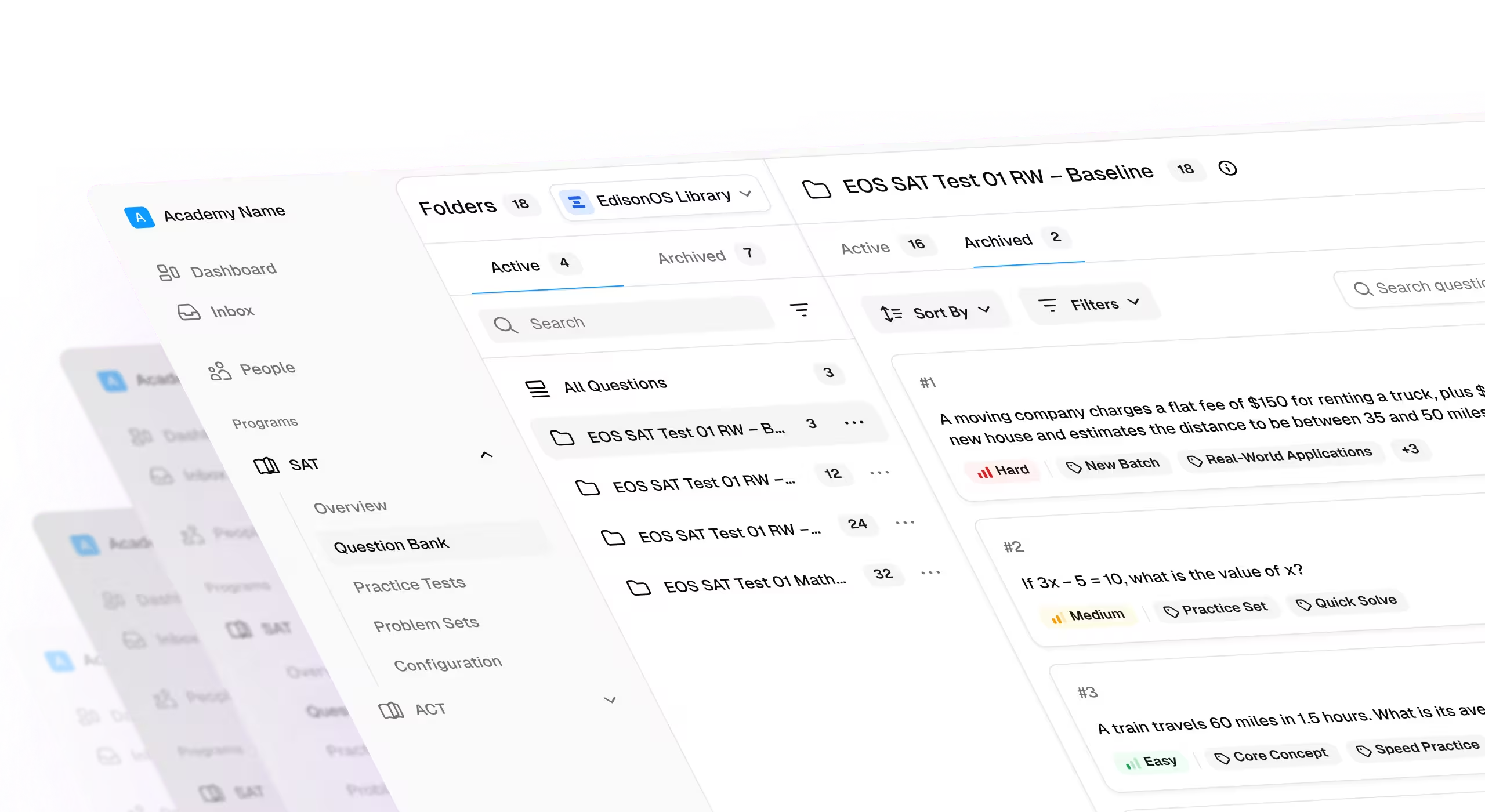
EdisonOS is a Digital SAT platform designed for tutors to craft high-quality practice tests, simulate the official exam environment, and access powerful student performance analytics.
The platform helps tutors boost student scores by 200+ points with access to 5000+ preeminent SAT experts-vetted questions and 22 expert-designed adaptive tests.
Tutors can build their own practice tests that mimic the real test-taking experience in under 60 minutes, allowing them to customize assessments based on each student's needs and target weak areas efficiently.
The platform offers tutor-centric tools to manage multiple students, track progress, and create personalized study plans with ease, enabling tutors to identify which question types. Book a demo today.
Frequently Asked Questions
.svg)



.png)

.png)