.png)
- IB and Cambridge schools in India already operate within demanding academic calendars, making SAT/ACT preparation a scheduling and resource-allocation challenge.
- Schools generally have three options: outsource SAT/ACT prep, run it internally without a dedicated platform, or run it in-house on a digital platform.
- An in-house program gives schools greater control over scheduling, instruction, and student experience, but requires the right content, assessments, reporting, and staff support.
- A practical school-wide program should map SAT/ACT preparation around IB Internal Assessments, Extended Essay milestones, IGCSE assessments, mock exams, and school holidays.
- Diagnostics should establish a baseline early, while repeated practice tests and skill-level analytics help counselors and instructors track progress.
- Parent reporting should go beyond a single test score to show progress, strengths, gaps, and next steps.
- A digital platform can give schools the infrastructure to run SAT/ACT preparation without building an entire testing and reporting system from scratch.
For heads of school, academic coordinators, and college counseling teams, ACT and SAT prep can be another way to support students through the university admissions process. But adding test preparation to an IB or IGCSE school is not simply a matter of finding an instructor and adding another class to the timetable.
India has a substantial and growing international-curriculum school ecosystem. The International Baccalaureate currently lists 274 IB World Schools in India, while Cambridge International says more than 700 schools in India offer Cambridge programmes and qualifications.
That creates a practical question for schools: How do you offer SAT/ACT preparation without disrupting the academic programs students already have to manage?
The answer depends on the program model, how much control the school wants, and how much infrastructure it is prepared to build internally.
This guide looks at the three common approaches, how to fit preparation into an IB/IGCSE calendar, what schools need to run an in-house program effectively, and where a digital platform can reduce the operational burden.
SAT/ACT Program Models for IB & IGCSE Schools at a Glance
The choice is less about whether one model is universally better and more about what the school wants to own.
How Choosing a Program Model Actually Works
Two questions can quickly clarify which model fits a school's needs:
- Who owns the schedule? Outsourcing generally means the external provider determines much of the delivery schedule. Both in-house models allow the school to place SAT/ACT preparation around its own academic calendar, student availability, and assessment periods.
- What can the school see? A platform-supported program makes it easier to collect and analyze diagnostic results, score trends, practice performance, and student progress in one place. That gives counselors and instructors a clearer basis for intervention and parent conversations.
What to Know About Each Model
Outsourcing to an External Coaching Institute
Who it's for: Schools that want to offer SAT/ACT preparation without taking on additional instructional and operational responsibilities.
What it offers: The institute provides instructors, curriculum, assessments, and program delivery, allowing the school to meet demand with limited internal setup.
Where it falls short: The school has less direct control over scheduling, student progress data, instructional delivery, and how closely preparation fits the academic calendar.
Outsourcing can therefore be relatively simple operationally, particularly when a school has very few students interested in preparation. The trade-off is that the program can feel like an external service operating alongside the school's own academic and counseling ecosystem.
In-House, Without a Digital Platform
Who it's for: Schools with teachers or counselors who have the expertise and capacity to manage SAT/ACT preparation internally.
What it offers: The school controls scheduling, instructors, content selection, practice assignments, and student experience.
Where it falls short: Diagnostics, content delivery, assessment creation, data tracking, and parent reporting may require several separate tools or manual processes.
This model gives the school maximum ownership but also puts more operational responsibility on its staff. A teacher may be able to run a weekly SAT class, for example, but managing diagnostics, multiple practice tests, score trends, and individual student interventions across an entire cohort is a different workload.
In-House, on a Digital Platform
Who it's for: Schools that want to own the SAT/ACT program while reducing the amount of infrastructure staff have to build themselves.
What it offers: Scheduling control combined with digital diagnostics, exam-aligned content, practice tests, student management, analytics, and reporting.
Where it falls short: The school still needs instructors or counselors to interpret results, teach students, and manage the program. A platform provides the infrastructure, not the entire instructional strategy.
This model addresses the gap between the first two approaches: the school retains ownership of the program without having to build every component from scratch.
Fitting a Program Into an Already-Packed IB/IGCSE Calendar
SAT/ACT preparation works best when it is planned as a school-year program rather than added whenever students have free periods. Start by mapping major IB Internal Assessment deadlines, Extended Essay milestones, IGCSE assessment periods, school mock exams, holidays, and other high-workload periods. Then place diagnostics and foundational SAT/ACT instruction in relatively lighter academic windows, followed by structured practice-test cycles as students approach their intended test dates.
A reusable annual framework could look like this:
The exact timing will vary by school. The important part is creating the framework once and reusing it for each cohort, rather than rebuilding the schedule every year.
For teachers and counselors, this also means that SAT/ACT preparation does not have to compete equally with every academic period. The workload can rise and fall according to the school's existing calendar.
What Actually Limits Schools Choosing a Program Model
Several common mistakes can make an SAT/ACT program harder to manage than expected:
- Treating outsourcing as cost-free: An external provider can reduce internal workload, but the school may give up visibility, scheduling control, and ownership of the student experience. The cost is not only financial.
- Scheduling before mapping the academic calendar: Adding SAT/ACT sessions without accounting for IB Internal Assessments, Extended Essay milestones, IGCSE assessments, and mock exams can quickly create competing priorities.
- Using generic diagnostics: A baseline assessment should reflect the current digital SAT or ACT experience closely enough to provide useful information about where students actually stand.
- Treating parent reporting as optional: Parents typically need more than a final score. A useful report should show progress over time, areas of strength, gaps, and what the student should work on next.
What Does an In-House SAT/ACT Program Cost?
There is no single cost structure because schools can use existing faculty, hire specialist instructors, outsource delivery, or combine internal staff with a technology platform.
An indicative comparison provided for this framework puts the initial cost of an in-house program at approximately ₹3 lakh–₹8 lakh, including fixed salary and software/licensing, while outsourced programs may range from ₹25,000–₹45,000 per student where institutional minimums do not apply.
The important point is to look beyond the headline price.
These figures should be treated as indicative rather than universal market rates. Actual costs depend on student numbers, staffing, program duration, vendor pricing, and the amount of infrastructure the school already has.
For schools evaluating an in-house platform, the more useful calculation is often the total cost of ownership: staff hours, content creation, assessment tools, reporting, administration, and platform costs combined.
How EdisonOS Approaches School-Run SAT/ACT Programs
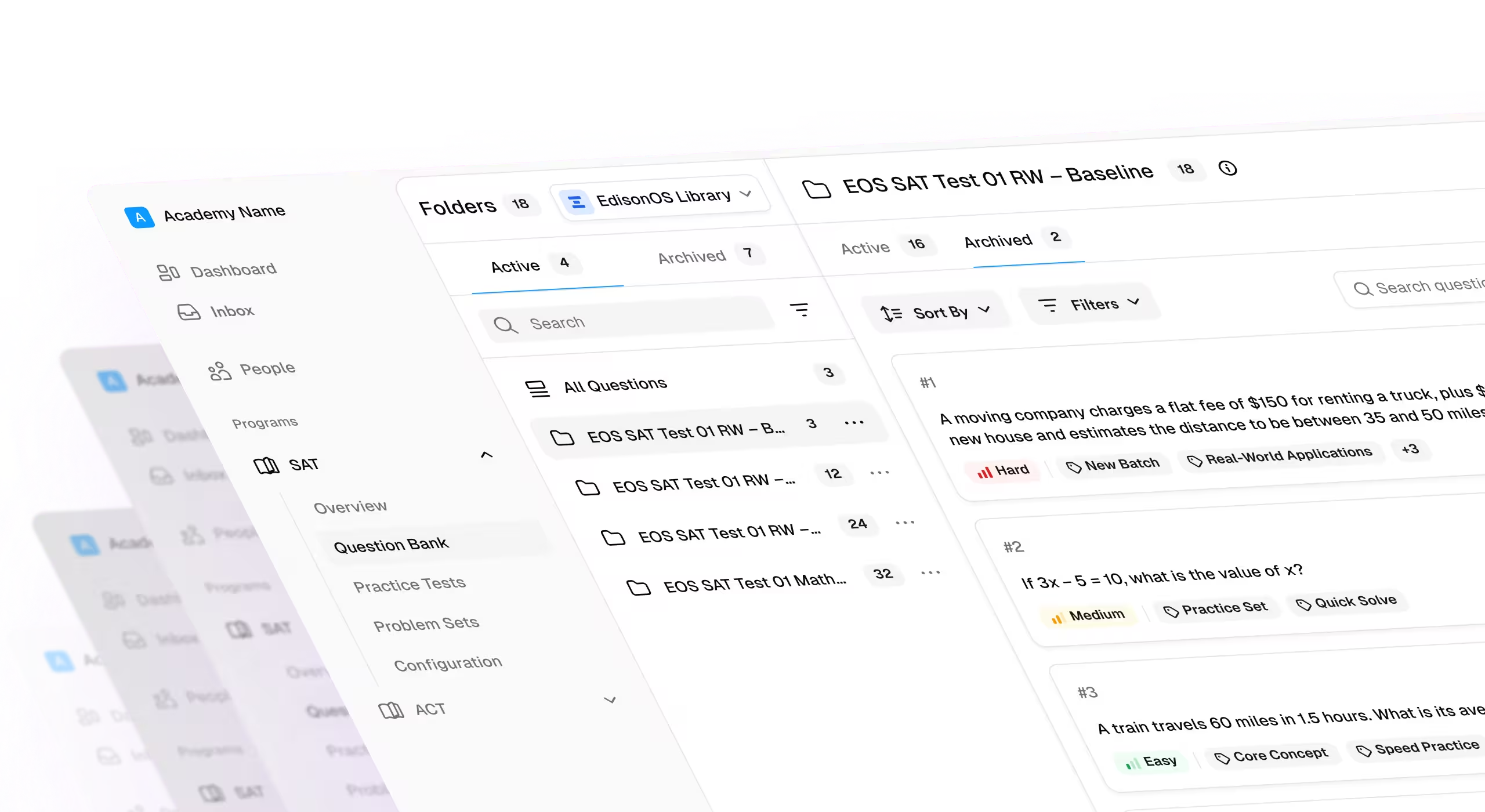
EdisonOS is designed to give schools the infrastructure to run their own test-preparation programs while keeping the program under the school's control.
- Digital SAT diagnostics and ACT assessments: Schools can establish student baselines and assign SAT and Enhanced ACT practice, including full-length tests and targeted assessments. EdisonOS currently provides 15 full-length SAT mocks and 10 full-length ACT mocks.
- Built-in content and LMS: Students can access exam-focused practice while instructors manage assignments and learning activities through the platform.
- Student and instructor management: School deployments can provide separate access for administrators, teachers, counselors, department heads, and parents.
- Live and self-paced learning: Schools can combine instructor-led sessions with independent practice and assessments instead of making the program entirely classroom-based.
- Progress and reporting: Student performance can be tracked through assessment reports and analytics, giving instructors and school teams visibility into progress, accuracy, pacing, and areas requiring intervention.
EdisonOS's school offering is built around an Enterprise plan, with per-student licensing and administrator and teacher seats sized to the school.
Schools typically start looking at a platform when an ad hoc program has moved beyond what teachers can comfortably manage with spreadsheets, PDFs, standalone assessments, and manual parent reports.
Outsourcing vs. EdisonOS: Which Is the Better Fit?
“Better” depends on the school's priorities, so the useful comparison is what each model gives the school control over.
EdisonOS currently positions its school platform around digital SAT and Enhanced ACT preparation, with school-level administration and reporting.
When Outsourcing Makes Sense (And When an In-House Platform Is a Better Choice)
Outsourcing can make sense when:
- Very few students are interested: Paying for an external program may be simpler than building internal infrastructure for a small cohort.
- The school has no available staff: If teachers and counselors are already at capacity, an external provider can take responsibility for instruction and delivery.
- A trusted institute already has capacity: A school with an established relationship with a local provider may prefer to continue using a model that already works operationally.
An in-house platform is a better choice when:
- Parent and student demand is growing: A repeatable program can serve larger cohorts without rebuilding the entire process each year.
- The school wants ownership of the program: Scheduling, student experience, data, and parent communication remain within the school's academic ecosystem.
- Staff already run an ad hoc program: If teachers are already delivering SAT/ACT preparation but relying on spreadsheets, PDFs, and disconnected tools, a platform can provide structure without requiring the school to outsource the program.
Frequently Asked Questions
.svg)



.png)

.png)