Reviewing SAT mistakes effectively means moving beyond just reading answer keys, building a detailed error log, re-solving every missed problem from scratch, and sorting errors by root cause before moving on.
- Log and categorize every error — Track question ID/topic, your answer vs. correct answer, root cause (content gap, misread word, rushing, or time panic), and a written explanation of why the correct answer works.
- Re-solve without looking — Cover the explanation and correct answer, redo the problem cold, and if it can't be solved unaided the second time, the underlying rule hasn't actually been absorbed yet.
- Content gaps — Return to study materials and drill 10-15 focused practice problems on that exact weak concept.
- Careless reading mistakes — Underline trap words like "not," "least," or "except," and on math, re-read the final sentence of the question to confirm the right variable was solved for.
- Execution errors — Verify work with a secondary method, like using the built-in Desmos calculator to check algebra intersections or plug values back in.
Every SAT mistake tells you something important. A wrong answer is not just a lost mark, it is a clue about what is slowing you down, confusing you, or breaking your test-taking strategy.
Many students spend hours solving new questions without ever reviewing why they got previous ones wrong. That leads to repeated mistakes, inconsistent scores, and slow improvement. Real score growth happens when you learn how to analyze your errors and fix the patterns behind them.
Some mistakes come from content gaps. Others come from rushing, misreading questions, weak pacing, or overconfidence. The key is learning how to identify the difference.
This guide breaks down how to review SAT mistakes effectively, track recurring errors, and turn practice tests into measurable score improvement. By the end, you will know how to stop repeating the same mistakes and build a smarter SAT prep strategy.
Why reviewing SAT mistakes is more than checking your answer key
Many students think reviewing means looking at the answer key, understanding the correct option, and moving on. But that kind of review rarely leads to long-term improvement.
Real SAT improvement comes from analyzing why you made the mistake in the first place.
For example, getting a math question wrong because you forgot a formula requires a completely different fix than getting it wrong because you rushed through the calculations. Similarly, missing a Reading and Writing question could come from weak comprehension, misreading the question, poor pacing, or falling for trap answer choices.
If you only check the correct answer without identifying the root cause, the same mistake is likely to happen again.
An effective SAT review focuses on patterns, not isolated errors. You need to ask questions like:
- Did I misunderstand the concept?
- Did I run out of time?
- Did I guess without confidence?
- Did I misread keywords in the question?
- Was this a careless mistake or a knowledge gap?
This type of analysis turns every practice test into actionable feedback instead of just a score report.
Over time, reviewing mistakes properly helps you:
- Identify recurring weak areas
- Improve pacing and decision-making
- Reduce careless errors
- Build stronger test-taking habits
- Increase score consistency across sections
The goal is not just to know the right answer. It is to understand the thinking process that leads to the right answer consistently.
Why the digital SAT’s adaptive format makes mistake review more critical
The digital SAT is a multi-stage adaptive test, which means your performance in one module affects the difficulty of the next. Because of this, repeated mistakes can impact not just individual questions, but your overall scoring potential.
This makes mistake review far more important than simply checking answers or tracking scores.
An effective SAT strategy requires you to identify patterns behind your mistakes. Some errors come from content gaps, while others come from pacing issues, rushing, or misreading questions.
By reviewing mistakes carefully, you can:
- Identify weaknesses in test prep more accurately
- Focus on high-impact improvement areas
- Reduce repeated mistakes across practice tests
- Build a more targeted study plan
Instead of relying on random practice, mistake analysis helps you prepare strategically for the adaptive SAT format.
Now that you understand why mistake review matters, let’s break down exactly how to review SAT mistakes effectively, step by step.
Step 1: Take a full-length, timed practice test under real conditions
To accurately gauge your SAT performance, take a full-length, timed practice test, under test-day conditions. This assessment is a baseline test that indicates how you currently rank and where you need to improve.
By simulating actual test conditions—taking the test in a quiet setting, using an official SAT practice exam, adhering to the prescribed time limits—you’ll get an accurate portrait of your skills. Many students are guilty of treating practice tests casually, but timed exams can help build stamina, focus, and comfort level with the SAT format.
Suppose a student takes their first practice test and scores 1200 (600 in Math, 600 in Reading & Writing). While this is a good starting point, it doesn’t reveal which specific topics need improvement.
Without this step, they might waste time studying concepts they already know instead of targeting weaker areas. So make sure you take a free SAT practice test and begin on the right note.
Step 2: How to categorize your SAT mistakes
Once you review your practice test, do not stop at checking which questions were wrong. The real improvement comes from understanding why you missed them.
This is one of the most important parts of analyzing SAT practice test mistakes step by step. Learning how to read your SAT score report properly can help you distinguish between content gaps, pacing problems, and careless mistakes more accurately.
Most SAT mistakes fall into four categories:
- Content gaps: You did not know the concept or formula required to solve the question correctly
- Careless mistakes: You knew the concept but made a small error, such as a calculation mistake or skipping a keyword
- Misreading the question: You misunderstood what the question was asking or overlooked important details
- Timing and pacing issues: You rushed, ran out of time, or guessed without fully solving the question
For example, getting an algebra question wrong because you forgot a formula requires a different fix than missing it because you rushed through the calculations.
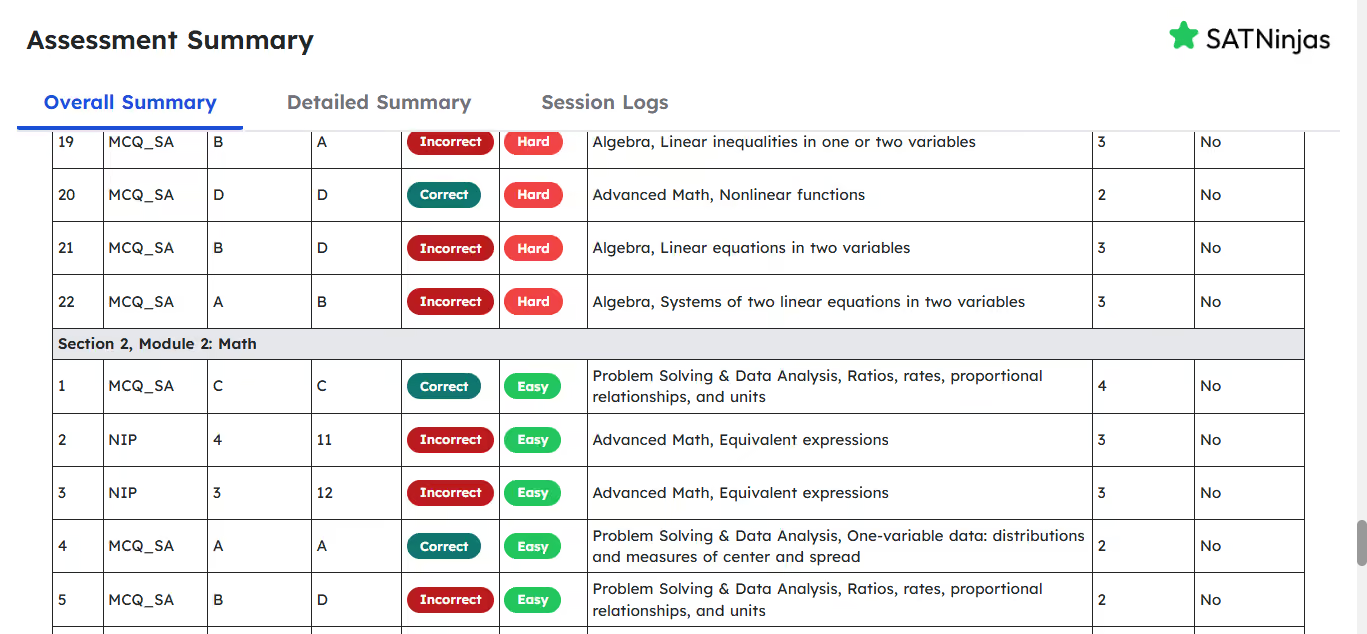
Visual skill accuracy charts can make this process much easier. Instead of manually guessing weak areas, analytics platforms like EdisonOS show accuracy by specific skills such as quadratic equations, transitions, punctuation, or data analysis, helping students identify patterns faster.
Categorizing mistakes helps you identify patterns across practice tests. You may discover that:
- Reading mistakes mostly come from rushing passages
- Writing mistakes come from grammar rule gaps
- Math errors happen more under time pressure than from weak concepts
This level of analysis makes your study plan far more targeted and efficient. Instead of reviewing entire sections repeatedly, you can focus directly on the habits and concepts that are lowering your score.
Step 3: How to build a simple SAT error log
An SAT error log is one of the most effective tools for improving your score consistently. Instead of forgetting mistakes after reviewing a test, an error log helps you track patterns over time and prevent repeated errors.
The goal is simple: document every serious mistake and understand what caused it.
Your error log does not need to be complicated. A spreadsheet, notebook, or digital tracker is enough as long as you update it consistently after every practice test.
For each incorrect question, record:
- The section and question type
- The topic being tested
- Why you got it wrong
- The correct solving approach
- What you need to do differently next time
For example:
- “Misread the question and solved for x instead of y”
- “Forgot the quadratic formula under time pressure”
- “Rushed through passage and missed evidence clue”
Over time, the error log helps you identify recurring patterns. You may notice that:
- Most careless mistakes happen near the end of sections
- Grammar questions involving transitions appear repeatedly
- Geometry mistakes increase when rushing
This turns your SAT prep into a data-driven process instead of random practice.
Reviewing mistakes becomes much more effective when students can immediately rework problems while analyzing them. Platforms like EdisonOS integrate tools such as Desmos, reference sheets, and detailed summaries directly into the results page, allowing students to revisit questions without leaving the platform.
A good error log also makes revisions more efficient. Instead of redoing entire tests, you can revisit your highest-frequency
Step 4: How to analyze your results using section scores and skill data
After categorizing your mistakes and tracking them in an error log, the next step is analyzing your performance patterns using section scores, domain scores, and skill-level data.
Your digital SAT results contain much more than a final score. They show how you performed across Reading and Writing domains, Math skills, pacing, and question difficulty levels.
Start by reviewing your section scores to identify where the biggest score gaps exist. Then go deeper into domain-level performance:
- Information and Ideas
- Craft and Structure
- Expression of Ideas
- Standard English Conventions
- Algebra
- Advanced Math
- Problem-Solving and Data Analysis
- Geometry and Trigonometry
This helps you understand whether your weaknesses are conceptual, strategic, or timing-related.
For example:
- Strong Algebra but weak Advanced Math may indicate higher-level concept gaps
- Weak Craft and Structure scores may point to comprehension or vocabulary issues
- Inconsistent performance across modules may suggest pacing problems rather than content weaknesses
Digital analytics platforms like EdisonOS make this process easier by tracking:
- Section-wise performance trends
- Accuracy across difficulty levels
- Skill growth over time
- Pacing and timing patterns
- Repeated weak areas across multiple tests
This type of analysis helps you move beyond raw scores and build a study plan based on measurable performance data. It is suggested to track your progress every 1–2 weeks and adjust your strategy accordingly.
Step 5: What to do after you've identified your weak areas
Identifying weak areas is only useful if you turn those insights into action. Once you know where you are losing points, the next step is building a focused improvement plan.
Start by prioritizing high-impact weaknesses instead of trying to fix everything at once. For example, recurring algebra mistakes or grammar rule gaps will usually affect your score more than isolated errors.
Your study plan should match the type of mistake:
- Content gaps: Review concepts, formulas, and solving methods before practicing more questions
- Careless mistakes: Slow down, double-check work, and improve focus under timed conditions
- Pacing issues: Practice timed drills and learn when to skip and return to difficult questions
- Misreading errors: Train yourself to underline keywords and identify exactly what the question is asking
It is also important to retest strategically. After reviewing weak areas, take sectional tests or targeted drills before jumping into another full-length practice test.
Platforms like EdisonOS make this process more structured by combining:
- SAT error analysis
- Skill-level performance tracking
- Adaptive practice tests
- Full-length digital SAT simulations
- Analytics across multiple tests and questi
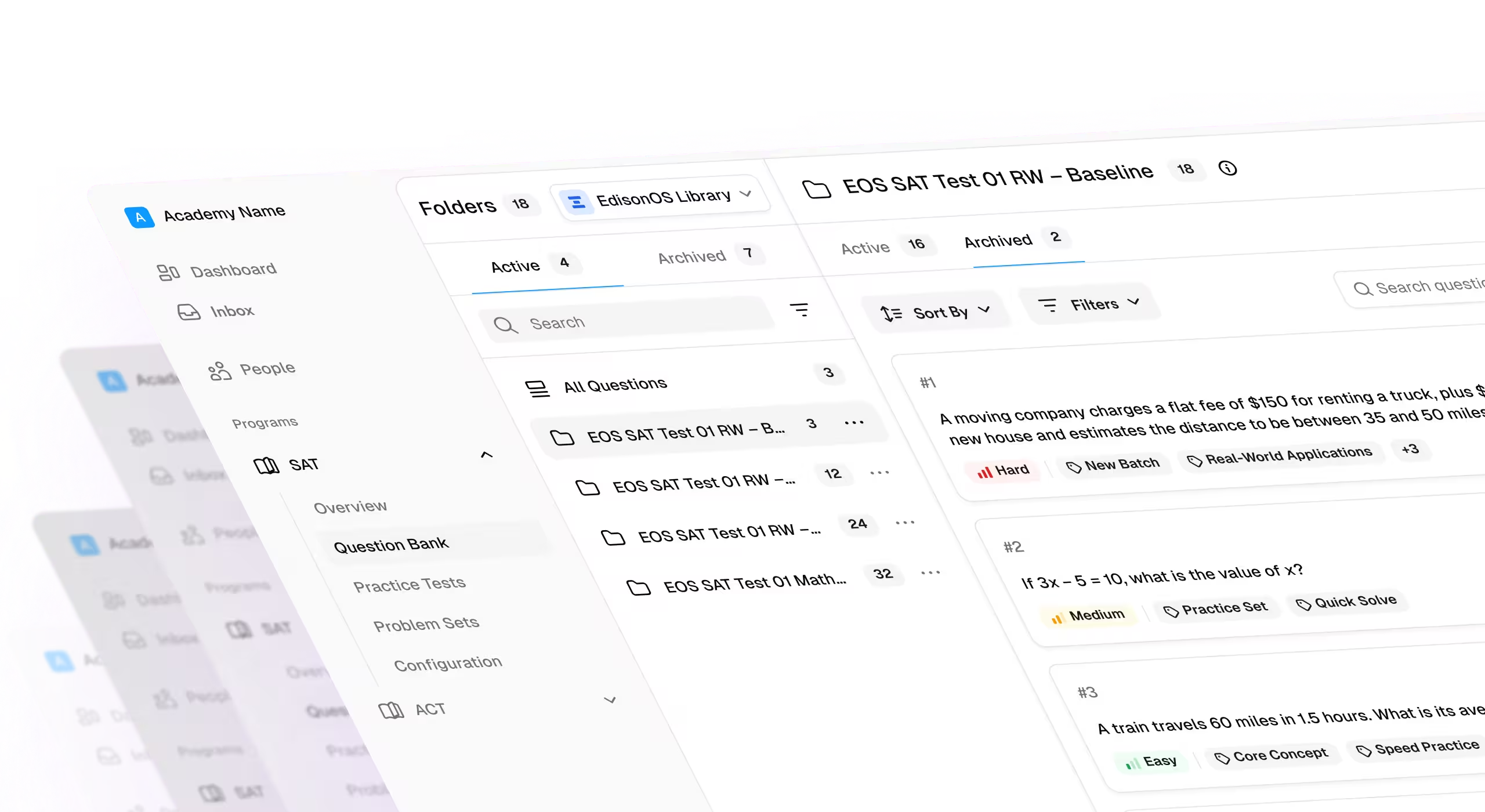
Once weak areas become clear, targeted practice is far more effective than random full-length testing. EdisonOS allow tutors and students to build customized SAT practice tests from thousands of questions in minutes, focusing only on the concepts and question types that need improvement.
The goal is not just to practice more, but to practice based on patterns revealed by your mistakes.
How often should you review SAT mistakes?
Reviewing mistakes should be a regular part of your SAT prep, not something you do occasionally after a bad test.
Ideally:
- Review mistakes immediately after practice sessions while the reasoning process is still fresh
- Spend dedicated time each week revisiting your error log and recurring weak areas
- Reanalyze patterns after every full-length practice test
A common mistake students make is taking multiple free SAT practice tests without reviewing them deeply. This creates the illusion of progress without actually fixing underlying problems.
Consistent mistake review helps you:
- Prevent repeated errors
- Strengthen weak concepts faster
- Improve pacing and decision-making
- Measure whether your strategy is actually working
As your prep progresses, your mistakes should also change. Early mistakes may come from content gaps, while later mistakes often come from timing pressure or advanced question difficulty.
Consistent review makes it easier to monitor SAT progress over time and identify whether recurring mistakes are actually improving.
EdisonOS: Transform Insights into Score Gains with Precision
Assessing your SAT strengths and weaknesses is the key to achieving your target score. By using a structured approach, analyzing mistakes, and creating a focused study plan, you can improve in the areas that matter most.
Understanding the SAT scoring algorithm helps you prioritize high-impact sections, ensuring that your efforts translate into tangible score gains. It isn’t about studying harder. You need to study smarter, and that begins with a clear assessment of where you stand.
With EdisonOS, you get access to data-driven SAT prep tools, personalized performance insights, and AI-powered analysis to pinpoint weak areas efficiently. Our platform simplifies test preparation and enhances learning through adaptive strategies aligned with the SAT scoring algorithm.
With EdisonOS, you can confidently tackle the SAT, knowing you have the right tools and insights to maximize your score.
Book a free SAT demo with EdisonOS today and take the first step toward SAT success!
Frequently Asked Questions
.svg)





.avif)