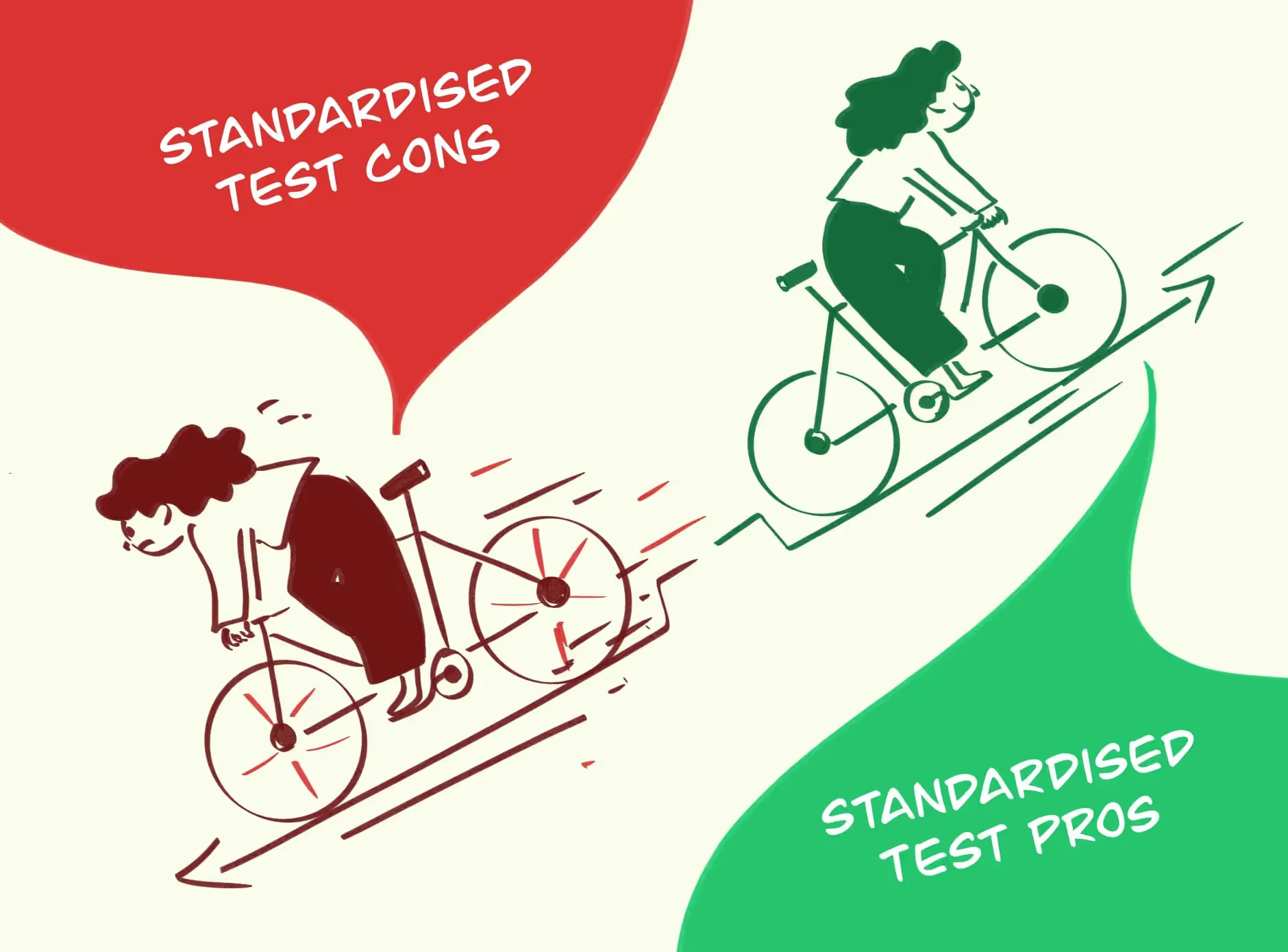
Standardized testing offers consistent benchmarks, objective scoring, and measurable accountability, but critics argue it narrows the curriculum, fails to capture creativity or true potential, and drives high stress for students and educators.
- Objective measurement — Computer scoring removes personal bias, producing a clear, comparable numeric score.
- School accountability — Helps state and local programs identify underperforming schools and direct funding accordingly.
- Identifying gaps — Highlights broad learning deficits across student groups and geographic areas.
- Clear baselines — Offers a consistent snapshot of student progress over time.
- High anxiety — Puts intense pressure on students, often hurting mental health and same-day performance.
- Teaching to the test — Pushes teachers to skip deeper or creative lessons in favor of test-specific tricks.
- Narrow focus — Overlooks traits like art, critical thinking, and emotional intelligence.
- Potential bias — Can favor wealthier students who have greater access to test prep resources.
Remember Good Will Hunting (1997), in which Matt Damon plays a math genius? The irony is that he plays the role of a self-taught math genius who keeps himself almost invisible behind the small-time job of a janitor at MIT.
The character of Will Hunting is a subtle reminder that there might be as many bright people outside conventional education as there are inside. Is there a similar case for standardized testing too? Is it possible that colleges might inadvertently reject some bright students who may not be skilled with such tests yet may be exceptional? Are there any alternatives to standardized tests?
In this post, we examine both sides of the coin: the advantages and shortcomings of standardized tests. We examine why many colleges find standardized testing effective and convenient. We also draw from the opinions of educators and tutors.
But first, a rapid overview of standardized tests.
What Is Standardized Testing?
Besides academics, standardized tests are used in a variety of disciplines, ranging from music to military, among others. In many standardized tests, all students attempt the same test and the evaluation criteria to assess their responses are also identical.
However, in adaptive tests, different students are asked different yet comparable questions. Such tests adapt to the student's abilities. Those students who perform above a certain benchmark in one section are asked more difficult questions in the next. The goal is to maintain objectivity and compare students’ competence more accurately.
Testing seems to have come—or is coming—a full circle. Until about the mid-19th century, when education was restricted to only a few people, open-ended, non-standardized tests were prevalent. As the number of people getting an education increased, most non-standardized assessments were replaced by standardized tests. That was important to democratize education, especially after the rapid growth fueled by the Industrial Revolution.
Paradoxically, higher standards of education are forcing educators to look beyond standardized tests. That’s because an increasing number of employers are looking for diverse and more sophisticated skills from their workforce. The sweeping changes in technology and commerce require the labor force to have heterogeneous capabilities, not all of which are covered by standardized testing.
Why Colleges Use Standardized Tests
In order to fully understand the pros and cons of standardized testing, it will help you understand why most colleges use the scores of standardized tests as an important criterion while making admissions offers.
Below are the three principal reasons:
1. Speed and scalability: Standardized tests like the digital SAT can be assessed very quickly. Moreover, they can be easily scaled up or down as the number of students changes without compromising the test or its results.
2. Reliability: Because the scores have been arrived at by using a neutral system, the scores are reliable. A score of 1500 is clearly better than a score of 1400, since both scores have been arrived at using the same system.
3. Comparability: The scores are comparable because all students have been attempting nearly identical questions under identical test conditions in that comparing score range. This prevents any bias in making comparisons.
Are Standardized Tests a Good Predictor of College Success?
Yes, various studies have repeatedly shown that there is direct correlation between standardized test scores and performance at college.
For instance, the key findings of a study by Opportunity Insights: “Students with higher SAT/ACT scores are more likely to have higher college GPAs than their peers with lower scores”. The same study points out that high-school grades do a “poor job of indicating academic success at college”.
While there are many reasons why this happens, the Fordham Institute points out two clear reasons:
- Standardized testing better summarizes and offers an objective evaluation of a student’s reading ability and math. Highschool grades typically fall short here.
- Standardized tests are unaffected by grade inflation (GPAs rising without a corresponding improvement in actual academic capabilities).
An important outcome here is that data from standardized tests also provide policymakers and educators with objective, state-wide data.
Are Standardized Tests Fair to All Students?
While using standardized test scores for admissions has distinct merits, there is some rationale for questioning its use as well.
Here’s something to start with. NEAToday, in its August 2025 article, calls standardized tests ineffective at gauging what students know.
Consider two students Luke and Jiah, who took the SAT two months back. Luke scored 1450 while Jiah scored 1170. On the face of it, Luke has performed better than Jiah.
But once you learn about their backgrounds, a different picture emerges. Luke went to an expensive private school and could afford test prep courses. Jiah's family was barely making ends meet, and her school was not much. Even when she struggled with math, she had no one to turn to. From failing most of her math tests in school to getting 540 on the SAT math, she has come a long way.
The problem with using standardized test scores to accept—or reject—students is that the system fails to consider such differences. The skills and competence of all the students are measured using the exact same yardstick devised decades back. Such an approach fails to take into consideration the rapidly evolving world of today.
The Limitations of Standardized Testing
Below are the downsides of using standardized tests:
- Works against some students: Some students are quite talented and skilled, but they come from disadvantaged backgrounds. An Australian study, cited by Issues in Educational Research (IIER), mentioned a phenomenon called “zip code effect”: students’ scores correlated with the socio-economic characteristics of where they lived. In other words, students from weaker backgrounds started with a substantial disadvantage.
- Limits to certain learning styles only: Because such tests follow a fixed pattern of questions, they do not suit all styles of teaching and learning. For instance, some students may be great at applying theoretical concepts to practical situations. One potential drawback of standardized tests is that they don’t gauge a student’s socio-emotional intelligence.
- Restricts performance to a few hours: A single test, spread over 3 or 5 hours, cannot accurately measure a student’s abilities or potential of how they’d fare in the professional world. Such tests provide only a partial view of a student’s capabilities. A low score, therefore, can significantly lower a student’s faith in themselves, as studies like this one suggest.
- Ignores student’s overall growth: Such tests evaluate students in absence of any data on where the student was, say, a year back, and where the student is right now. As Megan Padden of OWL Education Services told us, “The states to assess a student accurately need to have a portfolio. … And that should not just be filling in bubbles because sometimes they just don't care.”
- Offers a narrow view: Many students attempt such tests more than once and often improve their scores. What’s important to note is that they may have probably improved their test-taking abilities. They have not improved any real-life skills that will help them in their careers. Hence, an improved score may misguide colleges into believing the student has improved.
- Carries limited context: Any score that a standardized test report is based on questions designed with a certain context. Hence, the scores are valid only for that particular context and not others. For instance, the Analytical Writing part that you see in the GRE is unable to tell you if the student is as persuasive in public speaking.
Does Standardized Testing Lead to "Teaching to the Test"?
While answering this question, it’s important to not confuse teaching with learning by rote.
Sure, standardized nature tests follow a certain pattern and thus become teachable. On the other hand, the digital SAT March 2026 takeaways clarify that the test is designed to not differentiate between students who get coaching and students who don’t. Basically, the test makes sure mere ‘teaching to the test’ won’t work.
So teaching is the operative term. Coaching that focuses on real skill-building benefits students in more than one way. It builds skills that are useful to achieve a good score. Perhaps even more important is the fact that the same skills are useful for academic excellence. They help students improve for career options.
Against that, drilling for tactics alone, without any value-addition in skills, can lead to extremely narrow, potentially counter-productive outcomes. It can build hollow confidence in the student, without building any skills. But when it’s actual test time, students realize there’s been no meaningful preparation.
The Digital SAT and the Enhanced ACT are designed to minimize any benefits of drilling or learning by rote. They reward real learning, real skill-building. And that is where valuable coaching comes in.
So, to sum up, it’s not impossible to teach the test. However, score improvements from mere drills will always be limited, and that too without any long-term benefits. Real coaching, on the other hand, helps students build actual skills and achieve better test scores.
Does Test Anxiety Affect Standardized Test Scores?
An SAT or the ACT is, after all, a test. It evaluates the student’s preparedness for a test that can considerably impact their college admissions chances. Stress is no surprise in such a case.
- Stress can impact how students execute their strategy: Although the SAT or the ACT don’t require rote learning, students come with certain strategies in mind. Stress can confuse students and make them forget a tactic or too.
- Stress can lower your working memory: That means students might forget some part of the passage they’ve read. Eventually, they end up picking the wrong answer choices.
- Stress leads to performance anxiety: When they walk into the test center, students come with a certain target score in mind. This could weigh on their minds and make them extra-cautious or take too many risks. Both of these can harm the student’s performance.
In addition to strategic actions - like learning mind-calming methods and extensive practice, for instance - students can also beat stress by doing small things right. Reaching the test center ahead of time, for example, prevents anxiety of rush-hour traffic or finding your way through unfamiliar localities.
The Benefits of Standardized Testing
Sure, standardized tests aren’t the perfect tool to get the measure of a test taker’s potential. But that doesn’t mean such tests aren’t practical. They have been used for years, and they have their own merits.
Here are the main strengths of standardized tests:
- Brings uniformity across regions: Tests like the GMAT, GRE, and SAT are conducted and evaluated at a national level. A large number of international students write these tests. This gives a larger picture of comparison on a uniform platform, which is both important and useful for college admissions committees. In the absence of such tests, they’d have to rely on the results of regional tests, which are often inconsistent with one another.
- Remains objective: An overwhelming proportion of students getting A’s (called ‘grade inflation’) makes it difficult to reliably compare their caliber or preparations. A standardized test, conducted across the nation, can provide an objective comparison of performances. This helps the admissions committee minimize bias.
- Summarizes performance in a simple way: The scores of such tests act as a single point of truth. At the end of the day, parents, students, and admission officers need a brief statement that encapsulates a student’s performance. More importantly, the statement shouldn’t be difficult to interpret, or else it could lead to bias in judgment. The score cards of standardized tests like the GMAT give you just that: numbers that display how the student has fared.
- Makes it easy for the admission officers: Admission committees get a clear picture of a student’s performance in areas that are defined in advance. For instance, the scores of the SAT math section easily shows the extent to which a student is comfortable with highschool algebra, arithmetic, and geometry. These are prerequisites for a big number of undergraduate courses. Hence, the college knows whether the student they’re accepting is already capable of taking the course or whether they will need some extra help.
- Encourages competition: Standardized tests motivate students to raise their benchmarks. Sam Belows told us in one of our podcasts that “it is important to have this kind of a competition because this is what pushes everybody to raise their standards…”.
- Supports big volumes: Scoring, when carried out for multiple choice questions, can be scored really fast, without losing accuracy. Irrespective of the number of students, a standardized test will always be In contrast, evaluation of non-standardized tests take more time, can become inaccurate or biased as the volume grows, and may even miss the purpose of testing.
- Offers better representation: There is some evidence that standardized tests actually ‘benefits under-represented students’. The Encyclopedia Britannica, in its November 2025 article, clearly states: “Standardized tests help students in marginalized groups”.
What Can Replace Standardized Testing?
After analyzing the pros and cons of standardized tests, we have come to believe that such tests have a very important role to play, whether it’s college admissions or hiring. Hence, replacing standardized testing entirely would be like throwing away the baby with the bathwater.
Introducing new segments or formats in tests needs to be done with caution. Otherwise, the newer versions will bring in new limitations or deepen the current weaknesses.
As an example, let’s say colleges decide to replace a writing section with videos. The college can permit students to record their own videos and send it to the college, and make essay writing optional or redundant. It sounds great because it’s a creative challenge. However, a new set of video consultants will crop up to guide and assist students. Again, the purpose behind the video exercise will be diluted.
Descriptive tests or practical evaluations for, say, engineering skills, may have the constraint of time or uniformity of evaluation. Some other forms of evaluations, like a live, in-person interview, have challenges like scaling.
One option that seems viable is that of giving options to the student. If a college requires a student to submit ten items, there could be a bunch of fifteen items out of which the student chooses which ten to select. As an example, some students might choose an essay over a video, or some might choose a descriptive test over an objective test.
Of course, these are only early observations; more refined activities will emerge as we begin to prepare ourselves to change. But the whole point is that it’s a good time to begin discussing what can complement standardized tests. Inputs and participation from all stakeholders will help us discover a system that’s superior to the one we currently use.
How EdisonOS Helps Students Prepare for Standardized Tests
EdisonOS is a Digital SAT platform designed for tutors to craft high-quality practice tests, simulate the official exam environment, and access powerful student performance analytics. Since the Digital SAT's complex scoring system considers both question difficulty and correctness, tutors need sophisticated tools to prepare students effectively and demonstrate measurable results.
Why Tutors Choose EdisonOS:
- Expert-Vetted Content at Scale: Access 5000+ SAT experts-vetted questions and 22 expert-designed adaptive tests, helping tutors boost student scores by 200+ points
- Rapid Test Customization: Build your own practice tests that mimic the real test-taking experience in under 60 minutes, allowing you to target each student's specific weak areas
- Authentic Test Environment: Mimics the Bluebook interface to reduce test anxiety and familiarize students with the real test format, ensuring students are comfortable before test day
- Data-Driven Insights: Detailed breakdown of student performance where every second spent is analyzed, with tutor-centric tools to manage multiple students, track progress, and create personalized study plans with ease
Ready to transform your Digital SAT tutoring? Join thousands of tutors using EdisonOS to deliver measurable results and help students achieve their target scores.
(Many of the ideas in this article are based on the conversations during our podcasts, in particular with the ones with Sam Belows, Megan Padden, Michelle McAnaney, and Christine Lawlor King.)



.png)

.png)