Improving analytical reasoning is the best way to boost Digital SAT scores, helping students break down complex texts, analyze data, and solve multi-step problems logically across both sections.
- Predict the answer first — Formulate a mental answer before viewing choices to avoid trap answers that look plausible but aren't correct.
- Find three wrong answers — Use process of elimination to cross out extreme, off-topic, or unsupported options rather than hunting straight for the "right" one.
- Create visual organizers — Sketch T-charts for comparisons or quick timelines for sequences to externalize thinking on dense passages.
- Work backward in math — Test given answer choices against the problem's conditions when stuck on algebra.
- Estimate to eliminate — Rough estimates before exact calculation rule out clearly wrong answers and catch careless mistakes faster.
- Draw labeled diagrams — For geometry or word problems, sketching and labeling variables makes the logical structure obvious.
- Daily micro-practice — Consistency beats marathon sessions: summarize one article's main idea daily, edit a paragraph for clarity, or solve one data-analysis problem and explain the reasoning in two sentences.
Analytical reasoning is an essential skill for the Digital SAT, as it enables students to break down complex problems, evaluate information, and make logical inferences. This skill is tested in both the Reading & Writing and Math sections, requiring you to interpret data, recognize patterns, and apply critical thinking. Improving your analytical reasoning abilities is vital for excelling in the Digital SAT, as these skills will help you tackle challenging questions more efficiently. In this article, we’ll explore strategies to improve your analytical reasoning for the Digital SAT, focusing on problem solving, data analysis, and logical thinking.
Analytical Reasoning Structure in the Digital SAT
The Digital SAT tests your ability to analyze and reason through information across different types of questions. Analytical reasoning is necessary when:
Interpreting charts and graphs: You will need to extract relevant data from visual aids and apply mathematical principles to solve problems.
Making inferences: Many questions, particularly in the Reading & Writing section, require you to infer meaning and conclusions based on the given information.
Evaluating arguments: You’ll be asked to assess the strength of arguments or claims, making it essential to recognize valid reasoning and logical fallacies.
Adaptive Nature of the Digital SAT
The Digital SAT is adaptive, meaning that the difficulty of questions in the second module is determined by your performance in the first module. The adaptive structure makes analytical reasoning even more critical, as performing well in the first module unlocks more challenging questions that can significantly boost your score.
Here’s a breakdown of how analytical reasoning plays into the adaptive structure of the SAT:

8 Strategies to Improve Analytical Reasoning for the Digital SAT 2026
1. Break Down Complex Problems
Many analytical reasoning questions require multiple steps to reach the correct solution. Whether in the Math or Reading & Writing sections, breaking down complex problems is an essential skill for analytical reasoning.
Understand the Problem: Carefully read the question to understand exactly what is being asked. Look for keywords or phrases that point to the type of reasoning required (e.g., cause and effect, comparison, etc.).
Simplify the Problem: Break the question into smaller, more manageable parts. For example, if you’re working on a data analysis problem, isolate the important figures or data points before trying to solve the problem.
Work Methodically: Approach each part of the problem logically. Work step by step, ensuring that each answer makes sense before moving on to the next part of the question.
2. Improve Data Interpretation Skills
Many analytical reasoning questions in both the Math and Reading & Writing sections involve interpreting data from tables, charts, and graphs. Mastering this skill will help you solve data based questions more efficiently.
Understand Different Graph Types: Familiarize yourself with various types of graphs, including bar charts, line graphs, pie charts, and scatter plots. Each type of graph requires different strategies for extracting relevant information.
Identify Key Trends: Practice identifying patterns and trends in the data. This will help you make predictions and draw conclusions based on the visual representation of the information.
Solve RealWorld Data Problems: Engage with real world data sets, such as statistics from news articles or scientific studies, to sharpen your ability to interpret and analyze data.
EdisonOS offers specialized practice modules for interpreting data from charts, graphs, and tables. With real time feedback, the platform helps you build the analytical reasoning skills you need for the Digital SAT.
3. Strengthen Logical Reasoning
The SAT evaluates your ability to spot assumptions and evaluate evidence, even when presented with confusing claims.
Practice Syllogisms and Deductive Reasoning: Logical reasoning involves recognizing valid conclusions based on given premises. Practicing syllogisms (a form of reasoning where a conclusion is drawn from two premises) will help you understand how to apply deductive reasoning in SAT questions.
Avoid Logical Fallacies: Recognize common logical fallacies, such as circular reasoning or false causality. Identifying these errors will help you answer questions more accurately, particularly when analyzing arguments in the Reading & Writing section.
Solve Problems Step by Step: Many logical reasoning problems require careful thought and methodical problem solving. Always take time to evaluate each step of the reasoning process to ensure you’re on the right track.
4. Develop Critical Thinking Skills
Critical thinking is closely related to analytical reasoning and is essential for making inferences, evaluating evidence, and solving complex problems.
Make Inferences: Practice making logical inferences based on the information given. In the Reading & Writing section, many questions require you to draw conclusions that are not explicitly stated in the passage. Learn to identify the subtle clues that lead to these conclusions.
Evaluate Evidence: When evaluating an argument or claim, practice determining whether the evidence provided supports the conclusion. Look for gaps in reasoning or weak evidence that undermines the argument.
Compare and Contrast Ideas: Often, you’ll be asked to compare two different perspectives or pieces of information. Practice comparing and contrasting data points or arguments to identify similarities and differences.
5. Enhance Problem Solving Abilities
In the Math section, problem solving requires a combination of logical reasoning, numerical analysis, and analytical thinking. Strengthening these skills will help you tackle both basic and advanced math problems.
Work with Word Problems: Word problems often require analytical reasoning to break down the text and identify the relevant mathematical principles. Practice solving a variety of word problems that test different mathematical concepts, such as algebra, geometry, and data analysis.
Apply Logical Steps: For multistep problems, clearly define each step in the solution process. For example, if you’re asked to calculate an area and then apply it to a cost problem, approach each step separately before arriving at the final answer.
Improve Estimation Skills: Modern SAT rewards estimation and pattern recognition rather than raw calculative abilities. The test-maker wants to see if you can leverage numbers to draw the right inferences, rather than merely push the calculator buttons.
6. Practice with Official SAT Questions
To improve your analytical reasoning, practicing with real SAT questions is crucial. The more familiar you are with the types of analytical reasoning questions on the SAT, the better you’ll perform on test day.
Use Official Practice Tests: The College Board provides full length SAT practice tests that mirror the actual test conditions. These practice tests are perfect for building your analytical reasoning skills.
Platforms like EdisonOS offer personalized free digital SAT practice test modules that focus on developing the analytical reasoning skills necessary for the SAT. With adaptive feedback and targeted exercises, EdisonOS ensures you’re prepared to excel in both the Math and Reading & Writing sections of the Digital SAT.
Analyze Your Mistakes: After completing each practice test, review your mistakes and focus on the types of reasoning questions you got wrong. This will help you identify areas where you need more practice and improvement.
7. Manage Your Time Effectively
Effective time management is key to answering analytical reasoning questions within the allotted time. Since these questions often require deeper thought, it’s essential to pace yourself correctly.
Answer Easier Questions First: In both the Math and Reading & Writing sections, start by answering the easier questions. This will give you more time to focus on the analytical reasoning questions that require extra attention.
Skip and Return: If you encounter a particularly difficult analytical reasoning question, skip it and come back to it at the end. This prevents you from spending too much time on one question and ensures you have time to complete the rest of the section.
Use the Process of Elimination: For multiple choice questions, eliminate obviously incorrect answers. This strategy increases your chances of choosing the correct answer, even if you’re unsure.
8. Leverage AI effectively
That’s more than just turning to ChatGPT for theory or explanations. Using an AI platform for your SAT prep is a skill that we’ve broken down into three parts below:
Analyse Mistakes: Ask for error pattern analysis. Make it show you if you’re missing a step while drawing conclusions, using the wrong assumptions, or simply interpreting information the wrong way.
Get Feedback: Let AI offer feedback and show what concepts you need to work upon and what is it that you’re doing right. That way you can make corrections at the right place and feel confident about areas you’re already strong.
Work With Adaptive Tests: Modern SAT prep platforms increasingly use AI-driven adaptive learning to adjust question difficulty based on performance, helping students strengthen analytical reasoning more efficiently. Leverage technology.
How EdisonOS can help improve your Analytical Reasoning for the Digital SAT
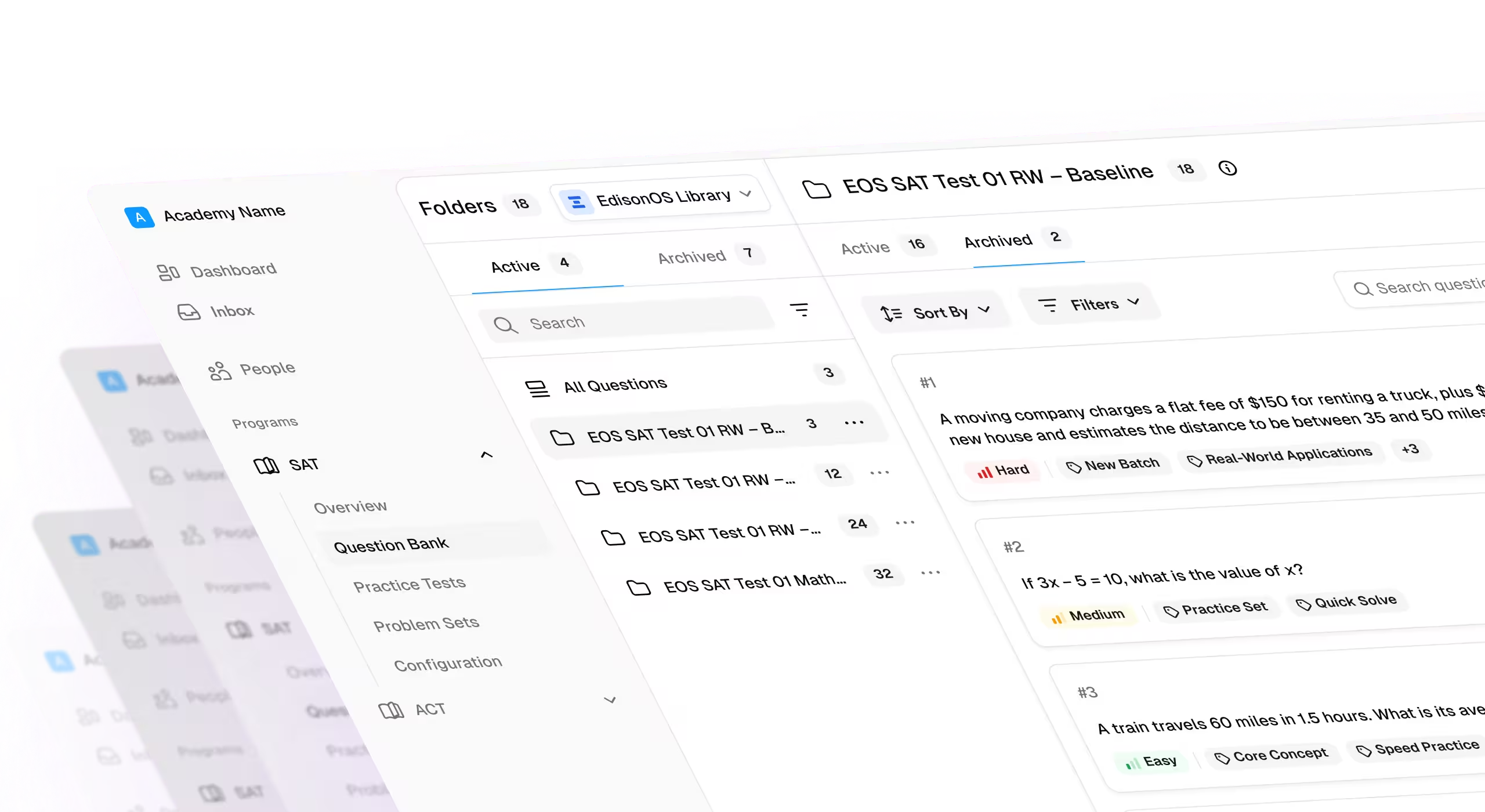
First things first: personalization is key. The technology stack behind EdisonOS uses student’s performance to understand the smallest details.
EdisonOS analytics shows you:
- Category of the question
- Difficulty level of each question
- Time taken to answer the question
- Detailed explanation of why a certain choice is correct
- Comparative analysis of why each of the other choices were incorrect
This helps tutors quickly identify what the student exactly needs in the next practice test. Personalization based on actual performance speeds up score improvement. Using this, you can create your own assessments from the large, expert-vetted question bank of EdisonOS.
Secondly, you can easily track the student’s progress. That way, you easily know what’s working, what’s not, and what changes you need to make.
Finally, EdisonOS allows you to share your students’ progress reports with their parents. That way, you keep them in the loop and make sure they know how close their child is to the dream scores.
Conclusion
Improving your analytical reasoning for the Digital SAT requires consistent practice in breaking down complex problems, interpreting data, and using logical reasoning. By strengthening your critical thinking and problem solving skills, you’ll be better equipped to tackle the most challenging questions on the exam.
Platforms like EdisonOS offer personalised free practice test modules that focus on developing the analytical reasoning skills necessary for the SAT. With adaptive feedback and targeted exercises, EdisonOS ensures you’re prepared to excel in both the Math and Reading & Writing sections of the Digital SAT.
Start integrating these strategies into your study routine today, and you’ll see significant improvements in your analytical reasoning abilities, setting you up for success on the Digital SAT.
Frequently Asked Questions
.svg)


.png)

.png)