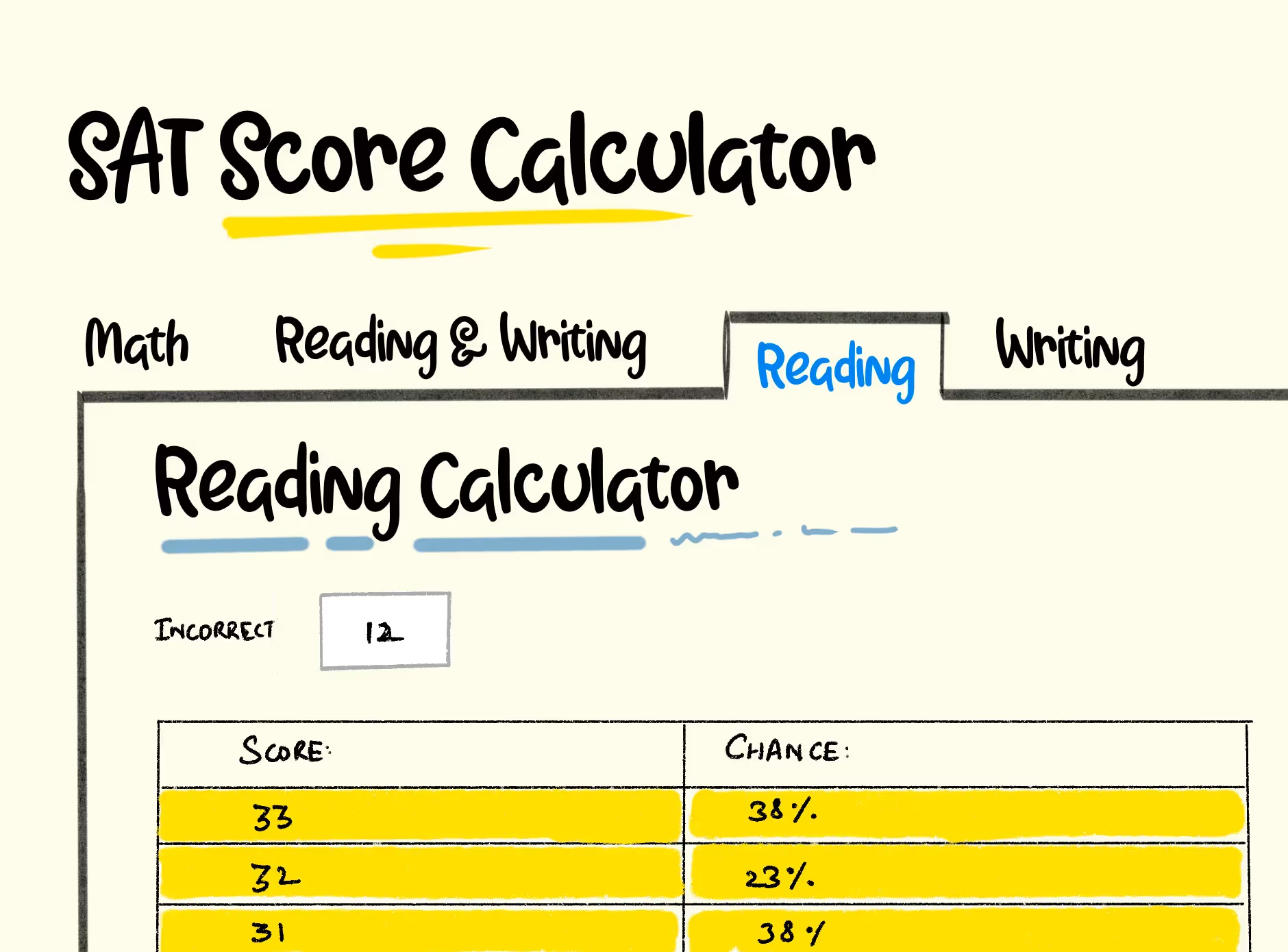
The Digital SAT total score ranges from 400 to 1600, combining two section scores (Reading and Writing, and Math), each ranging from 200 to 800, with no penalty for wrong answers.
- Score range — Total score spans 400 to 1600, with Reading and Writing and Math each contributing 200 to 800.
- No guessing penalty — Points are never deducted for incorrect answers, so every question is worth attempting.
- Step 1: Raw score — You earn 1 point for each correct answer across the modules, with no negative marking.
- Step 2: Adaptive module adjustment — Performance on Module 1 determines whether Module 2 is easier or harder, which changes the scaling potential and score ceiling.
- Step 3: Scaled score conversion — The College Board uses equating tables to convert raw performance into the final 200-800 scale per section, then adds both sections together for the total.
Securing a high score on the digital SAT is crucial for many students aiming to pursue higher education. At first glance, calculating SAT scores might seem as simple as counting correct answers, but in reality, it's far more complex, especially for tutors and tutoring companies running mock tests.
Because the Digital SAT's scoring system doesn't just add up raw scores but adjusts them based on question difficulty and adaptive modules to reflect the actual test experience. This is because the performance in the first module affects the difficulty of the second. So, tutors have to factor this into scoring.
Plus, the scoring system works automatically with the pre-assigned values that are weighted by difficulty level. So, tracking and applying these weights manually can be tedious and prone to errors.
In this article, we will break down the role of question difficulty and adaptive modules in the Digital SAT, how these factors influence the final scores, and how to calculate the DSAT scores.
Digital SAT Scoring Chart
The digital SAT, like its paper-based counterpart, employs a SAT scoring chart to evaluate a student's performance in two main sections: Reading and Writing and Math. For those asking, "Is SAT online?" the digital format is becoming more prevalent. Each section is divided into two modules with equal distribution in question and time. The maximum total score a student can achieve on the digital SAT is 1600 points, but the maximum SAT score for 2022 may vary. As students await the "August 2023 SAT results", understanding the scoring system becomes even more crucial.
Raw scores are awarded during the assessment and the final cumulative score is converted to a scaled SAT score. However, the digital format introduces certain changes and enhancements to the scoring process.
1. Reading and Writing
The Reading and Writing section of the digital SAT assesses a student's reading comprehension, language usage, and writing skills. It includes passages to read, grammar and language usage questions, and vocabulary-based questions. The scoring range for this section remains consistent with the paper-based SAT, typically between 200 and 800 points.
2. Math
Similar to the paper-based SAT, the Math section of the digital SAT evaluates a student's mathematical reasoning, problem-solving, and data analysis abilities. It includes multiple-choice questions as well as grid-in questions that require students to provide numerical or algebraic answers. The scoring range for the Math section also aligns with the traditional SAT, ranging from 200 to 800 points.
It's important to note that the digital SAT incorporates several enhancements in terms of the scoring system. One notable change is the introduction of section-specific time limits. Each section is now allocated a specific amount of time, allowing students to focus on one section at a time. Additionally, the digital format allows for adaptive testing, where the difficulty of the questions can dynamically adjust based on a student's performance.
To determine the overall SAT score, the scores from the Reading and Writing section and the Math section are combined. The maximum total score a student can achieve on the digital SAT is 1600 points, combining the scores from the two sections.
What's the difference between SAT raw scores and SAT scale scores?
The SAT raw scores and SAT scale scores are two distinct components of the SAT scoring system. There is no wrong answer penalty, meaning that incorrect answers or unanswered questions do not affect the raw score. This raw score is then converted to a scaled score, often using a SAT scoring guide.
1. SAT Raw Scores
- The raw score represents the number of questions a student answered correctly on a specific section of the SAT.
- Each correct answer in the Reading, Writing and Language, and Math sections contributes one raw point to the respective section's raw score.
- There is no penalty for incorrect or omitted answers, meaning that incorrect answers or unanswered questions do not affect the raw score.
- The raw score provides a simple count of correct responses and serves as the initial score before any conversions or adjustments are made.
- Raw scores are not reported directly to test takers or colleges. Instead, they are used as the basis for calculating scaled scores.
2. SAT Scaled Scores
- The scaled SAT score is the converted score that takes into account the difficulty level of the test form and enables fair score comparisons across different SAT administrations.
- The conversion from raw scores to scaled scores is performed using a statistical process called equating.
- Equating ensures that the scaled scores have the same meaning, regardless of the specific test form or administration.
- The scaled score range for each section, including the Reading and Writing and Math sections, is typically between 200 and 800.
- The scaled scores for the Reading and Writing and Math sections are then combined to form the overall SAT score, which also ranges from 400 to 1600.
How to Calculate Digital SAT Score?
When calculating digital SAT scores, there are specific rules and factors to consider for each section. If you've ever used an SAT score generator, you'll know that the overall score is determined by combining the scores from the Reading and Writing sections with the scores from the Math section. This is where average SAT scores and percentile scores come into play.
1. Reading and Writing
This section receives a raw score based on the number of correct answers provided. For those who have taken a practice test, you'll know that incorrect or omitted answers do not affect the raw score. The raw score is then converted to a scaled score, which falls within the range of 200 to 800.
Let's take an example. In Module 1, the reading and writing module consists of 27 questions, which are a mix of easy, medium, and hard questions. The student's performance in Module 1 determines whether they get the hard or easy adaptive Module 2.
If Module 1 of reading and writing has 27 questions, and the threshold is 18:
If a student gets 18 or more correct, they are routed to the hard Module 2
If they get fewer than 18 correct, they go to the easy Module 2.
Getting routed to the hard Module gives access to more hard questions, which in turn creates the possibility of a higher scaled score.
Note: A perfect baseline section will put you in the 550–800 range.
2. Math
The Math section evaluates a student's mathematical reasoning, problem-solving, and data analysis abilities. It includes multiple-choice math questions as well as grid-in questions that require students to provide numerical or algebraic answers. The scoring range for the Math section also aligns with the traditional SAT, ranging from 200 to 800 points.
Eg: In module 1 of the Math section, there are 22 questions, and the student's performance on these determines whether they are routed to the harder or easier Module 2.
For example, if in the Hard Module the student answers 18 out of 22 questions correctly, their overall performance could scale to a Math score of around 720 to 750.
On the other hand, if the student has scored only 12 correct in Module 1, they are routed to the easy Module 2, which limits their maximum possible Math score.
Note: A perfect baseline section will put you in the 570-800 range
3. Combining the Scores
To determine the overall SAT score, the scores from the Reading and Writing section and the Math section are combined. The maximum total score a student can achieve on the digital SAT is 1600 points, combining the scores from the two sections.
The raw score conversion to scaled score is unknown. But a secret threshold is set and the raw scores are converted into scaled scores.
So, in this section, let's say a student's scaled score in Reading & Writing comes out to 640, and their scaled score in Math is 710.
Reading & Writing Score = 640
Math Score = 710
Total score = 1350.
Another student might score 580 in Reading & Writing and 770 in Math:
Reading & Writing Score = 580
Math Score = 770
Total Score = 1350
Though both students end up with the same total, their section strengths are different. This is why colleges look at section scores separately, especially for programs that value strong Math or strong Reading/Writing skills.
Note that when considering the SAT or ACT, it's essential to understand that each has its unique scoring system. The "ACT composite score," "ACT score," and SAT ACT concordance conversion chart are different from the SAT's system, and students often choose either the SAT or the ACT based on their strengths.
SAT Score Range for the Digital SAT 2025
The digital SAT follows the same scoring scale as the paper-based SAT, with score ranges that provide a standardized measure of a student's performance. Here's a more detailed explanation of the score ranges for the digital SAT, including average score and percentile score considerations.
1. Section Scores
- Each section of the digital SAT, including the Reading, Writing and Math sections, receives a score ranging from 200 to 800.
- The section scores reflect a student's performance in the specific section and are determined through equating, which takes into account the difficulty level of the test form.
- The maximum score a student can achieve on each section is 800, indicating a perfect performance in that particular section.
2. Overall SAT Score
- The overall SAT score is the combination of the section scores from the Reading and Writing module and Math module.
- The total score ranges from 400 to 1600, representing the student's overall performance on the digital SAT.
- The combined Reading and Writing and Math scores determine the overall SAT score, where each section contributes equally to the total score.
SAT Raw Scores Calculation
When it comes to calculating SAT raw scores, the process is fairly straightforward. The raw score represents the number of questions a student answered correctly, without any penalty for incorrect or omitted answers. Here's a more detailed explanation of calculating raw scores for the digital SAT:
1. Reading Section
- The digital SAT Reading section consists of 54 questions.
- For each correct answer, you will receive one raw point.
- Incorrect answers and omitted questions do not affect your raw score.
- Therefore, the maximum raw score for the digital SAT Reading section is 54, indicating that you answered all 54 questions correctly.
2. Math Section
- The digital SAT Math section comprises 44 questions.
- Similarly, for each correct answer, you will earn one raw point.
- Incorrect answers and omitted questions do not impact your raw score.
- Consequently, the maximum raw score for the digital SAT Math section is 44, signifying that you answered all 44 questions correctly.
It's important to note that the raw score represents the number of correct answers only. The raw score does not take into account the difficulty level of the questions or provide any indication of your performance on the test.
The raw score serves as the starting point in the scoring process and is subsequently converted into scaled scores using equating techniques, as discussed earlier. The scaled scores provide a standardized measure that takes into consideration the difficulty level of the specific test form and enables fair score comparisons across different test administrations.
How to convert SAT Raw Scores to Scaled Scores?
After completing the digital SAT, your performance is initially measured in terms of raw scores. However, these raw scores need to be converted into scaled scores to account for the varying difficulty levels across different test forms. The conversion process ensures fairness and allows for accurate score comparisons between test takers.
The College Board, the organization responsible for administering the digital SAT, utilizes a statistical method called equating to establish score equivalencies. Equating involves comparing the difficulty level of different test forms to ensure that a similar level of performance on one form corresponds to the same scaled score as on another form.
Equating involves analyzing the statistical performance of a sample group of test takers who have taken both the new test form and a reference form with established equating properties. The performance data is used to determine the relationship between the raw scores and the scaled scores for each section.

(The actual Digital SAT mock test offered by EdisonOS. A white-lablled platform, for tutors, offering Digital SAT practice tests)
To provide students with an understanding of the conversion process, the College Board releases official score conversion tables. These tables present the raw-to-scaled score conversion for each section of the digital SAT. They typically include a range of raw scores and their corresponding scaled scores. By referring to the table, test takers can determine their estimated scaled scores based on their raw scores.
Digital SAT raw score conversion table
As we mentioned before, once the raw score is calculated, the Digital SAT platform uses a process called equating to convert it into a scaled score between 200 and 800 for each section. Because the Digital SAT is adaptive, the exact conversion often referred to as the digital SAT curve can vary depending on the difficulty level of the second module you receive.
Below are approximate raw-to-scaled score ranges based on publicly available data and sample scoring research. These give you a general idea of how many correct answers correspond to each score range.
Reading and Writing Section (54 Questions Total)
Math Section (44 Questions Total)
It's important to note that the conversion process may result in slight variations in scaled scores for different test forms. These variations occur due to differences in the difficulty levels of the test questions. The equating process aims to ensure that an equally competent performance on any form of the digital SAT is awarded the same scaled score.
The College Board provides official score conversion tables on their website, which can be accessed by students who have taken the digital SAT. These tables offer detailed mappings of raw scores to scaled scores, allowing test takers to interpret their performance accurately and compare it to the broader population.
How EdisonOS Can Help You Prepare Students for the Digital SAT
EdisonOS is purpose-built to help tutoring companies deliver Digital SAT prep for students, where they can get a real experience, get realistic scaled scores and provide molecular-level reporting for the student’s performance.
One of the biggest strengths is the ability to maximize SAT scores with free practice tests, offering each student access to 22 full-length DSAT mock tests. Other standout features of EdisonOS are
- Real test simulation: EdisonOS has replicated the official Bluebook interface by matching the design, navigation tools, and on-screen experience that students will see on the test day. This helps tutors to train their students under authentic conditions and build more familiarity with the test and hence reduce the test-day anxiety.
- Expert-curated content: Another important feature is the expert-curated content library that EdisonOS has. We teamed with SAT experts with 2 decades of experience to create the question bank of 5000+ questions with zero usage of AI. As tutors, you can use our resource to create mock tests or create your own from scratch within minutes.
- Multi-stage adaptive testing: The platform also supports multi-stage adaptive testing, just like the real DSAT. After each test, EdisonOS uses its own scaled score system, closely modeled after the College Board's scoring logic, to provide a detailed scoring report breakdown with accurate, real-world insights into each student's readiness. Tutors can even customize these scoring rules to match internal benchmarks or teaching strategies.
- Molecular-level reporting: Finally, EdisonOS delivers molecular-level reporting. Tutors and students get a detailed scoring report with analytics: section-wise scores, skill-based breakdowns, performance on different difficulty levels, and even time spent per question. This helps tutors pinpoint where the students are lacking and personalize lessons accordingly and measure progress over time. It also helps identify when a student has hit a score plateau so tutors can course-correct their strategies early.
Conclusion
To get a comprehensive understanding of the SAT score, utilize the official score conversion tables provided by the College Board. These tables help one interpret their scaled scores and determine their percentile rank, indicating how your scores compare to those of other test-takers. Reviewing your SAT results report after each mock test is equally important to track progress across multiple attempts. Calculating the digital SAT score involves several steps that allow one to gauge their performance and assess their SAT strengths and weaknesses for targeted improvement. This is where analytics tools like EdisonOS, SAT Saver, and more can be beneficial for targeted preparation. Students struggling with lower results can also explore low SAT ACT score recovery strategies to get back on track.
Frequently Asked Questions
.svg)


.png)

.png)